


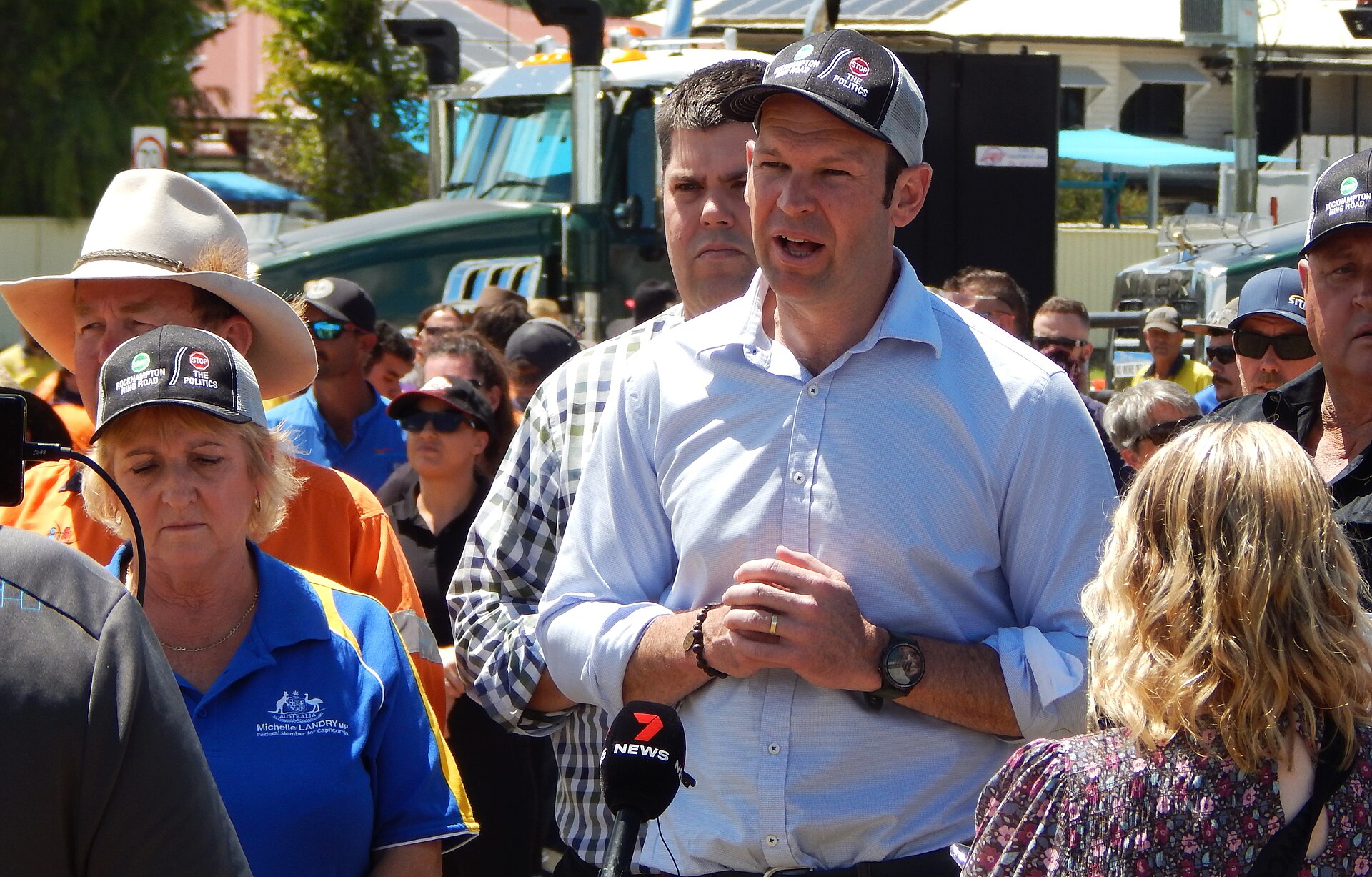
Matt Canavan Highlights Food Production Crisis in Speech to Nationals
Matt Canavan wants the Nationals to reclaim agriculture, but reversing Australia’s decline in food production will require far more than promises to build dams.
Struggling to find a brand identity in the crowded space that is the centre right in Australian politics these days, Nationals Leader Matt Canavan has decided to go back to basics and adopt a stronger focus on agriculture.
Canavan has pledged to revive the Nationals’ core business of dams, water security and a commitment to boosting farming while warning of the long-term decline in production of Australian-produced fruit, pork and dairy.
In reality, the Nationals have not strictly been a “farmers party” for many years, their constituency is broadly any of the diverse electorates of regional Australia, and is focused on the mining industry, energy and manufacturing, trucking and transport, defence, and small business.
But with the rise of One Nation, which is currently dominating the national conversation on populist and popular issues as diverse as immigration, superannuation and cultural issues, it makes sense that Canavan tries to ensure that his party at least owns the agriculture space.
Australia’s Farming Crisis Is Deepening
The irony is that Australia’s “farmers” have dwindled in number over the past few decades as free trade, water buybacks and other policies have severely impacted industries like sugar, dairy, tobacco and forestry.
Canavan’s warning speech to the Nationals Federal Conference on August 15 was in marked contrast to the tone at the National Farmers Federation (NFF) recent landmark event, at which it celebrated Australia’s $100 billion in “farmgate output”.
More than 300 leaders from across agriculture, business and regional Australia gathered at the Great Hall of Parliament House. NFF president Hamish McIntyre declared:
“This milestone did not happen by accident. It happened because Australian farmers backed themselves, took risks, adapted, innovated and kept producing some of the best food and fibre in the world through some tough conditions.”
In fact, the “milestone” was built on an illusion: the $100 billion was largely achieved through big wheat crops and inflation, while the profitability of farmers themselves has not improved at all.
Meanwhile, back in the land of reality, The Australian reported that the Australian Bureau of Statistics and the Australian Bureau of Agricultural and Resource Economics and Sciences have projected shortfalls in production of basic Australian foodstuffs.
By 2040, there will be shortfalls in Australian-produced pork (47 per cent), butter (40 per cent), eggs (21 per cent), apples (16 per cent), chicken (15 per cent), rice (14 per cent) and cheese (7 per cent). These statistics should be a wake-up call to all Australians that a country the size of Australia soon will not in fact produce sufficient basic commodities to feed itself.
More Than Speeches Will Be Needed
In his speech to the Nationals Federal Conference in Canberra, Canavan called for a renewed focus on Australian agricultural production.
“We need to grow Australian farming again. The Nationals remain committed to grow more food, create more farming jobs and provide affordable and healthy food for Australian families,” he said.
“We will grow Australian farming again by building dams and investing in water infrastructure, as we did when we were last in office.”
Ironically, these are the exact same calls on dams that Canavan’s old boss and now One Nation MP Barnaby Joyce made for more than a decade, including when he was Deputy Prime Minister.
Canavan held onto one success — that the last Coalition government built the Rookwood weir in Central Queensland, which is now helping to grow over 500,000 macadamia trees along the Fitzroy River. But he conceded that, “overall, we have not opened new farming areas this century”.
“In 2022, we left the Labor Party with plans and the funds to build new farming districts across the country. The Hells Gate dam, the Dungowan dam, the Emu Swamp dam, the Hughenden Irrigation Scheme, Big Rocks weir and the Paradise dam were funded,” Canavan said.
Canavan is right, but unless there is a major shift in federal and state relations, there is no prospect of any dams being built by anyone, including One Nation.
With governments carpeting the countryside with windmills and solar farms, turning prime agricultural land into carbon sink plantings, and a host of other policies — from animal welfare to water buybacks — Australian agriculture is in peril.
It will take more than one speech to turn around this crisis of government. It will take a major change of heart and gumption in Canberra.
___
Republished with thanks to News Weekly. Image courtesy of Wikimedia Commons.
3 Comments
Leave A Comment
Recent Articles:

25 October 2026
4 MINS
Prayer is active partnership with God, and he is awakening his body to prayer, not by might or by power, but by his Spirit.
24 October 2026
3.3 MINS
When we ask God, "What is in my hand?", and see our possessions, money and time as seed that God asks us to sow, life becomes simpler.
23 October 2026
6.8 MINS
Hillsong UNITED’s Joel Houston reflects on fame, faith and the burden of ministry, questioning performative Christianity as he seeks a more authentic walk with God.

23 October 2026
13.1 MINS
Tasmania’s proposed conversion practices legislation raises serious questions about religious freedom, pastoral care and whether Christians can freely pray with those seeking to live according to their faith.
23 October 2026
7.7 MINS
Melbourne Catholic Archbishop Peter Comensoli has spoken out clearly against the deadly promises by both major parties in Victoria ahead of the election, drawing a comparison between abortion and capital punishment.

23 October 2026
3.1 MINS
As Western societies grow more hostile, could abandoning Christianity’s moral foundations be contributing to the rise of ideological extremism, political intolerance and violence?

23 October 2026
5.1 MINS
France’s escalating riots expose the dangers of political extremism, antisemitism and radical alliances, offering America a stark warning about the future of Western democracy.



Why is it so difficult to work out what our country needs re food and what food we can trade with and then create policies that protect farms and farmers? Water and food, can we survive without them! I have no economics degree but I know how to shop to feed my family nourishing meals while remaining within my budget, not allowing the marketing bs and surrounding noise to influence my core responsibilities. Work together Conservatives for the love of God and country!
Yes one day you might find yourself an outcast in this land
Perhaps your heart will tell you then, ‘I should have made a stand’
Just go and ask the farmers that should remove all doubt
Then join the swelling ranks who say, ‘don’t sell Australia out’
Courtesy of Chris Long (Great Aussie Bush Poet
Our best farmland is foreign -owned , eg permission has been granted to a foreign corporation to turn huge dairy farmland in Tasmania into plantation to grow pines. Almost every basic thing we use in daily life is imported, and , not just from China ! US interests , like Vanguard, etc , are major shareholders of CommBank which is currently attempting to pay out of my bank account International Fraudsters who have used AI DeepFake of a famous doctor , Celebrities and falsely claimed the product was ” FDA approved ” . I should be protected by the 120 Day Rule , but , CommBank refuses to call it “Fraud “–just a “Dispute ” which gives me NO protection ! . Our govt. does not protect us–does not actively enforce the Rules which should protect Consumers. It seems all our Govt. does is collect statistics on how many Australians are defrauded , and, by how much ! The Fraudsters have a connection to USA, Netherlands, island of Cyprus, and heaven knows where else! It operates through phony Shell companies . The FBI should investigate as our Federal Police will probably do nothing and more Australians, etc will be Victims of this particular Fraud( “Cardio Flush ” on You Tube ). CommBank is happy to pay International Fraudsters, ie be COMPLICIT ! I am doing all I can to get justice. Even lodging a Police Report has obstacles ! Australia should hang its head in SHAME !