Western Christians must carefully consider Palestinian Christian claims about Israel, the legacy of dhimmitude, and how fear and persecution may shape today’s political narratives.
In July 2026, the Church of England General Synod voted to “hear” Kairos Palestine II (A Moment of Truth: Faith in a Time of Genocide), as a “heartfelt expression of Palestinian Christians’ lived experience”.
Issued by Palestinian Christian leaders, and claiming to be the voice of the Palestinian community (“the collective word of Palestinian Christians” according to the original 2009 Kairos document), the document describes Israel’s Gaza campaign as “genocide”, and calls Israel a colonial/settler/apartheid entity built on racism and “Jewish supremacy”.
Kairos II also contains a call to “isolate Israel, hold it accountable, impose sanctions, boycott it, and ban the export of arms.” Palestinian Christians must surely know what they are calling for.
They know that support for Hamas tripled in the West Bank in the direct aftermath of October 7, when its mass killings, sexual violence and hostage taking, as seen on Al Jazeera, were all that they knew about it, and support for what happened on October 7 was between 60 and 80% of the population.
Yet, after seeing what happened on October 7 (when Israeli communities were not properly defended), they still issued a call to make all Israel less well defended, to “isolate Israel, hold it accountable, impose sanctions, boycott it, and ban the export of arms.” Palestinian Christians must know what would happen if their call were to be effective. Massacre and atrocity on an unimaginable scale against their Jewish/Israeli neighbours. Yet Kairos II still calls for it.
So, why do it???
And, how should Western Christians relate to this document?
These questions make this article, originally written in August 2021, of even greater relevance now.
Palestinian Christians: Are They Faithful Witnesses?
A recent article by Dexter Van Zile began:
“[In July], the United Church of Christ (UCC)’s General Synod passed a ‘peacemaking’ resolution that declared Israel guilty of sins against the Palestinian people. The resolution repeats the narrative offered about the evils of the Jewish state broadcast by Palestinian Christians in the West Bank and eastern Jerusalem, who have been demonising Israel for decades.”[1]
This Western church, like numerous others, was attacking Israel on the basis of information provided by Palestinian Christians. This raises the important question: “How should we view Palestinian Christian statements about their situation in Israel/Palestine?”
Given that Western churches are acting upon this advice, this is an important question for them to consider. The discussion begins with the concept of dhimmitude, and its impact upon the spiritual lives of the Palestinian Christians.
Dhimmitude was the contract entered into between the Muslim conquerors and the conquered Christian and Jewish populations. Basically, it treated them as rubbish in exchange for not murdering them. They had to promise not to speak badly about Islam, not to preach the Gospel, and to accept endless humiliations and contempt from the ruling Muslims. See The Pact of Umar (Shurut Umar) and later jurists (al-Shafi‘i, al-Mawardi, and others).
The Christian communities have been suffering under this system for 1300 years(!), and its effects are profound.
“Dhimmis can appear to collude to conceal their own condition, finding themselves psychologically unable to critique or oppose it. The psychology of gratitude and inferiority can manifest in the dhimmi as denial or concealment of the condition.
… the psychology of inferiority can mean that people from a dhimmi background are themselves the least able to analyse or expose their own condition. A powerful silence rests over the whole subject like a thick blanket or a strong dose of anaesthetic.”[2]
“Christian communities native to the Middle East today exhibit the scars of centuries of inferiorization and marginalization. They constitute living relics of the ravages of a system that, although technically abolished in many modern Arab states, continues on the level of official as well as popular attitudes and practices. The Christians of the Holy Land, for example ‘Palestinian Christians’, are symptomatic of this dhimmi genre and its attendant complexes.”[3]
Sadly, the Palestinian Christian communities, their leadership, and many of their members, witness to this internalised oppression all too frequently. They may well rationalise it by believing that by agreeing with the Muslims, they are protecting their communities from even greater harm, but their calling is to preach the truth, not to fear men. Life truly has not been easy for them! We should pray for them!
Examples of life under Muslim rule from Palestinian Christian history
In 1785, Constantin de Volney wrote:
“Faithful to the spirit of the Koran, it [the government] treats the Christians with a severity which displays itself in varied forms. … All kinds of public worship is prohibited the Christians, … They cannot build any new churches; and if the old ones fall into decay, they are not allowed to repair them, unless by a permission which costs them very dear. A Christian cannot strike a Mahometan without risk of his life, but if a Mahometan kill a Christian, he escapes for a stipulated price.”[4]
As the Mufti of Jerusalem said in a fatwa issued in 1853, “It is against the honour of the Moslem religion to permit Christian Churches to be erected.”[5] In 1823, some Christian villagers refused to pay “the excessive and arbitrary” taxation laid upon them (but not the Muslims).
The soldiers then “caught hold of an infirm old peasant of the Christian village of Beit Jalla, shot him, cut off his head, and stuck it up inside the Jaffa gate of Jerusalem, where it was pelted and spit upon by boys of the street for three days. Christians passing by were melted into tears, but dared not give expression to their feelings.”[6]
The early Anglican priest, Michael Kawar, mentioned in his autobiography that anti-Christian riots in Nazareth had forced his father to flee to Lebanon in the 1820s.[7] In 1828, in Nazareth, a Christian girl who refused the advances of a Muslim man was killed by being dragged through the streets behind a horse. This would have served as a reminder to all other Christian girls not to resist a Muslim.
Indeed, prior to 1845, James Finn wrote that Christian women were “dishonoured with impunity.” As Colonel P. Campbell, A Visit to Israel’s Holy Places (1839) wrote: “The Mussulmans [of Syria-Palestine], … from the bottom of his heart he believes and maintains that a Christian, and still more so a Jew, is an inferior being to himself.”[8]
Ottoman reforms granting civil rights to Christians and Jews in the nineteenth century upset this centuries-old pattern, and provoked a savage backlash from the Muslim community. The American Protestant missionary, Henry H. Jessup, wrote that, “the new liberties granted to the Christian sects, … had kindled [among the Muslims] fires of fanatical hatred.”[9]
In 1853 in Nablus, the sight of a Syrian Christian official sitting in a chair roused a Muslim mob to shout: “Kill him, kill him. Did you ever see a Christian like that before?”
In 1856, Muslim riots in Nablus left a number of Christians dead and forced the expulsion of the entire Protestant community. The Nablus Protestants wrote to the Sultan. They spoke of “their afflicted and calamitous state … the injuries inflicted on them, the loss of their freedom, the insecurities of their lives, property and families, all of which they presently endure (and for the previous 5 months). Since the issue of the Firman (February 1856) declaring religious liberty, the Mohammedans of Nablus have been filled with rage against the Christians.”
On Friday, April 4th, most of the Ulamahs of Nablus assembled in one of the Mosques … after this, the call was given by one of them going through the streets; “Oh religion of Mohammad, attack the Christians.” At the same time, all the Mohammedans being assembled for prayer, the Ulamahs stopped the Muazzins and made them come down from the Minarets, saying there shall be no prayers for the religion of Muhammad is dead.”
They aroused the populace “to fury, that they might fall upon the Christians.” They destroyed the school of Bishop Gobat, and the attached chapel. They also killed a number of Christians, burying one boy in lime.
The shouts of the mob were “frightful, together with those of the females who shrieked on the terraces to excite and encourage them.” The Greek Orthodox, “from fear, have appeared outwardly satisfied with the Mohammedans, and have made no claim [of] satisfaction for the injuries done.”[10]
That is, the local Christians, from fear, did not even attempt to gain compensation through the court, but simply accepted the murder, violence, robbery and destruction of property they had been subjected to. Such was their life under Muslim rule. Note also the cry from the crowds that if they are unable to persecute Christians, then Islam is dead.
The Rev. Arthur George Harper Hollingsworth wrote in 1852, “No Christian is secure against insult, robbery, and ruin.”[11] In 1858, the two villages of Zebabdeh and Likfair (where the inhabitants were all Christian) “were utterly sacked, men and women stripped even to their shirts and turned adrift.”
“Whereas many villages in the district of Nablus have a few Christian families located in each, such families were subjected in every direction to plunder and insults.”
Also in 1858, James Finn wrote from Jerusalem, “Daily accounts are given me of insults in the streets offered to Christians and Jews, accompanied by acts of violence. … There is no clear case yet known of a Christian’s evidence being accepted in a court of justice, or in a civil tribunal against a Moslem.”[12]
In 1876, J.P. Newman wrote that in nearly all parts of Palestine, “the Christians are cringing and fearful.”[13] Christians were forbidden from entering or praying at the Temple Mount in Jerusalem, or Tomb of the Patriarchs in Hebron.
One reads of “the talk” that black parents give their children in America, and Jewish parents give their children worldwide. Christian parents in Muslim lands also rightly pass down their fears and nightmares. Najib Awad describes how beneath the rich history of plurality for eastern Christians, there hides a “parallel history of suffering, uncertainty, fear, pressure, difficulty, death and perpetual strife for survival as a minority in a non-Christian majority world.”[14]
Christian strategies supporting (secular) Arab nationalism and anti-Zionism cannot be fully understood apart from this overwhelming fear, a fear which, for obvious reasons, is rarely mentioned in public.
In 1923, Dr Alexander Paterson reflected in general upon the inter-communal relations:
“It was this age-long incompatibility, this irreconcilable enmity, that was more potent for evil than any other single factor, and harder to be dealt with than any other obstacle to mission work. The Moslem and Christian hated the Jew for denying and slaying the Messiah, the Christ. The Moslem and Jew hated the Christian for worshipping three gods.
The Jew and the Christian hated the Moslem for his arrogance and fanaticism and oppression, from which they never felt safe. Of course, they commonly existed in an armed truce; life otherwise were impossible. But an anniversary or an indiscreet word, an un-equal deal in business, or a false report, and their passions were in full cry, too often the cry for blood.”[15]
The sentence from the above quote is important: “Of course, they commonly existed in an armed truce; life otherwise were impossible.” Concerning the Jewish community during Ottoman times, Yaari writes, “subjected throughout to severe disabilities, restrictions and humiliations, they were as a rule not seriously molested.”[16]
Conditions did vary, both from place to place and over time. There were positive relations between members of the different communities, but everyone still understood the rules and knew the boundaries. Decent Muslims hid Jews during the 1929 Hebron massacre, but still, the Muslim mob murdered 67-9 Jews.
Likewise, during the 1834 pillaging of the Safed Jewish community, it is reported that Rabbi Menachem Mendel fled to the house of a Christian to escape the mob.[17] These positive, welcome exceptions do not nullify the more general situations described above. Obviously, community norms do not define every single member of that community.
Ongoing Effects
According to the Islamic scholar, Ibn ‘Ajibah, the purpose of dhimmitude was a killing of the soul: [The dhimmi] “is commanded to put his soul, good fortune and desires to death. Above all, he should kill the love of life, leadership and honour. [The dhimmi] is to invert the longings of his soul, he is to load it down more heavily than it can bear until it is completely submissive.”[18]
Dhimmitude entails a spiritual as well as a social enslavement. Being subservient, keeping quiet, submitting to countless minor humiliations, not resisting even when beaten, or community members are raped — all of this has profound effects upon the self-image of those subjected to it. They come to believe that they are indeed inferior, that Muslims are indeed superior.
The dhimmi was, in fact, made to feel gratitude towards the Muslims for not killing him. There are obvious similarities between this and the appalling ‘battered wife syndrome.’[19] Dhimmis lose all self-respect and come to believe they deserve their fate. As seen, they also will not speak out against Islam.
All of these characteristics can be seen in the Palestinian Christian leadership today. Being generally better educated, and at the same time, desperate to ingratiate themselves, Palestinian Christians have indeed often taken the lead in defending Islam to the West.
Western Christians all too often view such Christians as co-religionists, as an unbiased but knowledgeable reference for all things Muslim, especially on the treatment by Muslims of non-Muslims. They also trust their views on the Arab Israeli conflict for the same reasons.
And the Palestinian Christians continually tell their Christian brothers and sisters in the West how well they and the Muslims get on, how happy they always were together, and how Islam is a religion of peace.
“In the Palestinian historiography today, the discrimination in past and present of the Christian Palestinians and the periodical tensions among the Muslims and Christians are regarded as taboo.”[20]
Bat Ye’or notes how Syrian Christians have “dedicated themselves to extolling at both a political and a literary level the greatness and tolerance of Islamic civilization.”[21] This is also seen in Palestinian Christian Edward Said’s book Orientalism.[22]
Muslim/Christian relations have “all too often been mythologised by intellectuals and clergymen who never tire of insisting that harmony has always prevailed between Muslims and Christians in Palestine.
The Anglican Bishop of the Diocese of Jerusalem Riyah Abu-‘Assal stated emphatically to this author: ‘The entire history of Palestine never witnessed any religious conflict between Christians and Muslims.’”[23]
Likewise in 2011, Father Manuel Musallam, head of Gaza’s Catholics, met with Hamas leader, Mahmoud al Zahar, and declared that “Christians are not threatened by Muslims.”[24]
Presumably wanting to protect their own community from real dangers, they seem incapable of warning their Christian brothers and sisters of the horrors they have experienced. What we get are essentially hostage videos. Do we really expect the Christian community, about 1% of the Palestinian population, to risk offending the dominant community at a time when Christian communities across the Middle East have been decimated? We should have the wisdom to recognise what lies behind their words.
As Mark Durie in his excellent book “Liberty to the Captives: Freedom from Islam and Dhimmitude through the Cross” shows, they need to repent of being dhimmis, break the power of Islam over them and step out into the freedom and truth of Jesus.
Contemptible Behaviour and False Hopes
Palestinian Christian leaders also know that Palestinian Christians receive better treatment from Israel than any other minority in the Middle East, and that the only Christian community in the Middle East which is thriving is in Israel.
They also know that Israel, the Jewish state, treats Christians and Muslims far better than Christians and Muslims ever treated Jews when they were in the minority. Yet no words of gratitude are heard. Instead, groups like Kairos spend all their time and energy, not preaching the Gospel, but attacking Israel.
Palestinian Christians need to wake up! A democratic, secular state is not going to happen. Sure, they have wanted this since the 1830s and the Ottoman Tanzimat reforms, because it gives them, as a tiny minority, advantages/protections from the reality of dhimmitude.
But it offers no advantage to the Muslim majority; rather, it conflicts with a fundamental aspect of Islam. We have already seen the rage these reforms produced locally in Palestine in 1856. The best the Palestinian Christians might hope for is to be in a situation similar to that in Jordan.
Interestingly, between 1947 and 1967, Palestinian Christians gained some experience of living under Jordanian rule. During that time, the Christian population of Jerusalem dropped from over forty-five thousand to twenty-eight thousand. (It had more than doubled during the British Mandate.) Christian institutions were barred from purchasing or even renting land in the Old City of Jerusalem. This was due to increasing Muslim demands.
Local Christians were again made to feel inferior, and dependent upon the diminishing goodwill of the Muslim majority. Christianity was attacked in Friday sermons, on radio and also physically, especially during times of crisis such as 1956 and 1966-7.
In 1966, the violence was so bad that the Latin and Greek Catholic bishops in Amman issued a rare public protest against the “official policy of discrimination and assaults on Christians.”[25]
Between official government restrictions and popular antipathy, Palestinian Christians during the Jordanian period again experienced the reality of living as a despised minority within a Muslim majority population. And all that was while they were under the protection of King Hussain, who was a moderate, pro-western due to his education, wife and allies, and generally viewed as a buffer to the increasingly anti-Christian legislation and acts of the government and population. There would be no King Hussain in any future Palestinian state.
In fact, within Palestine, the Christians have known since the 1920s that there will be no secular state, and they have been left always backing the least Islamic of the various Muslim contenders. Having spent the past 40 years backing the PA, many are now turning in despair to Hamas,[26] and hoping that they can ingratiate themselves sufficiently to survive.
More Recent Palestinian Christian History – Still Being Treated as Dhimmis
The photo below was taken in 2015, at the entrance to the Church of the Annunciation in Nazareth.
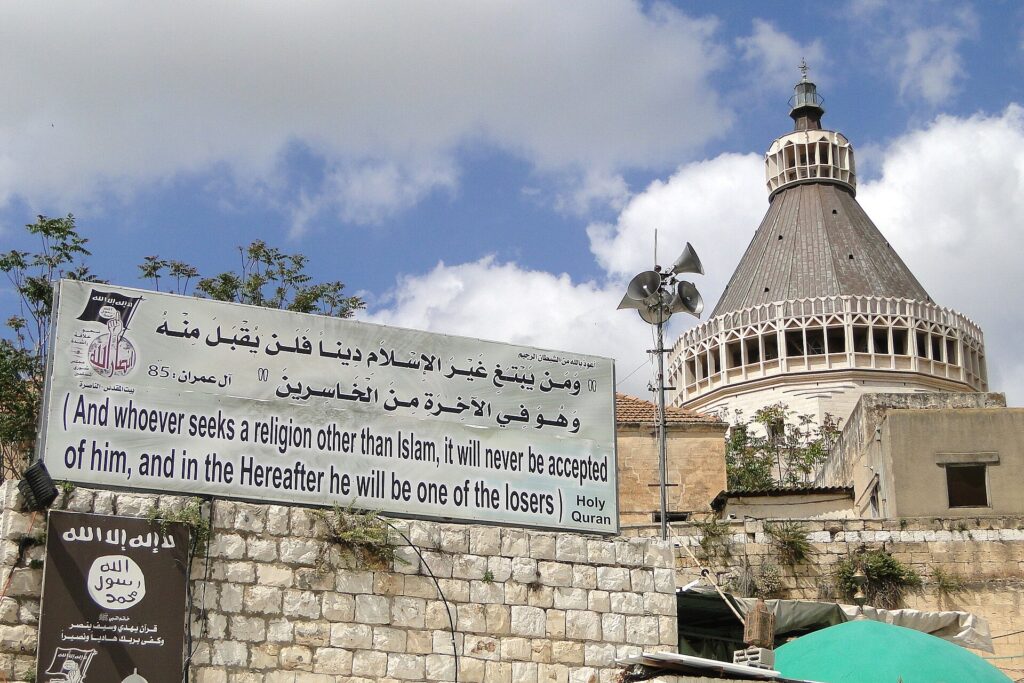
In 2005, a Christian village, Taiba, was “ransacked” by more than 500 Muslim men chanting “Allahu akbar” because a Christian man from that village had a romantic relationship with a Muslim woman.[27]
Also in 2005, Justus Reid Weiner investigated the human rights of Palestinian Christians living under the Palestinian Authority. He reported that “there is a widespread distrust of religious leaders among Palestinian Christians, who ‘obfuscate the situation as it affects their constituents.’
One Christian man said, ‘Our leaders are liars: They tell the newspapers that everything is OK. But when Christians go to the market, they’re afraid to wear crosses.’”[28]
In 2019, on April 25, “the terrified residents of the Christian village of Jifna near Ramallah asked the PA to protect them after they were attacked by dozens of Muslim gunmen. The violence erupted after a woman from the village submitted a complaint to the police that the son of a prominent, Fatah-affiliated leader had attacked her family.”
The attackers “fired hundreds of bullets in the air, threw petrol bombs while shouting curses, and caused severe damage to public property.” They also called on the residents to pay jizya.
Despite the residents’ cries for help, the PA police did not intervene. According to the BESA Centre, Fatah regularly exerts heavy pressure on Christians not to report the acts of violence and vandalism from which they frequently suffer.[29]
The Wider Impact of Dhimmitude
“… and sin, when it is full-grown, gives birth to death.” (James 1:15)
Having (in their eyes) been humiliated by the Jews for over 100 years, if Hamas/Hezbollah/PA/whatever succeeded in taking back control of Jerusalem, would they want this to be seen as a triumph of Western democratic secular values, or as a triumph of Islam?
Palestinian Christians need to think about this: they know the answer! Wake up, there is not going to be a secular, democratic state of Palestine.
“The fact is that if the Islamists ever fulfilled their dream of defeating the Israelis and hurling the Jews into the sea, they would hardly be predisposed to share power with Palestinian Christians, secular or otherwise. … the mirage of Palestinian nationalism will not save the Christians from the oppression that awaits them at the hands of the radical Islamists who are increasingly calling the shots in Palestinian society.”[30]
How Christians deal with their own persecution is up to them. In light of the second Commandment, the real question Palestinian Christian leaders need to ask themselves (given that some are working tirelessly to harm Israel) is, “If Israel were to be overpowered, what would happen to the defeated Jewish population?”
Again, they need to think about this, because deep down, hidden under layers of servile dhimmitude, they know the answer. Massacre. The Muslim Palestinians make no secret about it! Sermons about trees telling Muslims to kill Jews behind them, “the army of Khaybar”, etc! You know this!
They reward with large sums of money any Palestinian who murders Israeli civilians, including 3-month-old children. Statues are put up of, streets and soccer clubs are named after Palestinians who murder Israelis. Listen to Hamas sermons about killing Jews worldwide. They are not trying to hide this.
So Palestinian Christians, think clearly. Palestinian Christian organisations like Kairos want to weaken Western Protestant evangelical support for Israel. This is largely to show the Muslim majority that they have value, so they will not suffer the same fate as the other Christian communities across the Middle East. Shamefully, this is not just their dhimmitude in action. As well as that, some Palestinian denominations, like Christian denominations worldwide, have yet to acknowledge and repent of their own anti-Semitism.
The question you need to ask is, “Am I working and doing all of this year in and year out? Is what I am doing enabling and empowering genocide?”
Remember, one day, each one of you will have to answer to the God of Abraham, Isaac, and Jacob. You do not want to face him with that on your resume! I do not think it will happen, but that is the goal you are working to further.
The other option, taught by your Anglican founders, proclaimed God’s faithfulness to the Jewish people. When (according to their own worldview) the Muslims were defeated by the Jews in 1948, and again in 1967, they knew something spiritual had happened. They interpret reality in spiritual terms.
Had you spent the previous 100 years proclaiming God’s faithfulness to the Jewish people as part of the Gospel, they would not have liked you (they don’t anyway), but they would have been given the means to understand what was happening. Had you warned them, “do not oppose this return, for God is in it and you will not succeed”, the path of the Lord would have been straightened. Many might have repented. But they never heard it explained to them by you.
So rather than attacking God’s grace in rescuing and restoring the Jewish people to the land He promised to them, Palestinian Christian leaders and their Western allies need to repent, break the chains of dhimmitude, ask forgiveness from the Jewish people, and bear fruits of repentance.
And Christians in the West should be aware of all this when they evaluate their anti-Israeli pronouncements.
___
[1] Dexter Van Zile, “Time to Put the United Church of Christ on Trial for Antisemitism“, Camera, 9 August 2021.
[2] M. Durie, The Third Choice, 181.
[3] Habib C. Malik, “Christians in the Land Called Holy“, First Things, 1 January 1999.
[4] Bat Ye’or, 1985; The Dhimmi, 214-17.
[5] Bat Ye’or, 1985; 244-5.
[6] Bat Ye’or, 1985; 235-6.
[7] Farah, In Troubled Waters, 11.
[8] Bat Ye’or, 1985; 224.
[9] Freas, Muslim-Christian Relations in Palestine During the British Mandate Period, 39.
[10] Bat Ye’or, 1985; 246-8.
[11] Hollingsworth, Remarks on the present condition and future prospects of the Jews in Palestine, 1852, 4.
[12] Raphael Israeli, Green Crescent over Nazareth, 11. (See also Bat Ye’or, 1985; 252.) Taken from the official dispatches of James Finn.
[13] Emmett, Beyond the Basilica: Christians and Muslims in Nazareth 29.
[14] Ashdown, Christian–Muslim Relations in Syria, 11.
[15] A Galilee doctor being a sketch of the career of Dr D. W. Torrance of Tiberias by W. P. Livingstone.
[16] Avraham Yaari, The Goodly Heritage, 11.
[17] A. Yaari, 40.
[18] M. Durie, 140.
[19] See M. Duries, 283 for a discussion on this.
[20] Kimmerling, Processes. Quoted in Frantzman, 23.
[21] M. Durie, 201.
[22] See M. Durie, 201-2.
[23] Habib C. Malik, “Christians in the Land Called Holy“, First Things, 1 January 1999. Written by a Lebanese Christian, this whole article is well worth reading.
[24] Giulio Meotti, “Vatican’s twisted priorities: instead of focusing on decline of Arab Christianity, Catholic Church chooses to demonize Israel“, Ynet Global, 16 March 2012.
[25] Tsimhoni, Christian Communities in Jerusalem and the West Bank since 1948. 1993, 14.
[26] Dexter Van Zile, “The Palestinian Christians Defending Hamas“, The Algemeiner, 14 July 2021.
[27] M. Durie, 160.
[28] M. Durie, 203. See also “Bethlehem Churches Bear Brunt of Religious Hatred“, Israel Behind theNews, 1 September 2008.
[29] Dr. Edy Cohen, “The Persecution of Christians in the Palestinian Authority“, BESA, 27 May 2019.
[30] Habib C. Malik , “The Body and the Blood: The Holy Land’s Christians at the Turn of a New Millennium, A Reporter’s Journey“, First Things, 1 June 2002.
___
Image courtesy of Wikimedia Commons.






Palestinian Christians: Are They Faithful Witnesses?
29 September 2026
15.9 MINS
Western Christians must carefully consider Palestinian Christian claims about Israel, the legacy of dhimmitude, and how fear and persecution may shape today’s political narratives.
In July 2026, the Church of England General Synod voted to “hear” Kairos Palestine II (A Moment of Truth: Faith in a Time of Genocide), as a “heartfelt expression of Palestinian Christians’ lived experience”.
Issued by Palestinian Christian leaders, and claiming to be the voice of the Palestinian community (“the collective word of Palestinian Christians” according to the original 2009 Kairos document), the document describes Israel’s Gaza campaign as “genocide”, and calls Israel a colonial/settler/apartheid entity built on racism and “Jewish supremacy”.
Kairos II also contains a call to “isolate Israel, hold it accountable, impose sanctions, boycott it, and ban the export of arms.” Palestinian Christians must surely know what they are calling for.
They know that support for Hamas tripled in the West Bank in the direct aftermath of October 7, when its mass killings, sexual violence and hostage taking, as seen on Al Jazeera, were all that they knew about it, and support for what happened on October 7 was between 60 and 80% of the population.
Yet, after seeing what happened on October 7 (when Israeli communities were not properly defended), they still issued a call to make all Israel less well defended, to “isolate Israel, hold it accountable, impose sanctions, boycott it, and ban the export of arms.” Palestinian Christians must know what would happen if their call were to be effective. Massacre and atrocity on an unimaginable scale against their Jewish/Israeli neighbours. Yet Kairos II still calls for it.
So, why do it???
And, how should Western Christians relate to this document?
These questions make this article, originally written in August 2021, of even greater relevance now.
Palestinian Christians: Are They Faithful Witnesses?
A recent article by Dexter Van Zile began:
This Western church, like numerous others, was attacking Israel on the basis of information provided by Palestinian Christians. This raises the important question: “How should we view Palestinian Christian statements about their situation in Israel/Palestine?”
Given that Western churches are acting upon this advice, this is an important question for them to consider. The discussion begins with the concept of dhimmitude, and its impact upon the spiritual lives of the Palestinian Christians.
Dhimmitude was the contract entered into between the Muslim conquerors and the conquered Christian and Jewish populations. Basically, it treated them as rubbish in exchange for not murdering them. They had to promise not to speak badly about Islam, not to preach the Gospel, and to accept endless humiliations and contempt from the ruling Muslims. See The Pact of Umar (Shurut Umar) and later jurists (al-Shafi‘i, al-Mawardi, and others).
The Christian communities have been suffering under this system for 1300 years(!), and its effects are profound.
Sadly, the Palestinian Christian communities, their leadership, and many of their members, witness to this internalised oppression all too frequently. They may well rationalise it by believing that by agreeing with the Muslims, they are protecting their communities from even greater harm, but their calling is to preach the truth, not to fear men. Life truly has not been easy for them! We should pray for them!
Examples of life under Muslim rule from Palestinian Christian history
In 1785, Constantin de Volney wrote:
As the Mufti of Jerusalem said in a fatwa issued in 1853, “It is against the honour of the Moslem religion to permit Christian Churches to be erected.”[5] In 1823, some Christian villagers refused to pay “the excessive and arbitrary” taxation laid upon them (but not the Muslims).
The soldiers then “caught hold of an infirm old peasant of the Christian village of Beit Jalla, shot him, cut off his head, and stuck it up inside the Jaffa gate of Jerusalem, where it was pelted and spit upon by boys of the street for three days. Christians passing by were melted into tears, but dared not give expression to their feelings.”[6]
The early Anglican priest, Michael Kawar, mentioned in his autobiography that anti-Christian riots in Nazareth had forced his father to flee to Lebanon in the 1820s.[7] In 1828, in Nazareth, a Christian girl who refused the advances of a Muslim man was killed by being dragged through the streets behind a horse. This would have served as a reminder to all other Christian girls not to resist a Muslim.
Indeed, prior to 1845, James Finn wrote that Christian women were “dishonoured with impunity.” As Colonel P. Campbell, A Visit to Israel’s Holy Places (1839) wrote: “The Mussulmans [of Syria-Palestine], … from the bottom of his heart he believes and maintains that a Christian, and still more so a Jew, is an inferior being to himself.”[8]
Ottoman reforms granting civil rights to Christians and Jews in the nineteenth century upset this centuries-old pattern, and provoked a savage backlash from the Muslim community. The American Protestant missionary, Henry H. Jessup, wrote that, “the new liberties granted to the Christian sects, … had kindled [among the Muslims] fires of fanatical hatred.”[9]
In 1853 in Nablus, the sight of a Syrian Christian official sitting in a chair roused a Muslim mob to shout: “Kill him, kill him. Did you ever see a Christian like that before?”
In 1856, Muslim riots in Nablus left a number of Christians dead and forced the expulsion of the entire Protestant community. The Nablus Protestants wrote to the Sultan. They spoke of “their afflicted and calamitous state … the injuries inflicted on them, the loss of their freedom, the insecurities of their lives, property and families, all of which they presently endure (and for the previous 5 months). Since the issue of the Firman (February 1856) declaring religious liberty, the Mohammedans of Nablus have been filled with rage against the Christians.”
On Friday, April 4th, most of the Ulamahs of Nablus assembled in one of the Mosques … after this, the call was given by one of them going through the streets; “Oh religion of Mohammad, attack the Christians.” At the same time, all the Mohammedans being assembled for prayer, the Ulamahs stopped the Muazzins and made them come down from the Minarets, saying there shall be no prayers for the religion of Muhammad is dead.”
They aroused the populace “to fury, that they might fall upon the Christians.” They destroyed the school of Bishop Gobat, and the attached chapel. They also killed a number of Christians, burying one boy in lime.
The shouts of the mob were “frightful, together with those of the females who shrieked on the terraces to excite and encourage them.” The Greek Orthodox, “from fear, have appeared outwardly satisfied with the Mohammedans, and have made no claim [of] satisfaction for the injuries done.”[10]
That is, the local Christians, from fear, did not even attempt to gain compensation through the court, but simply accepted the murder, violence, robbery and destruction of property they had been subjected to. Such was their life under Muslim rule. Note also the cry from the crowds that if they are unable to persecute Christians, then Islam is dead.
The Rev. Arthur George Harper Hollingsworth wrote in 1852, “No Christian is secure against insult, robbery, and ruin.”[11] In 1858, the two villages of Zebabdeh and Likfair (where the inhabitants were all Christian) “were utterly sacked, men and women stripped even to their shirts and turned adrift.”
“Whereas many villages in the district of Nablus have a few Christian families located in each, such families were subjected in every direction to plunder and insults.”
Also in 1858, James Finn wrote from Jerusalem, “Daily accounts are given me of insults in the streets offered to Christians and Jews, accompanied by acts of violence. … There is no clear case yet known of a Christian’s evidence being accepted in a court of justice, or in a civil tribunal against a Moslem.”[12]
In 1876, J.P. Newman wrote that in nearly all parts of Palestine, “the Christians are cringing and fearful.”[13] Christians were forbidden from entering or praying at the Temple Mount in Jerusalem, or Tomb of the Patriarchs in Hebron.
One reads of “the talk” that black parents give their children in America, and Jewish parents give their children worldwide. Christian parents in Muslim lands also rightly pass down their fears and nightmares. Najib Awad describes how beneath the rich history of plurality for eastern Christians, there hides a “parallel history of suffering, uncertainty, fear, pressure, difficulty, death and perpetual strife for survival as a minority in a non-Christian majority world.”[14]
Christian strategies supporting (secular) Arab nationalism and anti-Zionism cannot be fully understood apart from this overwhelming fear, a fear which, for obvious reasons, is rarely mentioned in public.
In 1923, Dr Alexander Paterson reflected in general upon the inter-communal relations:
The sentence from the above quote is important: “Of course, they commonly existed in an armed truce; life otherwise were impossible.” Concerning the Jewish community during Ottoman times, Yaari writes, “subjected throughout to severe disabilities, restrictions and humiliations, they were as a rule not seriously molested.”[16]
Conditions did vary, both from place to place and over time. There were positive relations between members of the different communities, but everyone still understood the rules and knew the boundaries. Decent Muslims hid Jews during the 1929 Hebron massacre, but still, the Muslim mob murdered 67-9 Jews.
Likewise, during the 1834 pillaging of the Safed Jewish community, it is reported that Rabbi Menachem Mendel fled to the house of a Christian to escape the mob.[17] These positive, welcome exceptions do not nullify the more general situations described above. Obviously, community norms do not define every single member of that community.
Ongoing Effects
According to the Islamic scholar, Ibn ‘Ajibah, the purpose of dhimmitude was a killing of the soul: [The dhimmi] “is commanded to put his soul, good fortune and desires to death. Above all, he should kill the love of life, leadership and honour. [The dhimmi] is to invert the longings of his soul, he is to load it down more heavily than it can bear until it is completely submissive.”[18]
Dhimmitude entails a spiritual as well as a social enslavement. Being subservient, keeping quiet, submitting to countless minor humiliations, not resisting even when beaten, or community members are raped — all of this has profound effects upon the self-image of those subjected to it. They come to believe that they are indeed inferior, that Muslims are indeed superior.
The dhimmi was, in fact, made to feel gratitude towards the Muslims for not killing him. There are obvious similarities between this and the appalling ‘battered wife syndrome.’[19] Dhimmis lose all self-respect and come to believe they deserve their fate. As seen, they also will not speak out against Islam.
All of these characteristics can be seen in the Palestinian Christian leadership today. Being generally better educated, and at the same time, desperate to ingratiate themselves, Palestinian Christians have indeed often taken the lead in defending Islam to the West.
Western Christians all too often view such Christians as co-religionists, as an unbiased but knowledgeable reference for all things Muslim, especially on the treatment by Muslims of non-Muslims. They also trust their views on the Arab Israeli conflict for the same reasons.
And the Palestinian Christians continually tell their Christian brothers and sisters in the West how well they and the Muslims get on, how happy they always were together, and how Islam is a religion of peace.
Bat Ye’or notes how Syrian Christians have “dedicated themselves to extolling at both a political and a literary level the greatness and tolerance of Islamic civilization.”[21] This is also seen in Palestinian Christian Edward Said’s book Orientalism.[22]
Muslim/Christian relations have “all too often been mythologised by intellectuals and clergymen who never tire of insisting that harmony has always prevailed between Muslims and Christians in Palestine.
The Anglican Bishop of the Diocese of Jerusalem Riyah Abu-‘Assal stated emphatically to this author: ‘The entire history of Palestine never witnessed any religious conflict between Christians and Muslims.’”[23]
Likewise in 2011, Father Manuel Musallam, head of Gaza’s Catholics, met with Hamas leader, Mahmoud al Zahar, and declared that “Christians are not threatened by Muslims.”[24]
Presumably wanting to protect their own community from real dangers, they seem incapable of warning their Christian brothers and sisters of the horrors they have experienced. What we get are essentially hostage videos. Do we really expect the Christian community, about 1% of the Palestinian population, to risk offending the dominant community at a time when Christian communities across the Middle East have been decimated? We should have the wisdom to recognise what lies behind their words.
As Mark Durie in his excellent book “Liberty to the Captives: Freedom from Islam and Dhimmitude through the Cross” shows, they need to repent of being dhimmis, break the power of Islam over them and step out into the freedom and truth of Jesus.
Contemptible Behaviour and False Hopes
Palestinian Christian leaders also know that Palestinian Christians receive better treatment from Israel than any other minority in the Middle East, and that the only Christian community in the Middle East which is thriving is in Israel.
They also know that Israel, the Jewish state, treats Christians and Muslims far better than Christians and Muslims ever treated Jews when they were in the minority. Yet no words of gratitude are heard. Instead, groups like Kairos spend all their time and energy, not preaching the Gospel, but attacking Israel.
Palestinian Christians need to wake up! A democratic, secular state is not going to happen. Sure, they have wanted this since the 1830s and the Ottoman Tanzimat reforms, because it gives them, as a tiny minority, advantages/protections from the reality of dhimmitude.
But it offers no advantage to the Muslim majority; rather, it conflicts with a fundamental aspect of Islam. We have already seen the rage these reforms produced locally in Palestine in 1856. The best the Palestinian Christians might hope for is to be in a situation similar to that in Jordan.
Interestingly, between 1947 and 1967, Palestinian Christians gained some experience of living under Jordanian rule. During that time, the Christian population of Jerusalem dropped from over forty-five thousand to twenty-eight thousand. (It had more than doubled during the British Mandate.) Christian institutions were barred from purchasing or even renting land in the Old City of Jerusalem. This was due to increasing Muslim demands.
Local Christians were again made to feel inferior, and dependent upon the diminishing goodwill of the Muslim majority. Christianity was attacked in Friday sermons, on radio and also physically, especially during times of crisis such as 1956 and 1966-7.
In 1966, the violence was so bad that the Latin and Greek Catholic bishops in Amman issued a rare public protest against the “official policy of discrimination and assaults on Christians.”[25]
Between official government restrictions and popular antipathy, Palestinian Christians during the Jordanian period again experienced the reality of living as a despised minority within a Muslim majority population. And all that was while they were under the protection of King Hussain, who was a moderate, pro-western due to his education, wife and allies, and generally viewed as a buffer to the increasingly anti-Christian legislation and acts of the government and population. There would be no King Hussain in any future Palestinian state.
In fact, within Palestine, the Christians have known since the 1920s that there will be no secular state, and they have been left always backing the least Islamic of the various Muslim contenders. Having spent the past 40 years backing the PA, many are now turning in despair to Hamas,[26] and hoping that they can ingratiate themselves sufficiently to survive.
More Recent Palestinian Christian History – Still Being Treated as Dhimmis
The photo below was taken in 2015, at the entrance to the Church of the Annunciation in Nazareth.
In 2005, a Christian village, Taiba, was “ransacked” by more than 500 Muslim men chanting “Allahu akbar” because a Christian man from that village had a romantic relationship with a Muslim woman.[27]
Also in 2005, Justus Reid Weiner investigated the human rights of Palestinian Christians living under the Palestinian Authority. He reported that “there is a widespread distrust of religious leaders among Palestinian Christians, who ‘obfuscate the situation as it affects their constituents.’
One Christian man said, ‘Our leaders are liars: They tell the newspapers that everything is OK. But when Christians go to the market, they’re afraid to wear crosses.’”[28]
In 2019, on April 25, “the terrified residents of the Christian village of Jifna near Ramallah asked the PA to protect them after they were attacked by dozens of Muslim gunmen. The violence erupted after a woman from the village submitted a complaint to the police that the son of a prominent, Fatah-affiliated leader had attacked her family.”
The attackers “fired hundreds of bullets in the air, threw petrol bombs while shouting curses, and caused severe damage to public property.” They also called on the residents to pay jizya.
Despite the residents’ cries for help, the PA police did not intervene. According to the BESA Centre, Fatah regularly exerts heavy pressure on Christians not to report the acts of violence and vandalism from which they frequently suffer.[29]
The Wider Impact of Dhimmitude
Having (in their eyes) been humiliated by the Jews for over 100 years, if Hamas/Hezbollah/PA/whatever succeeded in taking back control of Jerusalem, would they want this to be seen as a triumph of Western democratic secular values, or as a triumph of Islam?
Palestinian Christians need to think about this: they know the answer! Wake up, there is not going to be a secular, democratic state of Palestine.
How Christians deal with their own persecution is up to them. In light of the second Commandment, the real question Palestinian Christian leaders need to ask themselves (given that some are working tirelessly to harm Israel) is, “If Israel were to be overpowered, what would happen to the defeated Jewish population?”
Again, they need to think about this, because deep down, hidden under layers of servile dhimmitude, they know the answer. Massacre. The Muslim Palestinians make no secret about it! Sermons about trees telling Muslims to kill Jews behind them, “the army of Khaybar”, etc! You know this!
They reward with large sums of money any Palestinian who murders Israeli civilians, including 3-month-old children. Statues are put up of, streets and soccer clubs are named after Palestinians who murder Israelis. Listen to Hamas sermons about killing Jews worldwide. They are not trying to hide this.
So Palestinian Christians, think clearly. Palestinian Christian organisations like Kairos want to weaken Western Protestant evangelical support for Israel. This is largely to show the Muslim majority that they have value, so they will not suffer the same fate as the other Christian communities across the Middle East. Shamefully, this is not just their dhimmitude in action. As well as that, some Palestinian denominations, like Christian denominations worldwide, have yet to acknowledge and repent of their own anti-Semitism.
The question you need to ask is, “Am I working and doing all of this year in and year out? Is what I am doing enabling and empowering genocide?”
Remember, one day, each one of you will have to answer to the God of Abraham, Isaac, and Jacob. You do not want to face him with that on your resume! I do not think it will happen, but that is the goal you are working to further.
The other option, taught by your Anglican founders, proclaimed God’s faithfulness to the Jewish people. When (according to their own worldview) the Muslims were defeated by the Jews in 1948, and again in 1967, they knew something spiritual had happened. They interpret reality in spiritual terms.
Had you spent the previous 100 years proclaiming God’s faithfulness to the Jewish people as part of the Gospel, they would not have liked you (they don’t anyway), but they would have been given the means to understand what was happening. Had you warned them, “do not oppose this return, for God is in it and you will not succeed”, the path of the Lord would have been straightened. Many might have repented. But they never heard it explained to them by you.
So rather than attacking God’s grace in rescuing and restoring the Jewish people to the land He promised to them, Palestinian Christian leaders and their Western allies need to repent, break the chains of dhimmitude, ask forgiveness from the Jewish people, and bear fruits of repentance.
And Christians in the West should be aware of all this when they evaluate their anti-Israeli pronouncements.
___
[1] Dexter Van Zile, “Time to Put the United Church of Christ on Trial for Antisemitism“, Camera, 9 August 2021.
[2] M. Durie, The Third Choice, 181.
[3] Habib C. Malik, “Christians in the Land Called Holy“, First Things, 1 January 1999.
[4] Bat Ye’or, 1985; The Dhimmi, 214-17.
[5] Bat Ye’or, 1985; 244-5.
[6] Bat Ye’or, 1985; 235-6.
[7] Farah, In Troubled Waters, 11.
[8] Bat Ye’or, 1985; 224.
[9] Freas, Muslim-Christian Relations in Palestine During the British Mandate Period, 39.
[10] Bat Ye’or, 1985; 246-8.
[11] Hollingsworth, Remarks on the present condition and future prospects of the Jews in Palestine, 1852, 4.
[12] Raphael Israeli, Green Crescent over Nazareth, 11. (See also Bat Ye’or, 1985; 252.) Taken from the official dispatches of James Finn.
[13] Emmett, Beyond the Basilica: Christians and Muslims in Nazareth 29.
[14] Ashdown, Christian–Muslim Relations in Syria, 11.
[15] A Galilee doctor being a sketch of the career of Dr D. W. Torrance of Tiberias by W. P. Livingstone.
[16] Avraham Yaari, The Goodly Heritage, 11.
[17] A. Yaari, 40.
[18] M. Durie, 140.
[19] See M. Duries, 283 for a discussion on this.
[20] Kimmerling, Processes. Quoted in Frantzman, 23.
[21] M. Durie, 201.
[22] See M. Durie, 201-2.
[23] Habib C. Malik, “Christians in the Land Called Holy“, First Things, 1 January 1999. Written by a Lebanese Christian, this whole article is well worth reading.
[24] Giulio Meotti, “Vatican’s twisted priorities: instead of focusing on decline of Arab Christianity, Catholic Church chooses to demonize Israel“, Ynet Global, 16 March 2012.
[25] Tsimhoni, Christian Communities in Jerusalem and the West Bank since 1948. 1993, 14.
[26] Dexter Van Zile, “The Palestinian Christians Defending Hamas“, The Algemeiner, 14 July 2021.
[27] M. Durie, 160.
[28] M. Durie, 203. See also “Bethlehem Churches Bear Brunt of Religious Hatred“, Israel Behind theNews, 1 September 2008.
[29] Dr. Edy Cohen, “The Persecution of Christians in the Palestinian Authority“, BESA, 27 May 2019.
[30] Habib C. Malik , “The Body and the Blood: The Holy Land’s Christians at the Turn of a New Millennium, A Reporter’s Journey“, First Things, 1 June 2002.
___
Image courtesy of Wikimedia Commons.
About the Author: Colin Barnes
COMMENTARY / Fairness & Justice / Faith / Freedom / HISTORY / Politics / Safety & Security / World
SHARE >
We need your help. The continued existence of the Daily Declaration depends on the generosity of readers like you. Donate now. The Daily Declaration is committed to keeping our site free of advertising so we can stay independent and continue to stand for the truth.
Fake news and censorship make the work of the Canberra Declaration and our Christian news site the Daily Declaration more important than ever. Take a stand for family, faith, freedom, life, and truth. Support us as we shine a light in the darkness. Donate now.
Recent Articles:
The Feminist Revolt Against Givenness
29 September 2026
16.1 MINS
Feminism challenged genuine injustices, but its legacy also reshaped Western ideas about sex, authority, autonomy and human nature in ways Christians must reconsider.
‘Quiet Revival’ Debate is Reopened After New British Research from Ligonier
29 September 2026
3 MINS
New research suggests more Britons, especially younger men, are attending church—but growing numbers need solid biblical teaching to understand the faith they are exploring.
New Policies to Fix the Disastrous Murray-Darling Basin Plan
29 September 2026
4 MINS
The Murray-Darling Basin faces mounting food, water and environmental pressures, prompting calls to replace flawed policies with practical engineering and strategic planning.
Digital Duty of Care: Australia’s New Speech Pacifier
28 September 2026
6.1 MINS
Australia’s proposed Digital Duty of Care bill promises greater online safety, but its sweeping surveillance, speech and regulatory powers raise serious questions about liberty.
ACL Helps Stop NSW Labor From Supercharging Its Hate Speech Laws
28 September 2026
4.3 MINS
The NSW Government has rejected proposed hate speech law expansions, following pressure from the ACL and others defending free speech and religious liberty.
Church Mice: The Silence of Christian Leaders Over Islamic Antisemitism
28 September 2026
2.2 MINS
A Royal Commission into the Bondi terror attack must confront every plausible source of antisemitism, while Christian leaders should not retreat from difficult questions.
The High Holy Days
28 September 2026
4.8 MINS
Exploring the biblical significance of the Lord’s appointed feasts, revealing the prophetic patterns of the High Holy Days and pointing towards repentance, redemption, harvest and Christ’s return.
Use your voice today to protect
Faith · Family · Freedom · Life
MOST POPULAR
ABOUT
The Daily Declaration is an Australian Christian news site dedicated to providing a voice for Christian values in the public square. Our vision is to see the revitalisation of our Judeo-Christian values for the common good. We are non-profit, independent, crowdfunded, and provide Christian news for a growing audience across Australia, Asia, and the South Pacific. The opinions of our contributors do not necessarily reflect the views of The Daily Declaration. Read More.
MOST COMMENTS
GOOD NEWS
HALL OF FAME
BROWSE TOPICS
BROWSE GENRES