A major Australian religious liberty conference has highlighted growing tensions over conscience, faith-based education, speech, public safety and social cohesion.
Religious freedom is a right that most Australians take for granted. But in an increasingly polarised society, there are worrying tensions and fracture.
At its 12th annual Religious Liberty Lecture and Conference last month, the University of Notre Dame Australia’s School of Law and Business tackled some of these hot-button issues. The event was supported by Freedom For Faith, the Affinity Intercultural Foundation and the Sikh Community of Australia.
When Conscience Collides With State Interests
The keynote lecture was delivered by Michael Quinlan, emeritus professor of the UNDA Law School.
His topic was “State Interests and the Freedom of Thought, Conscience and Belief of Individuals in New South Wales.” He spoke about two situations in which state interests and the freedom of conscience of individuals come into conflict: access to voluntary assisted dying and abortion.
He argued that the current legislative protections for conscientious objectors in NSW were inadequate, and he highlighted the egregious use of guidelines and policies issued by bureaucrats to undermine even those protections.
The conference featured speakers from many religious traditions. Three of them spoke about the pressures on faith-based education.
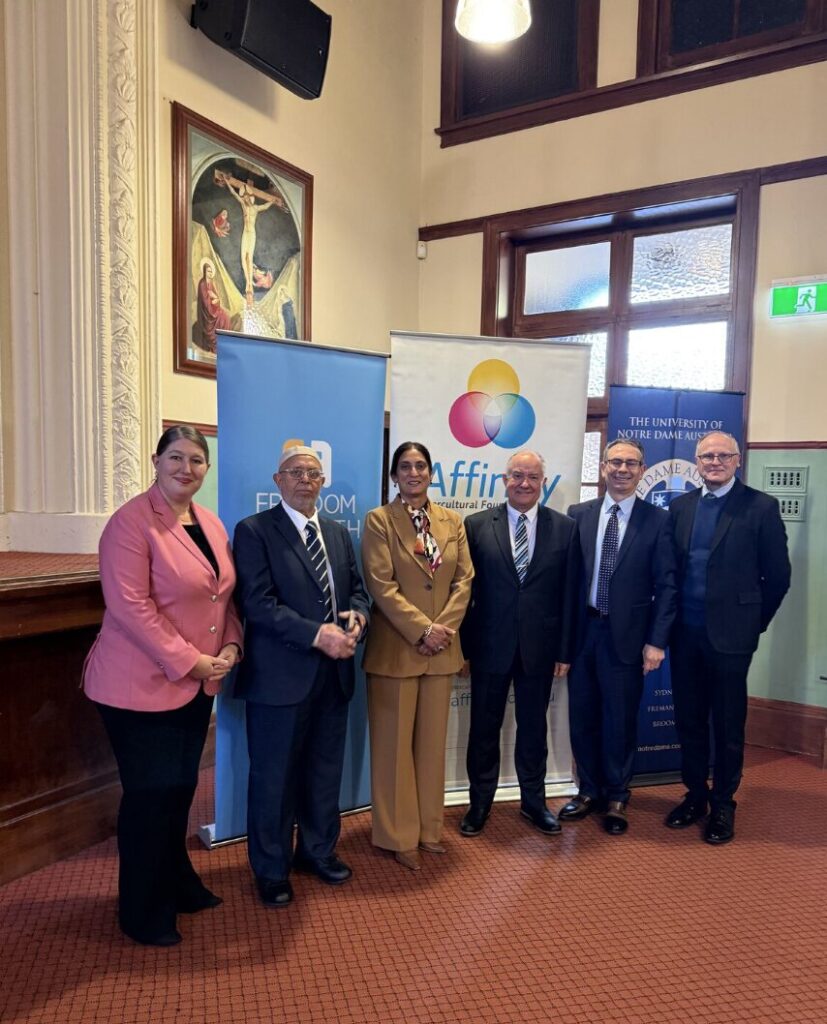
(L-R) Lorraine Finlay, Zia Ahmad, Rattan Virk, Keith Thompson, Ahmet Polat (Affinity Intercultural Foundation), Michael Quinlan. Photo: Supplied.
Mark Sneddon, director of the Institute for Civil Society, insisted that religious schools must be clear about their nature and argued that students flourish at religious schools. Dr Paul Morrissey, president of Campion College, spoke of the importance of religious schools being coherent and integrating faith into all of their activities.
Osman Karolia, principal of the Islamic College of Sport, spoke of the growth of independent – primarily faith-based – schools. He highlighted the contribution that religious schools can make to civic cohesion and a shared understanding of nationality.
Faith, Violence and the Bondi Aftermath
The theme of another panel discussion was that religious freedom is for everyone, not just for the majority. The Australian Human Rights Commissioner, Dr Lorraine Finlay, spoke of the difference between social conformity and social inclusion and belonging and of the need for universal religious freedom.
Rabbi Yehoram Ulman, of the Chabad Synagogue in Bondi, argued that true morality cannot exist without God and also emphasised the uniqueness of each person and of their personal life mission. And Dr Rattan Virk, Sikh Community of Australia, spoke of the need for cohesion and of the importance of visible religion as a living part of Australian society.
The Bondi terrorist attack last December, in which 15 innocent people died at the Chanukah by the Sea festival, has raised the question of how religious people should respond to violence.
Zia Ahmad, editor of Australian Muslim Times, spoke of the Koran’s rejection of violence and recognition of the human dignity of all people. Monica Doumit, Chancellor of the Catholic Archdiocese of Sydney, spoke of the central importance of prayer in response to tragedy and of the place that faith leaders can play in addressing hatred, and especially, antisemitism.
Anglican Bishop Michael Stead spoke of the Faith Affairs Council and the multiple statements rejecting hate and violence in the name of religion which it had issued. He emphasised the importance of faith leaders speaking, standing and being together, particularly at times of crisis.
And after Bondi, striking the right balance between public safety and religious freedom has been fiercely debated.
Building Social Cohesion Through Dialogue
Mike Southon, of Freedom For Faith, spoke of the danger of regulating “harmful speech”. He acknowledged that there are limits to free speech, but he argued for a social response rather than criminalisation of speech.
Dr Paul Taylor, a law lecturer at the University of Queensland, spoke of recent Commonwealth legislative responses to antisemitism, hate groups, and hate speech. He was critical of the lack of a definition of “violence” and the criminalisation of “the promotion of violence”, which heaps one vague concept on another.
Dr Keith Thompson, of The University of Notre Dame Australia, spoke of the implied freedom of political communication and asked where the appropriate line might be for the State to regulate speech.
The last panel discussion explored how to build social cohesion in a time of division. Reverend Faa’imata Havea Hiliau, the Moderator of the Uniting Church Sydney of NSW and ACT, noted that social cohesion begins with relationships. Parviz Deamer, of the Australian Baha’i Community, spoke of the key role that religious groups can play in transforming society and providing everyone with the opportunity to flourish.
Professor John Rees, an honorary professor at St Mary’s University in the UK, spoke of the importance of practising decency and of the need for dialogue. He spoke of the role that religious communities can play in sharing experiences of humiliation – a current or historical reality for most if not all religious traditions – and of treating others with decency.
___
Republished with thanks to The Catholic Weekly. Image courtesy of Adobe.






UNDA Conference Highlights Pressures on Religious Freedom
1 October 2026
3.2 MINS
A major Australian religious liberty conference has highlighted growing tensions over conscience, faith-based education, speech, public safety and social cohesion.
Religious freedom is a right that most Australians take for granted. But in an increasingly polarised society, there are worrying tensions and fracture.
At its 12th annual Religious Liberty Lecture and Conference last month, the University of Notre Dame Australia’s School of Law and Business tackled some of these hot-button issues. The event was supported by Freedom For Faith, the Affinity Intercultural Foundation and the Sikh Community of Australia.
When Conscience Collides With State Interests
The keynote lecture was delivered by Michael Quinlan, emeritus professor of the UNDA Law School.
His topic was “State Interests and the Freedom of Thought, Conscience and Belief of Individuals in New South Wales.” He spoke about two situations in which state interests and the freedom of conscience of individuals come into conflict: access to voluntary assisted dying and abortion.
He argued that the current legislative protections for conscientious objectors in NSW were inadequate, and he highlighted the egregious use of guidelines and policies issued by bureaucrats to undermine even those protections.
The conference featured speakers from many religious traditions. Three of them spoke about the pressures on faith-based education.
(L-R) Lorraine Finlay, Zia Ahmad, Rattan Virk, Keith Thompson, Ahmet Polat (Affinity Intercultural Foundation), Michael Quinlan. Photo: Supplied.
Mark Sneddon, director of the Institute for Civil Society, insisted that religious schools must be clear about their nature and argued that students flourish at religious schools. Dr Paul Morrissey, president of Campion College, spoke of the importance of religious schools being coherent and integrating faith into all of their activities.
Osman Karolia, principal of the Islamic College of Sport, spoke of the growth of independent – primarily faith-based – schools. He highlighted the contribution that religious schools can make to civic cohesion and a shared understanding of nationality.
Faith, Violence and the Bondi Aftermath
The theme of another panel discussion was that religious freedom is for everyone, not just for the majority. The Australian Human Rights Commissioner, Dr Lorraine Finlay, spoke of the difference between social conformity and social inclusion and belonging and of the need for universal religious freedom.
Rabbi Yehoram Ulman, of the Chabad Synagogue in Bondi, argued that true morality cannot exist without God and also emphasised the uniqueness of each person and of their personal life mission. And Dr Rattan Virk, Sikh Community of Australia, spoke of the need for cohesion and of the importance of visible religion as a living part of Australian society.
The Bondi terrorist attack last December, in which 15 innocent people died at the Chanukah by the Sea festival, has raised the question of how religious people should respond to violence.
Zia Ahmad, editor of Australian Muslim Times, spoke of the Koran’s rejection of violence and recognition of the human dignity of all people. Monica Doumit, Chancellor of the Catholic Archdiocese of Sydney, spoke of the central importance of prayer in response to tragedy and of the place that faith leaders can play in addressing hatred, and especially, antisemitism.
Anglican Bishop Michael Stead spoke of the Faith Affairs Council and the multiple statements rejecting hate and violence in the name of religion which it had issued. He emphasised the importance of faith leaders speaking, standing and being together, particularly at times of crisis.
And after Bondi, striking the right balance between public safety and religious freedom has been fiercely debated.
Building Social Cohesion Through Dialogue
Mike Southon, of Freedom For Faith, spoke of the danger of regulating “harmful speech”. He acknowledged that there are limits to free speech, but he argued for a social response rather than criminalisation of speech.
Dr Paul Taylor, a law lecturer at the University of Queensland, spoke of recent Commonwealth legislative responses to antisemitism, hate groups, and hate speech. He was critical of the lack of a definition of “violence” and the criminalisation of “the promotion of violence”, which heaps one vague concept on another.
Dr Keith Thompson, of The University of Notre Dame Australia, spoke of the implied freedom of political communication and asked where the appropriate line might be for the State to regulate speech.
The last panel discussion explored how to build social cohesion in a time of division. Reverend Faa’imata Havea Hiliau, the Moderator of the Uniting Church Sydney of NSW and ACT, noted that social cohesion begins with relationships. Parviz Deamer, of the Australian Baha’i Community, spoke of the key role that religious groups can play in transforming society and providing everyone with the opportunity to flourish.
Professor John Rees, an honorary professor at St Mary’s University in the UK, spoke of the importance of practising decency and of the need for dialogue. He spoke of the role that religious communities can play in sharing experiences of humiliation – a current or historical reality for most if not all religious traditions – and of treating others with decency.
___
Republished with thanks to The Catholic Weekly. Image courtesy of Adobe.
About the Author: Michael Quinlan
Australia / COMMENTARY / Fairness & Justice / Faith / Freedom / Identity Politics / Politics
SHARE >
We need your help. The continued existence of the Daily Declaration depends on the generosity of readers like you. Donate now. The Daily Declaration is committed to keeping our site free of advertising so we can stay independent and continue to stand for the truth.
Fake news and censorship make the work of the Canberra Declaration and our Christian news site the Daily Declaration more important than ever. Take a stand for family, faith, freedom, life, and truth. Support us as we shine a light in the darkness. Donate now.
Recent Articles:
Maryka Groenewald Launches WA Campaign to Protect Christian Schools’ Faith-Based Hiring
1 October 2026
3.1 MINS
Christian schools in Western Australia can currently hire staff who share their faith. Under reforms flagged by the Cook Government, they may lose that protection wherever faith is not deemed an “inherent requirement” of the role.
Michael Sweet and Billy Corgan: Unafraid to Talk About God
1 October 2026
3.9 MINS
Billy Corgan and Michael Sweet discuss faith, fear and integrity as two rock frontmen explain why they refuse to hide their belief in Jesus.
Apparent UK Terror Attack Foiled as Iran Drags Out War
1 October 2026
6.2 MINS
A foiled terror plot at RAF Fairford highlights the vigilance of local residents, heightened threats to Western military bases, and growing concerns over Iran’s role.
The British Government’s War on Britain
1 October 2026
6.2 MINS
Britain’s mounting security failures, immigration pressures and restrictions on public expression raise profound questions about political leadership, national sovereignty and the spiritual state of the West.
Day 1: A Revived Church — Our Only Hope
1 October 2026
3.7 MINS
A revived Church is the only hope for a dying world. As Billy Graham (1918–2018) said, “An awakened Church is the greatest evangelistic tool in the world.”
Eternity Truck: Steve Grace’s Mission Rig Almost Stage-Ready
30 September 2026
2.8 MINS
Steve Grace’s Eternity Truck is bringing music and the Gospel beyond church walls, taking a mobile concert stage to remote communities and country towns.
Jesus and Australia Today: Not a Swear Word, But Our Saviour
30 September 2026
3.2 MINS
In an increasingly secular and pluralistic Australia, Christians must recover their confidence in proclaiming Jesus Christ as the unique, sufficient and only Saviour.
Use your voice today to protect
Faith · Family · Freedom · Life
MOST POPULAR
ABOUT
The Daily Declaration is an Australian Christian news site dedicated to providing a voice for Christian values in the public square. Our vision is to see the revitalisation of our Judeo-Christian values for the common good. We are non-profit, independent, crowdfunded, and provide Christian news for a growing audience across Australia, Asia, and the South Pacific. The opinions of our contributors do not necessarily reflect the views of The Daily Declaration. Read More.
MOST COMMENTS
GOOD NEWS
HALL OF FAME
BROWSE TOPICS
BROWSE GENRES