


UNDA Conference Highlights Pressures on Religious Freedom
A major Australian religious liberty conference has highlighted growing tensions over conscience, faith-based education, speech, public safety and social cohesion.
Religious freedom is a right that most Australians take for granted. But in an increasingly polarised society, there are worrying tensions and fracture.
At its 12th annual Religious Liberty Lecture and Conference last month, the University of Notre Dame Australia’s School of Law and Business tackled some of these hot-button issues. The event was supported by Freedom For Faith, the Affinity Intercultural Foundation and the Sikh Community of Australia.
When Conscience Collides With State Interests
The keynote lecture was delivered by Michael Quinlan, emeritus professor of the UNDA Law School.
His topic was “State Interests and the Freedom of Thought, Conscience and Belief of Individuals in New South Wales.” He spoke about two situations in which state interests and the freedom of conscience of individuals come into conflict: access to voluntary assisted dying and abortion.
He argued that the current legislative protections for conscientious objectors in NSW were inadequate, and he highlighted the egregious use of guidelines and policies issued by bureaucrats to undermine even those protections.
The conference featured speakers from many religious traditions. Three of them spoke about the pressures on faith-based education.
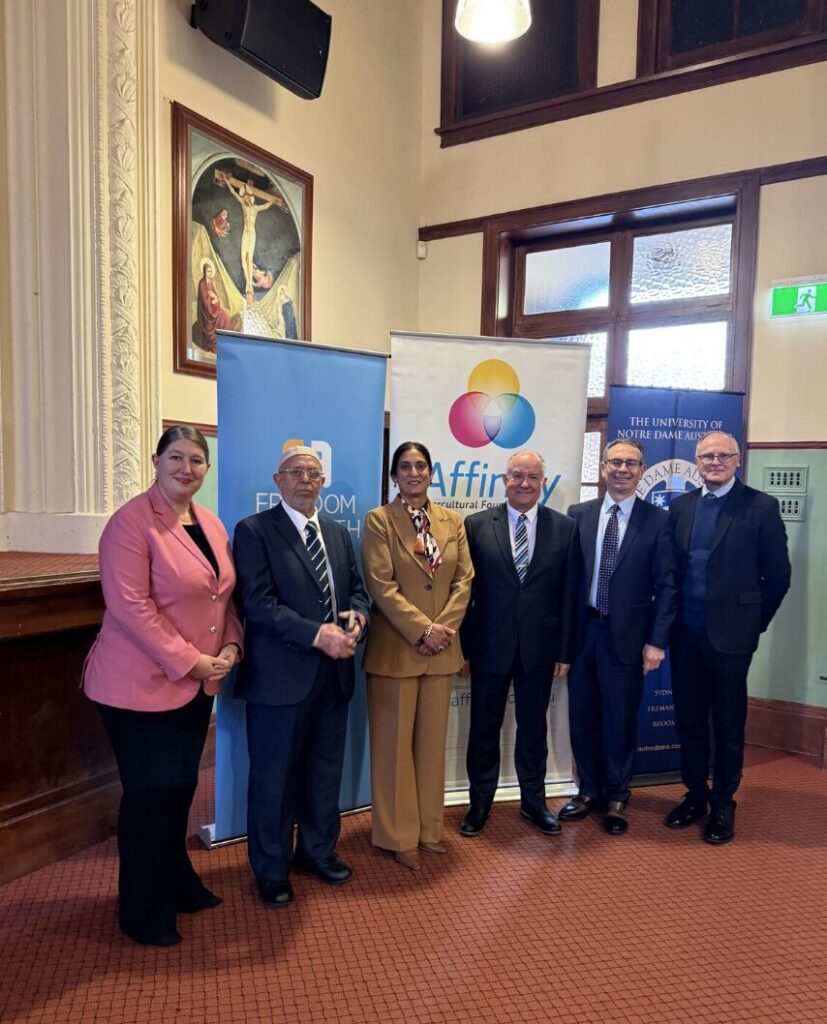
(L-R) Lorraine Finlay, Zia Ahmad, Rattan Virk, Keith Thompson, Ahmet Polat (Affinity Intercultural Foundation), Michael Quinlan. Photo: Supplied.
Mark Sneddon, director of the Institute for Civil Society, insisted that religious schools must be clear about their nature and argued that students flourish at religious schools. Dr Paul Morrissey, president of Campion College, spoke of the importance of religious schools being coherent and integrating faith into all of their activities.
Osman Karolia, principal of the Islamic College of Sport, spoke of the growth of independent – primarily faith-based – schools. He highlighted the contribution that religious schools can make to civic cohesion and a shared understanding of nationality.
Faith, Violence and the Bondi Aftermath
The theme of another panel discussion was that religious freedom is for everyone, not just for the majority. The Australian Human Rights Commissioner, Dr Lorraine Finlay, spoke of the difference between social conformity and social inclusion and belonging and of the need for universal religious freedom.
Rabbi Yehoram Ulman, of the Chabad Synagogue in Bondi, argued that true morality cannot exist without God and also emphasised the uniqueness of each person and of their personal life mission. And Dr Rattan Virk, Sikh Community of Australia, spoke of the need for cohesion and of the importance of visible religion as a living part of Australian society.
The Bondi terrorist attack last December, in which 15 innocent people died at the Chanukah by the Sea festival, has raised the question of how religious people should respond to violence.
Zia Ahmad, editor of Australian Muslim Times, spoke of the Koran’s rejection of violence and recognition of the human dignity of all people. Monica Doumit, Chancellor of the Catholic Archdiocese of Sydney, spoke of the central importance of prayer in response to tragedy and of the place that faith leaders can play in addressing hatred, and especially, antisemitism.
Anglican Bishop Michael Stead spoke of the Faith Affairs Council and the multiple statements rejecting hate and violence in the name of religion which it had issued. He emphasised the importance of faith leaders speaking, standing and being together, particularly at times of crisis.
And after Bondi, striking the right balance between public safety and religious freedom has been fiercely debated.
Building Social Cohesion Through Dialogue
Mike Southon, of Freedom For Faith, spoke of the danger of regulating “harmful speech”. He acknowledged that there are limits to free speech, but he argued for a social response rather than criminalisation of speech.
Dr Paul Taylor, a law lecturer at the University of Queensland, spoke of recent Commonwealth legislative responses to antisemitism, hate groups, and hate speech. He was critical of the lack of a definition of “violence” and the criminalisation of “the promotion of violence”, which heaps one vague concept on another.
Dr Keith Thompson, of The University of Notre Dame Australia, spoke of the implied freedom of political communication and asked where the appropriate line might be for the State to regulate speech.
The last panel discussion explored how to build social cohesion in a time of division. Reverend Faa’imata Havea Hiliau, the Moderator of the Uniting Church Sydney of NSW and ACT, noted that social cohesion begins with relationships. Parviz Deamer, of the Australian Baha’i Community, spoke of the key role that religious groups can play in transforming society and providing everyone with the opportunity to flourish.
Professor John Rees, an honorary professor at St Mary’s University in the UK, spoke of the importance of practising decency and of the need for dialogue. He spoke of the role that religious communities can play in sharing experiences of humiliation – a current or historical reality for most if not all religious traditions – and of treating others with decency.
___
Republished with thanks to The Catholic Weekly. Image courtesy of Adobe.
4 Comments
Leave A Comment
Recent Articles:
24 October 2026
3.3 MINS
When we ask God, "What is in my hand?", and see our possessions, money and time as seed that God asks us to sow, life becomes simpler.
23 October 2026
6.8 MINS
Hillsong UNITED’s Joel Houston reflects on fame, faith and the burden of ministry, questioning performative Christianity as he seeks a more authentic walk with God.
23 October 2026
13.1 MINS
Tasmania’s proposed conversion practices legislation raises serious questions about religious freedom, pastoral care and whether Christians can freely pray with those seeking to live according to their faith.
23 October 2026
7.7 MINS
Melbourne Catholic Archbishop Peter Comensoli has spoken out clearly against the deadly promises by both major parties in Victoria ahead of the election, drawing a comparison between abortion and capital punishment.
23 October 2026
3.1 MINS
As Western societies grow more hostile, could abandoning Christianity’s moral foundations be contributing to the rise of ideological extremism, political intolerance and violence?
23 October 2026
5.1 MINS
France’s escalating riots expose the dangers of political extremism, antisemitism and radical alliances, offering America a stark warning about the future of Western democracy.
23 October 2026
3.1 MINS
The one who is worthy of it all is awakening his Church to be captivated by him, so that we will honour one another and share his gospel with humility and courage.



Great article Michael!!!
The dialog mentioned above is potentially helpful, BUT
when Zia Ahmad, editor of Australian Muslim Times, spoke of the Koran’s rejection of violence and recognition of the human dignity of all people, one must be skeptical of his rhetoric.
As Franklin Graham has pointed out, and I quote, “The Koran provides ample evidence that Islam encourages violence in order to win converts and to reach the ultimate goal of an Islamic world. Conversions from Islam to any other faith are often punishable by death”.
Yes Ian. And apparently Muslims are expected or encouraged (?) – at the very least allowed – to lie to the ‘infidels’; written in the Koran? To ‘play friendly’ in their pursuit to overtake us.
Quite right Helen.