



Christians, Married People Feel Their Lives Are Most Meaningful: Study
New research from the United States underscores the importance of faith and family in the search for a meaningful life.
Americans who believe in God and those who are married have a greater sense of meaning and purpose in their lives than unbelievers and single people, a new national survey has found.
“Overall, religious Americans tend to believe their life is meaningful more often than do those who are not religious,” the American Enterprise Institute’s (AEI) Survey Center on American Life discovered. “Americans who have never married, are not religious, and have lower levels of formal education feel their lives have meaning less often than other Americans do,” the survey said.
A majority of evangelical Christians (56%) said “in the past 12 months they always or often have felt their life has meaning,” the survey discovered.
On the other hand, the Nones — Americans who describe themselves as religiously unaffiliated — have a lower-than-average sense that their life is significant. Only 42% of those unaffiliated with any religion agree. Evangelical Christians are 33% more likely than unbelievers to say their actions matter in the grand scheme of things.
Designed for Connection and Responsibility
“It’s unsurprising that secularism tends toward a sense of meaninglessness. If our existence is an accident, it is also without purpose,” Joseph Backholm, senior fellow for Biblical Worldview and Strategic Engagement at Family Research Council, told The Washington Stand. “But if we were created on purpose, by someone who loves us and seeks a relationship with us both now and into eternity, suddenly everything has a point” — even when life is hard.
“The more we learn about the world, the more it confirms that the instructions God provided to humanity were for our benefit and not for our harm. We were designed to walk with our Creator,” Backholm told TWS.
“His perfect design included marriage, children, and productive work. Research consistently concludes that ordering your life in this way leads to greater life satisfaction,” said Backholm.
The survey found the generation with the highest level of religious faith also holds the strongest belief that life has significance. A majority of only one generation (56%) — the Baby Boomers — see direction in their daily lives, compared with 46% of Gen X, 44% of millennials, and 45% of Gen Z. A majority (58%) of Baby Boomers belong to a church, while only one in three (36%) millennials and Gen Z do. A nearly-identical majority (57%) of Baby Boomers said they went to church at least weekly as children, while shrinking minorities of millennials (45%) and Gen Z (40%) had the same religious upbringing.
A Yearning for Significance
The survey also revealed a deep emptiness and national longing for a life imbued with importance. Less than half of Americans say they often, or always, feel their lives have meaning. Nearly one out of every four Americans say they rarely (13%) or never (9%) feel their life has a purpose, the Survey Center on American Life found. That’s only a little lower than the one-in-five American Nones, those who do not affiliate with any specific religion. The fraction of Americans who do not identify with any particular religious background has remained steady at 21% for five years (2017-2022). Still, nearly two-thirds (61%) of religiously unaffiliated Americans believe in some conception of God.
This yearning for significance comes as church membership has receded. For the first time in U.S. history, a majority of Americans reported not belonging to a church or house of worship in 2021; 47% told Gallup they maintain religious membership. Christian pollster George Barna’s Cultural Research Center at Arizona Christian University (ACU) put the number higher: 75% of millennials “say, ‘I don’t know why I should get out of bed in the morning,’” Barna told “Washington Watch with Tony Perkins” this spring.
Faith, Family, Happiness and Meaning
Multiple studies have found that faith and family bring a deep sense of happiness and meaning:
- Americans who believe in God and value marriage are more likely to be “very happy”than non-believers and single people, according to a Wall Street Journal-NORC poll taken in March;
- Americans who attended religious services regularly were 44% more likely to say they were “very happy” than the religiously inactive, found a 2019 Pew Research Center study;
- Practicing Christians who regularly read the Bible report a higher score on the Human Flourishing Index — which measures “happiness & life satisfaction,” “mental & physical health,” “meaning & purpose,” “character & virtue,” “close societal relationships” and “financial & material stability” — than non-practicing Christians or the Nones/religiously unaffiliated: 7.8 for Christians, compared to 6.9 for inactive Christians and 6.7 for religious unaffiliated, according to an American Bible Society report released this June. The biggest difference between active Christians and non-Christians came in “meaning & purpose”; and
- Childhood church attendance and prayer benefited adults later in life, according to a Harvard study. “[P]eople who attended weekly religious services or practiced daily prayer or meditation in their youth reported greater life satisfaction and positivity in their 20s — and were less likely to subsequently have depressive symptoms, smoke, use illicit drugs, or have a sexually transmitted infection — than people raised with less regular spiritual habits,” according to a summary of a 2018 study conducted by researchers from Harvard University’s T.H. Chan School of Public Health.
Biblical Morality and a Sense of Identity
Although social science points to religious faith as a root of personal happiness, Americans increasingly believe worldly wealth and relationships will satisfy them. Millennials are more than four times more likely than Baby Boomers to worry about finding a meaningful career, AEI found. “When asked what it takes to lead a fulfilling life, the public prioritizes job satisfaction and friendship over marriage and parenthood,” reported a separate Pew Research Center poll in September. In all, 71% of Americans say a fulfilling job makes for a good life, while only 23% say being married (and 26% say having children) are “extremely important in order for people to live a fulfilling life,” said Pew.
The survey did not ask about whether faith in God led to a meaningful life.
The problem of misplaced priorities — people striving to obtain vain and unfulfilling goals — has been a human temptation from the eternal past. “Why do you spend your money for that which is not bread, and your labor for that which does not satisfy?” asked God through the prophet Isaiah (55:2).
Those who follow biblical morality are also more likely to have a stable view of their personal identity and life’s purpose. “Americans who identify as bisexual, gay, or lesbian report more frequent feelings of uncertainty about who they are than do most other Americans,” AEI found. Two-thirds (67%) of Americans who identify as bisexual and half (48%) of self-identified gays said they felt “uncertain about who they were supposed to be” in the last year, as compared to about one out of four (29%) of those who identify as straight. That makes self-identified bisexuals 131% more likely to be unsure of their identity and self-identified gays 40% more likely to have an unstable personality than heterosexuals.
A Drop in Support for Same-Sex Marriage
The same survey found a massive, 11-point drop in Gen Z’s support for same-sex marriage in just one year. America’s youngest generation, those born since 1997 and most likely to live with parents who contracted a marriage after the 2015 Obergefell v. Hodges decision created the constitutional “right” to same-sex marriage, now support gay marriage at lower rates than their older siblings, the millennials.
The most recent study echoes the Bible’s promise of fulfillment to those who follow after God: “Trust in the Lord with all thine heart. … In all thy ways acknowledge Him, and He shall direct thy paths” (Proverbs 3:5-6). The survey also confirms the Bible’s teaching, “Happy are the people whose God is the Lord!” (Psalm 144:15).
Despite the robust body of scientific and analytical data confirming the importance of faith and traditional family life, Backholm says the reader will likely interpret the evidence according to his own worldview. “Skeptics will look at this research and conclude some delusions are helpful. Believers will see it as evidence that whomever wrote the Scriptures knew exactly what people needed” to thrive.
Originally published at The Washington Stand. Image via Unsplash.
One Comment
Leave A Comment
Recent Articles:

13 October 2026
2.6 MINS
Allegra Spender’s proposed bill reignites debate over discrimination protections, religious freedom and the right of faith-based schools to uphold their beliefs and values.

13 October 2026
3.9 MINS
Tasmania’s proposed conversion practices law raises serious concerns for churches, parents and faith-based schools, with broad definitions, severe penalties and uncertain protections for religious freedom.

13 October 2026
5.5 MINS
Stephen Baldwin’s journey from drug addiction to sobriety, Christian faith and family life reveals how surrender, daily discipline and renewed hope transformed his life.

13 October 2026
2.8 MINS
The church in Ephesus had so much going for it. Yet despite their hard work, perseverance, endurance, and discernment, there was something deeply wrong: they had left their first love.
12 October 2026
4.6 MINS
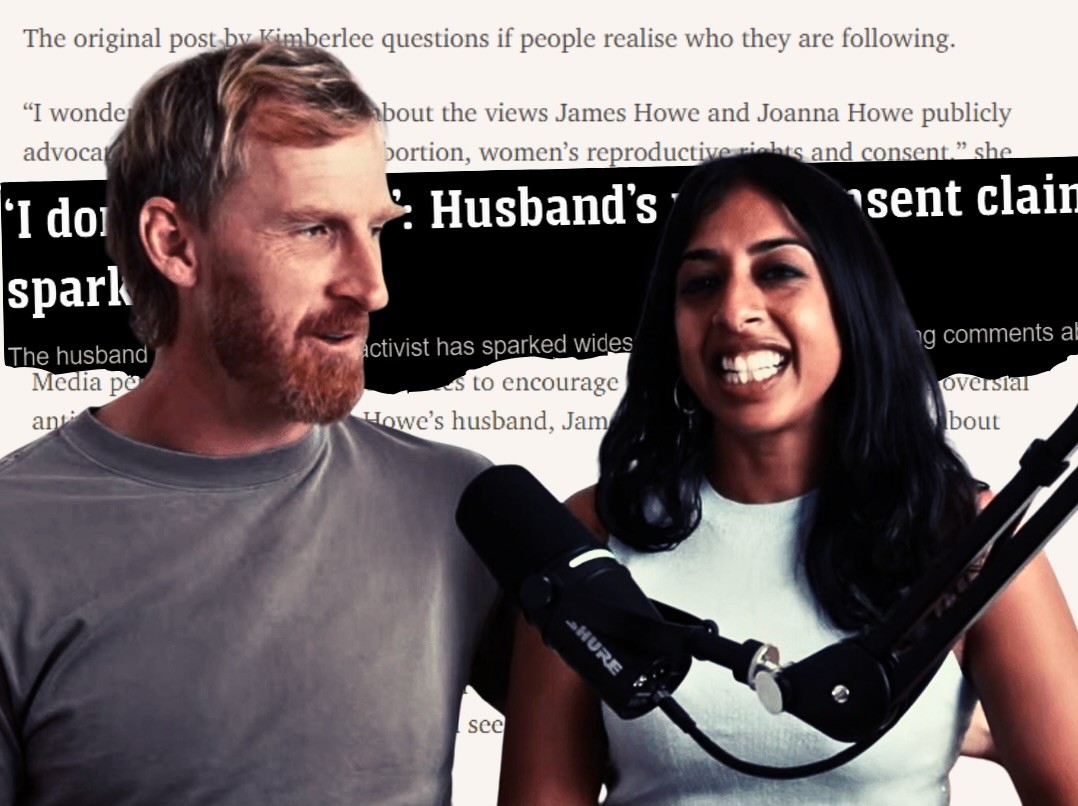
Learn how journalists use loaded language, selective quotes and misleading headlines to shape public opinion, using a controversial report about James and Joanna Howe as a case study.

12 October 2026
12.9 MINS
God’s judgement can seem difficult to reconcile with His goodness. But Scripture presents God’s perfect justice as something we can celebrate — and His present offer of mercy through Jesus as the good news.

12 October 2026
3.1 MINS
The proposed livestream of Nidal Hasan’s execution has reignited debate over justice, deterrence and public accountability, with critics comparing American justice to ISIS propaganda.



Finding this new article on my 47th wedding anniversary is such a wonderful reminder of all the joy and wonder that such a relationship with God provides.
This Scripture passage has been a constant encouraging reminder for us:
“Two are better than one because they have a good return for their labor; for if either of them falls, the one will lift up his companion. But woe to the one who falls when there is not another to lift him up! Furthermore, if two lie down together they keep warm, but how can one be warm alone? And if one can overpower him who is alone, two can resist him. A cord of three strands is not quickly torn apart.” (Ecclesiastes 4:9-12 NASB).