



Here Is One Thing We Should Be Talking About As a Society, But Aren’t
Secular society upholds universal human rights yet denies God, creating a moral contradiction. This article explores why true human dignity ultimately points to the existence of the King.
I was recently listening to the excellent ‘TRIGGERnometry’ podcast, where the hosts, Konstantin Kisin and Francis Foster, invited pro-Palestinian podcaster David Smith to discuss fraught topics such as Israel and Gaza. It was a fascinating (and civil!) debate about the rights and wrongs of Israel’s actions in the Middle East.
But after listening to it, what struck me was not the disagreement between the hosts and their guest, but the underlying agreement.
You see, both sides in that podcast debate tacitly agreed that there exists an objective moral standard, a moral law. This moral law is assumed to ‘exist apart from us’ that shows us what should and should not be done, regardless of how people feel about it, regardless of what a culture and people say, regardless of whether it’s in a person’s self-interest or not. And when this moral law is transgressed – whether by Hamas on October 7, or by the IDF in Gaza, there is anger and outrage, whether on the podcast or across Western societies.
While Israel and Gaza have generated a lot of moral outrage in the past few years, many other issues have also led secular people to be outraged. Just think of hot topics like abortion, transgender issues, immigration and climate change. There’s so much heat in these issues because secular people assume there’s some underlying moral law that’s being transgressed.
Or to put it more precisely, secular non-Christian people often assume a (Christian-ish) view of morality that goes something like this:
Human beings are different from animals, and therefore have inalienable, universal rights that animals don’t have. This is regardless of race, age, gender, ability, or location.
And so, whether you’re a child in Gaza today or a black woman in 1950s Alabama, secular people believe everyone, everywhere at all times has universal human rights. Which means nobody should be treated like an animal.
But this raises an urgent question. A question that we should be talking about as a society, but we’re not.
One thing we should be talking about as a society, but aren’t
Our secular Western culture, by and large, accepts this idea of universal human rights, which everyone must adhere to (even if they don’t agree with it).
On the other hand, secular society has the equally firm secular conviction that we live in a God-less, random, meaning-less universe. And that human beings are, at our core, nothing more than highly evolved animals. Secular scientists have been making this claim for 150 years since Darwin.
Thus, secular societies believe that human beings are merely animals, but must never be treated like animals.
How can both of those things be true? It’s a contradiction if ever there was one.
This contradiction is one thing we should be talking about as a society, but we’re not.
Our very civilisation depends on believing in universal human rights – in treating human beings with the dignity we afford to no other animal. It’s what has made the West a bastion of freedom and justice unseen in human history. It’s why millions of people (including my family) have flocked here.
But what reason does our secular world give for these rights?
Some attempts at reconciling this contradiction.
Now, attempts have been made to reconcile this contradiction.
Some argue that reason tells us that human beings have rights. In this view, it’s reasonable and rational to treat human beings with the dignity that we afford no other animal.
But this line of reasoning falls apart once we ask some simple questions.
Such as: Why is it unreasonable to treat (human) animals like animals? After all, a moment’s look at the animal kingdom will tell us that violence and the survival of the fittest are the natural order of the day. The lion eats the antelope, and we don’t get morally outraged at lions. We merely see this as the natural order of things. In fact, the secular view of reality teaches that evolution is inherently violent.
So, if it’s acceptable and natural for one animal to kill another animal, whether in the African savannah or your back garden, why is it unreasonable for one human animal to kill another human animal, whether in the back alleys of your city or the rubble of Gaza? [1]
Others might point out that evolution gives us morality – that our moral instinct comes from evolution. But this view proves too much. For if evolution gave Western societies the notion that universal human rights exist (and thus we should obey this instinct), what about those societies where cannibalism and tribal warfare are the order of the day? Does that mean they should obey those instincts? Not to mention all the other moral instincts that human beings have (e.g. selfishness, greed, lust) — presumably, evolution gave us those, too. Should we be obeying them?
A more intellectually honest (but disturbing) account of morality
In the face of these conundrums, an atheist like author Yuval Noah Harari gives the game away by saying our view of human rights is nothing more than a story, a convenient fiction we’ve made up for the sake of order and convenience:
Today in the world, many, maybe most legal systems are based on this idea, this belief, in human rights. But human rights are just like [the fictional ideas of] Heaven and like God. It’s just a fictional story that we’ve invented and spread around… It is not a biological reality. Just as jellyfish, and woodpeckers, and ostriches have no rights, Homo Sapiens have no rights also.
But if our view of human rights is nothing more than a made-up story, why would we get outraged when other people don’t hold to our made-up story?
Our secular world wants the Kingdom without the King
Western societies are built on the view that every human being has rights. It’s one of the things that has led to the West flourishing over the centuries.
But if the secular view of human rights is based on a contradiction, a fiction, then where does that leave secular society?
For starters, it means secular people don’t have a compelling reason for moral outrage when human rights are abused. They don’t have a rational reason to get morally upset by the images of starving Gazans or Sudanese. It no longer makes sense to be morally upset when Africans slaughter Africans, any more than it makes sense to be morally outraged when one African animal kills another.
And yet, there is still outrage (for which I’m thankful — I don’t want to live in a society where people aren’t outraged at human rights abuses). This shows that secular society wants to have it both ways. They don’t want the God of the Bible (which led to the West’s view of human rights), and yet they still want the Bible’s view of human rights. They want the kingdom without the King.
But how long can we have the fruits of the kingdom (human rights) without the King?
Time will tell. But at the very least, without a compelling reason to uphold human rights, human rights and human exceptionalism are at risk of eroding under pressure in our secular West. Consider the brave new world of AI. Many of the AI tech leaders in Silicon Valley believe that human beings are biological machines. In their view, if silicon machines become more intelligent than us, not only should they have rights, but it would be fine if they replaced us one day. This is the view of many who are pushing AI onto us.
Human rights point to the existence of the King
But as Christians, we know that the instinct that fellow human beings must never be treated like animals is the right moral instinct.
In which case, we’re not just animals, but something far more precious. If that’s the case, then why continue believing in the atheistic view of reality?
Maybe the existence of the kingdom points to the existence of the King.
Now that would be a conversation worth having.
___
[1] Furthermore, there are many situations where doing good is entirely unreasonable, and doesn’t make rational sense. Think of the many non-Jews who risked their lives and the lives of their families to hide Jews in occupied Europe during World War 2. Was it moral for these non-Jews to hide Jews from the Nazis? Of course – it’s one of the greatest acts of morality in human history.
But was it reasonable? Well, there’s nothing more reasonable than trying to keep you and your family safe. So it was hardly reasonable for them to put their lives and the lives of their children at enormous risk for strangers.
___
Republished with thanks to AkosBalogh.com. Image courtesy of Adobe.
2 Comments
Leave A Comment
Recent Articles:

27 October 2026
1.5 MINS
Labor’s Digital Duty of Care Bill threatens free speech, empowers covert online surveillance, and imposes potentially burdensome regulations on Australian businesses.

27 October 2026
10.3 MINS
As Tasmania and Western Australia consider conversion therapy bans, a former LGBT+ ministry leader warns of threats to religious freedom, personal choice and Christian discipleship.

27 October 2026
4.9 MINS
Nine Christians have been killed in a terrorist attack on a Jordanian church, prompting fierce condemnation, demands for justice and renewed concerns about religious persecution.

27 October 2026
3.6 MINS
For 25 years, the Mount Moriah Trust has supported struggling Christians across the Holy Land, bringing practical assistance, encouragement and hope to believers facing hardship and persecution.

27 October 2026
1.3 MINS
Moira Deeming’s re-election campaign has energised Family First supporters, raising $90,000 as the party prepares for a crucial Victorian election and a potential breakthrough.

26 October 2026
4.5 MINS
OECD chief Mathias Cormann warns Australia is losing its competitive edge, as excessive regulation, housing pressures, immigration challenges and declining public trust threaten national prosperity.
26 October 2026
2.5 MINS
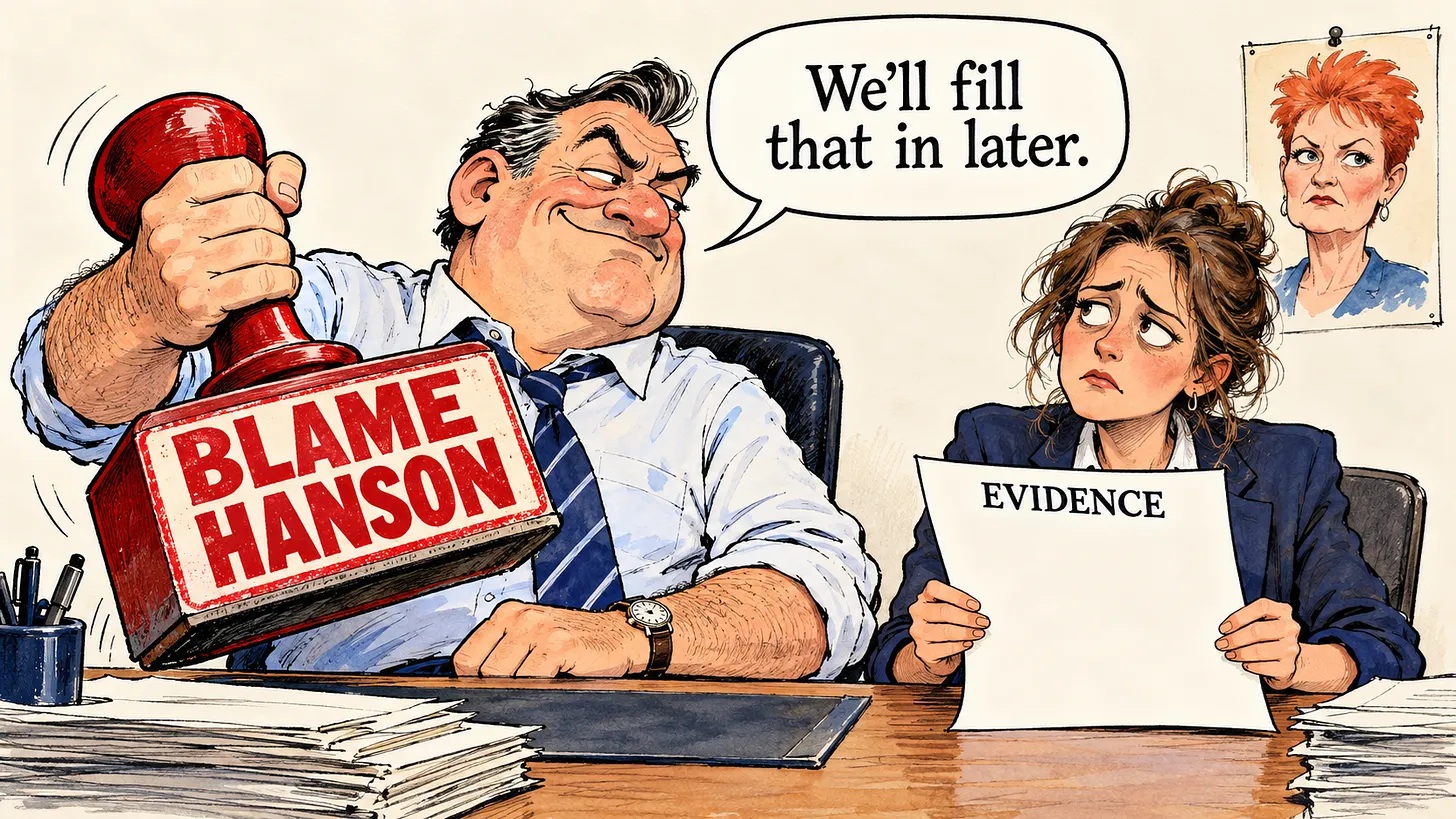
Nation First exposes the rush to weaponise the Haines attack against Pauline Hanson, conservative voices and men before investigators established a motive.



Hello Akos – an important article. The hard part now is getting those who need to read it, to read it! (and then talk about it – and that includes Christians).
I have tried to develop arguments along similar lines. To try and make them more reader friendly, especially for younger people, I have written and illustrated them in the form of seven short comics.
They can all be read at http://www.atheismforkidsandteens.com and can also be printed for free from there.
I’m always appreciative of feedback. Thanks.
That’s the problem with religion: when one is arguing from ‘separation’, it’s that separation that divides. And it’s that division that separates society into a secular and non-secular society. Jesus, with the Father and Holy Spirit, is the creator and sustainer of the cosmos, so there is nothing outside of Him (Them).
Father, Word and Holy Spirit: an Individable Oneness, were as One before creation. Their character and nature was individually and together, Love. And of that Love they made ‘man’ in their Image and Likeness, and that image and likeness was never lost or broken (separated) from God to man, but yes, man ‘alienated’ himself from God.
Morality cannot be separated from Love, nor from obedience to the law. Only as we individually acknowledge and experientially receive the love of God, as John explains in 17:26, in us can we act morally, because that morality is a response of our Love back to God.
Every man in history has desired, from the depths of his being, to know the Love of his original family. Jesus came, and His resurrection was the beginning of that remembrance for man to know from whence he came. We were brought out of darkness into the wonderful light, but we are too arrogant and stubborn to let go of our religious presuppositions.