


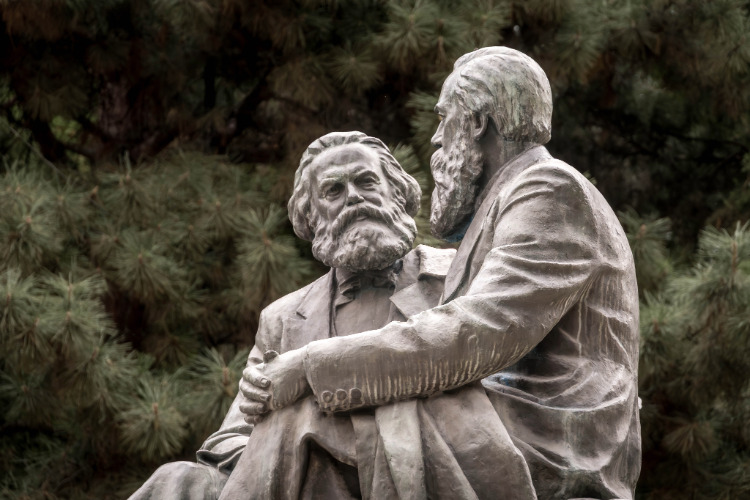
Why Communism is Back
The West thought it had outgrown Christianity. But in its search for meaning, morality and salvation, it may have simply turned politics into a substitute faith.
There is something wonderfully ironic about the West’s latest flirtation with communism.
For decades, Western intellectuals have been busy throwing Christianity out of the public square.
Religion, we were told, was primitive.
The Bible was an embarrassing relic.
And churches were dusty museums for people who still believed in sin, salvation and something called “eternal life”.
And yet, having evicted Christianity, the West has discovered that human beings still seem to want meaning.
People also want justice.
And they want belonging. They want morality. They want a cause greater than themselves. They want to know who the good guys are, who the bad guys are and what the point of their existence might be.
Secular humanism had a go at filling the void left by the abandonment of Christianity.
But it turns out that telling everyone to become an autonomous individual who lives to consume consumables and post content on social media before returning to dust wasn’t quite enough.
Enter Karl Marx.
Not necessarily the Marx of gulags, bread queues and secret police. That Marx remains somewhat difficult to put on a university tote bag.
Rather, it is Marxism as a moral framework that has become fashionable again: the language of oppressors and oppressed, exploitation and liberation, privilege and victimhood, systemic injustice and revolutionary transformation.
And this tells us something important about what happens when a society rejects Christianity without abandoning its appetite for a religious explanation of the world.
It doesn’t necessarily become less religious.
It just becomes religious about politics.
The rejection of Christianity has left a vacuum
Christianity didn’t merely tell Westerners to attend church on Sunday.
For centuries, it provided answers to some rather large questions.
What is a human being?
Why does every person have value?
What is justice?
Why should I love my neighbour?
Why is greed wrong?
What is sin?
What is the purpose of life?
And perhaps most inconveniently: what if I am part of the problem?
Modern secular culture has increasingly rejected Christianity’s answers.
But the questions haven’t gone away.
Human beings remain incurably interested in meaning. We still want a story that explains why the world is broken, who is responsible and how it can be fixed.
Nature abhors a vacuum.
So does the human soul.
Marxism provides a remarkably convenient replacement story
Christianity says the world is fallen.
Human beings are capable of selfishness, cruelty and injustice. The problem isn’t merely “out there”. It is also inside us.
Christianity offers a story of sin, redemption and ultimate restoration.
Marxism offers an alternate story.
The world is unjust because certain groups possess power over others. Society is divided between oppressors and oppressed. History is moving towards liberation. The existing order must be transformed.
You don’t need to believe in God.
You simply need to believe in History.
And History, in this version, has a plan.
That makes Marxism rather more than an economic theory. It becomes a story about human existence.
There is a Fall.
There are villains.
There are victims.
There is a struggle.
There is redemption.
And eventually, if everyone behaves themselves, paradise.
The only noticeable difference is that heaven has been relocated from eternity to Earth, and the pearly gates have been replaced by a government department.
Sin doesn’t disappear. It gets reassigned.
Christianity has a particularly annoying doctrine called sin.
It says the problem isn’t simply that society is badly organised.
The problem is us.
That is, shall we say, psychologically inconvenient.
It means the wealthy man might be greedy. But it also means the poor man might be greedy.
The conservative might be selfish. But the progressive might also be selfish.
And the revolutionary might become a tyrant.
In other words, nobody gets to escape the diagnosis.
Modern political ideologies can offer a much more comfortable arrangement.
Instead of asking, “What is wrong with me?” you can ask: “Who is oppressing me?”
Suddenly, the moral problem is conveniently located somewhere else.
Capitalism can become the villain.
Or colonialism.
Or racism.
Or patriarchy.
Or inequality.
These are not imaginary issues. Societies can contain genuine injustice, exploitation and discrimination.
The interesting question is what happens when political categories begin performing the role that “sin” once performed.
You have the guilty.
You have the innocent.
You have confession.
You have repentance.
You have moral purity.
You have heretics.
And you have people explaining on social media why someone else’s disagreement proves they are a terrible person.
The theology has changed, but the human instinct hasn’t.
Secular liberalism has a meaning problem
This helps explain why revolutionary politics can appeal particularly strongly to people who feel alienated.
Liberal democracy is deliberately boring about ultimate meaning.
It says you are free to pursue your own conception of the good life, provided you respect other people’s rights.
That’s a pretty sensible political arrangement.
But it isn’t exactly the stuff of epic poetry.
Nobody wakes up at 7 a.m. thinking: Today I shall bravely defend my right to choose between drinking Coke, Diet Coke or Vanilla Coke.
Revolutionary movements offer something more intoxicating.
They say: You have a mission.
You are not merely going to work, paying rent and scrolling through TikTok until death eventually finds you.
You are part of a historic struggle. Your life means something. Your actions contribute to the liberation of humanity.
That is an enormously powerful psychological proposition.
And it is very close to what religion has historically offered.
Politics can replace the community that religion once supplied
There is another problem.
Churches didn’t simply provide doctrines.
They provided fellowship.
Churches gave individuals somewhere to go, something to do and a community to belong to.
They provided rituals, relationships, responsibilities and a shared story.
As religious participation declines, people can become increasingly detached from those traditional communities.
Politics is increasingly providing a substitute.
There are meetings, marches, slogans, symbols, chants and causes.
There are people who are “with us” and people who are “against us”.
You can even celebrate the occasional conversion when someone comes over to your side.
The secular activist may insist he has escaped religion. But in actuality, he has simply joined a movement with its own doctrine, saints, sinners, rituals, commandments and apocalyptic predictions.
But please don’t call it a religion.
That would be offensive.
And so politics becomes theology
This may be the deepest irony of all.
The secular West thought it was escaping religion.
Instead, it may simply have secularised some of religion’s functions.
The language changes.
God becomes History.
Sin becomes systemic oppression.
Salvation becomes liberation.
The church becomes the movement.
The sermon becomes the rally.
The heretic becomes the person who asks awkward questions. Or who watches News24!
And heaven becomes the perfect society that is always just one revolution away.
There is nothing inherently wrong with wanting justice. Nor is criticism of capitalism, inequality or social injustice evidence of communism.
The point is something more fundamental.
Human beings cannot easily live without a story about what is wrong with the world and what would make it right.
Christianity supplied one.
Modern secularism removed it.
Something had to fill the space.
And communism — or various descendants of Marxist thought — has proved remarkably willing to apply for the vacancy.
Perhaps that is why the modern West’s renewed fascination with revolutionary politics is less mysterious than it first appears.
We didn’t stop believing. We simply changed the object of our belief.
And after spending half a century insisting that religion was nothing more than humanity’s desperate search for meaning, we may be discovering an awkward truth:
Take away God, and humanity doesn’t necessarily stop looking for salvation.
It just looks for a government powerful enough to promise it.
A final warning…
There is one final irony worth considering.
The socialist West may discover that its new secular faith is poorly equipped to withstand a much older and more confident religious worldview: Islamism.
A political culture that treats its own Christian inheritance as embarrassing, regards national borders as morally suspect and struggles to distinguish tolerance from surrender may find it difficult to resist a movement that has no such reservations about its own beliefs.
High immigration levels make the challenge more consequential, while the woke instincts of some Western socialist governments can discourage honest scrutiny of illiberal religious movements.
Socialism promises liberation.
But what happens when those it seeks to liberate have no interest in its progressive creed?
History suggests that abandoning your convictions doesn’t guarantee that everyone else will abandon theirs. Far from it.
___
Republished with thanks to The James Macpherson Report.
Recent Articles:
14 October 2026
6.7 MINS
A national poll challenges claims that pro-life Australians are extremists, revealing broad support for abortion restrictions, protections for unborn babies and safeguards for vulnerable women.

14 October 2026
2.8 MINS
Queensland recorded 1,082 assisted suicide and euthanasia deaths in 2025–26, as the review board called for consultation on potentially widening eligibility criteria.

14 October 2026
5.3 MINS
Marco Rubio’s Athens speech celebrates the Greek, Roman and Christian foundations of Western civilisation, warning that cultural self-loathing and radical ideologies threaten its future.
14 October 2026
2.8 MINS
Australia needs a courageous Church that never separates courage from Christian love — the courage of Peter and John, who, when ordered to cease speaking about Jesus, responded: “We can't stop.”

13 October 2026
2.6 MINS
Allegra Spender’s proposed bill reignites debate over discrimination protections, religious freedom and the right of faith-based schools to uphold their beliefs and values.

13 October 2026
3.9 MINS
Tasmania’s proposed conversion practices law raises serious concerns for churches, parents and faith-based schools, with broad definitions, severe penalties and uncertain protections for religious freedom.

13 October 2026
5.5 MINS
Stephen Baldwin’s journey from drug addiction to sobriety, Christian faith and family life reveals how surrender, daily discipline and renewed hope transformed his life.


