


Charter Officially Ratified for Trump’s Board of Peace: 3 Things to Know
A newly ratified “Board of Peace” led by Donald Trump aims to shape postwar Gaza governance, raising major questions about power, membership, global ambitions, and its future beyond the conflict.
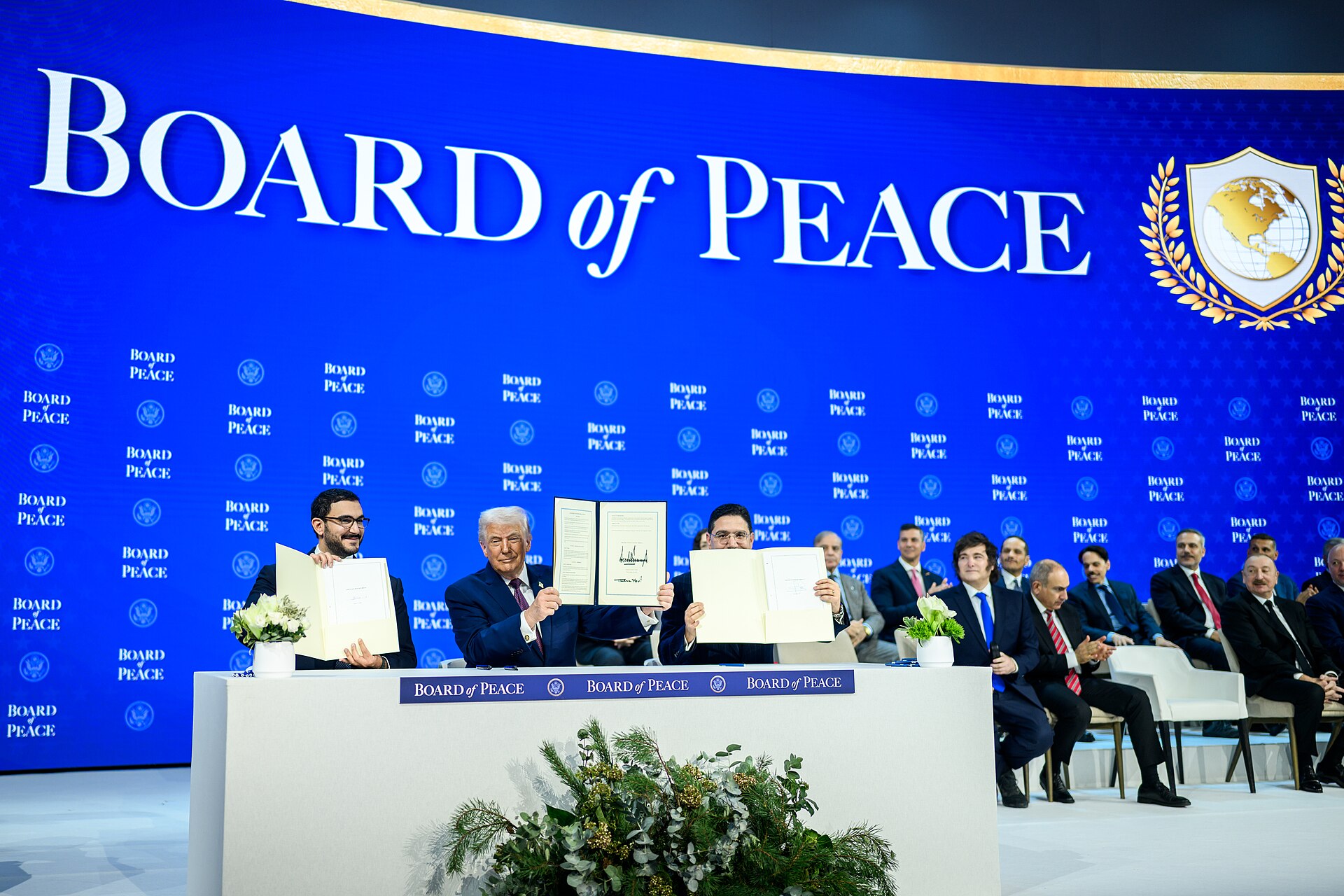
After months of negotiations, President Donald Trump and a coalition of the willing formally ratified a charter for the much-discussed Board of Peace on Thursday, alongside the World Economic Forum in Davos, Switzerland.
Following a UN Security Council vote in November 2025 that authorised an international peacekeeping force for Gaza, the charter lays the next diplomatic puzzle piece of Trump’s vision for a post-Hamas Gaza.
The Board of Peace blazes a new trail in international diplomacy with little precedent. For months, commentators have speculated about its nature, purpose, and prospects. Now that the board has adopted an official charter, that commentary can become more concrete. For the benefit of readers, here are five things to know about the Board of Peace.
1. Who are the participants?
“The Board of Peace consists of its Member States,” according to the Charter, and “Each Member State shall have one vote.”
Representatives from 20 countries participated in Thursday’s signing event as inaugural members, according to CNBC. Six of these nations were Muslim-majority nations in the Middle East: Jordan, Saudi Arabia, Qatar, Bahrain, the U.A.E., and Turkey.
Seven more nations were Muslim-majority nations located outside the Middle East: Azerbaijan, Pakistan, Kazakhstan, Uzbekistan, Indonesia, Morocco, and Kosovo. Armenia, a Christian-majority country trapped between Turkey and Azerbaijan, also joined. The other five nations, besides the U.S., represented the Americas (Argentina and Paraguay), southeastern Europe (Bulgaria and Hungary), and Asia (Mongolia).
This unusual list does not lend itself to any particular narrative. The Middle Eastern nations have a clear political interest in the fate of Gaza, although some (Turkey and Qatar) openly support Hamas. However, the Muslim-majority nations located outside the Middle East represent a compromise position; while they share religious sympathy for Gazan Muslims, they are more willing to work with Israel than Israel’s close neighbours. In particular, Israel identified Indonesia and Azerbaijan as two countries it trusted to manage Gaza’s security.
The role of other nations on the board is less clear. Some governments, like Argentina and Hungary, are ideological allies of the Trump administration. Others, such as Mongolia, have no obvious interest or influence that explains their participation.
Based on media reports, the Board of Peace will not be limited to nations that participated in Thursday’s charter ratification. Invitations to join the board were also sent to Israel, Russia, Belarus, China, and many European nations (although some European nations have declined to participate).
Thus, future additions could change — or at least fill out — the character of the board. In addition, member nations only serve a “three-year membership term” that is “subject to renewal by the Chairman,” unless they purchase a permanent seat for $1 billion.
The Board of Peace charter also established an executive board “selected by the Chairman” for two-year terms, “subject to removal by the Chairman and renewable at his discretion.” According to the charter, the Executive Board shall “consist of leaders of global stature” and “exercise powers necessary and appropriate to implement the Board of Peace’s mission.”
President Trump appointed seven members to the executive board: US Secretary of State Marco Rubio, US Special Envoy Steve Witkoff, Trump’s son-in-law Jared Kushner, Former UK Prime Minister Tony Blair, Apollo CEO Marc Rowan, World Bank President Ajay Banga, and Security Advisor Robert Gabriel.
These selections suggest that the meaning of the phrase “leaders of global stature” is open to the chairman’s discretion. Furthermore, the number of Trump aides on the executive board suggests that Trump designed it to act as he sees fit.
2. Who holds the power?
One of the most important issues in any organisational structure is which officers hold the most decision-making power. According to the Board of Peace charter, the most powerful figure is the chairman, and the “inaugural” chairman is Donald Trump.
As mentioned above, the chairman has broad power to determine the personnel on the executive board, who exercise the Board of Peace’s executive authority.
In addition, “The Chairman shall have exclusive authority to create, modify, or dissolve subsidiary entities as necessary or appropriate to fulfil the Board of Peace’s mission,” the charter states. The chairman also schedules Board of Peace meetings, sets the agenda of those meetings, “may issue invitations to relevant regional economic integration organisations to participate in the proceedings,” and “may also cast a vote in his capacity as Chairman in the event of a tie.” Trump may also cast a vote as the representative of the United States.
The charter requires the chairman to choose his own successor, ensuring that Trump’s policies will continue even if he steps aside. “What’s interesting is it doesn’t say that the chairman will necessarily always be the president of the United States,” observed David Resnick, vice president of research at the Foundation for Defense of Democracies, on Washington Watch. “He could nominate someone from another country. He could nominate an American. It doesn’t even necessarily have to be a world leader.”
However, this succession protocol will only become relevant at an unknown future date. “Replacement of the Chairman,” the charter stipulates, “may occur only following voluntary resignation or as a result of incapacity, as determined by a unanimous vote of the Executive Board,” the members of which are hand-selected by the chairmen. The charter does not provide a fixed term for the chairman, which means that “it does not run concurrent with his [Trump’s] term as president,” noted FRC President Tony Perkins. “He could remain as chairman” for as long as he wants after leaving the White House.
3. Where will it focus?
With regard to its mission, the charter for the Board of Peace significantly outgrew initial expectations. The concept was initially broached to provide a mechanism for third-party governance of Gaza that was disconnected from the unreliable (because anti-Semitic) organs of the United Nations. However, the charter codifies institutional separation between the Board of Peace and Gaza, suggesting that the Board envisions a greater or at least different role.
“You have two bodies which exist now under the Board of Peace,” Middle East Forum Executive Director Gregg Roman explained last week on “Washington Watch.” “One is the NCAG, or the National Committee for the Administration of Gaza, and the second is the Executive Board of the Board of Peace.” Led by “a former deputy Palestinian Authority planning minister,” the NCAG consists of Palestinian bureaucrats “responsible for water, energy, policing, traffic, building infrastructure… akin to a mayor’s cabinet.”
The NCAG appears to be one of the “subsidiary entities” created under the Board of Peace.
The executive board is “more responsible for overseeing the international fundraising for this and the administration of this on an international level,” he added.
Notably, the Board of Peace Charter makes no mention of Gaza. Instead, the charter identifies it as “an international organisation that seeks to promote stability, restore dependable and lawful governance, and secure enduring peace in areas affected or threatened by conflict.” The use of the plural, “areas”, conveys a mission that will last beyond Gaza to other “peace-building” ventures.
Thus, “its initial task is to deal with the situation in Gaza. But it appears that it may have a life after Gaza,” Perkins predicted. “That’s absolutely the case, if you listen to what the president’s aspirations are for it,” Adesnik agreed. “That’s also the reason there’s been a measure of backlash. Some European countries are concerned precisely that it’s an effort to sideline the United Nations.”
However, Adesnik advised against planning too far into the future. “Its first test is going to be one of its most difficult,” he warned. The Board of Peace is “born out of the situation in Gaza. … But what if it can’t bring peace to Gaza? Will it have a reputation that allows it to function elsewhere effectively? And right now, it’s not clear what the means are.” Currently, Hamas remains armed in Gaza, retains control over half the territory’s population, and refuses to agree to deals made without its involvement.
“It’s also not clear” how the Board of Peace would intervene in another warzone, Adesnik continued. “Would there need to be members who have some sort of jurisdiction if you’re dealing with some different war? What if the country involved or none of its neighbours are members of the Board of Peace? Would parties to the war be ready to listen? Or would it be a problem if all the neighbours are not in on the game?”
According to the charter, the Board of Peace could continue indefinitely, or it could dissolve itself after handling the Gazan crisis, or even before. The board “shall dissolve at such time as the Chairman considers necessary or appropriate, or at the end of every odd-numbered calendar year, unless renewed by the Chairman.” Once again, the chairman calls the shots.
Adesnik also assessed that the Board of Peace was unlikely to become a rival or replacement to the United Nations anytime soon. It does “possess international legal personality,” allowing it to “enter into contracts, acquire and dispose of immovable and movable property, institute legal proceedings, open bank accounts, receive and disburse private and public funds, and employ staff.”
However, “it is also wise to recall just how many institutions the U.N. has grown up over time that can do functional things like provide aid, regulate telecommunications,” he said. “Tens of billions of dollars are going each year to run it. It has the kind of prestige over time that usually gives it a seat at the table regardless of the crisis. So, it has assets that will be hard to replace with this new group.”
___
Republished with thanks to The Washington Stand. Image courtesy of Wikimedia Commons.
One Comment
Leave A Comment
Recent Articles:

8 October 2026
3.6 MINS
John Anderson warns that Australia’s decline is rooted in spiritual and cultural disintegration, calling for a recovery of Christian foundations, social cohesion and national purpose.

8 October 2026
1.6 MINS
A blackout at Australia’s $150 million Pre-COP climate summit in Fiji delivered an awkward lesson in energy reliability to delegates preaching the renewable transition.
8 October 2026
4.1 MINS
Italy honours St Francis of Assisi 800 years after his death, celebrating a saint whose devotion to Christ, radical simplicity and message of peace continue to shape generations.

7 October 2026
3.6 MINS
Victoria’s 18th March for the Babies will bring families together to peacefully affirm the value of every human life and call for a cultural change towards life.
7 October 2026
1.5 MINS
Across the Middle East, North Africa and Anatolia, Christianity once shaped entire civilisations. Could Britain’s Christian heritage likewise become a memory rather than a reality?

7 October 2026
6 MINS
What can Tucker Carlson’s interview with Jacob Rees-Mogg teach us about political disagreement? Their clash over war, Russia and national defence highlights the importance of listening carefully and understanding an opponent’s position before attempting to refute it.
7 October 2026
8.5 MINS
Gerald McDermott’s work challenges Christians to approach Israel through Scripture first, exploring God’s covenant faithfulness, Christian Zionism, Jewish identity and antisemitism.



The UN has shown it is a useless Body which sucks enormous money from its members, Australia included. The Gaza Board of Peace includes moderate Islamic countries who tend to quietly go about their business and which are against Terrorism and the Drug Trade . Instead, the main Muslim countries, supposedly US allies like Turkiye (in NATO ), the Saudi Kingdom, Qatar, UAE and Bahrain, have refused to allow the USA use of their US bases in their countries in the event of War between the USA and/or Israel versus Iran which funds Terrorism ( Hamas , Hezbollah , Houthis, ISIS ) , yells “Death to USA ” and has murdered some 60, 000 of its own people who want democracy to replace Theocracy. Leads me to wonder why the USA wastes monies on defending the regimes of these govts. against enemies which might try to overthrow them ? Apart from Turkiye, they are so fabulously rich , they can afford to pay for their own defence . The World is in an awful Mess in which Evil reigns. All I can do is pray for the freedom of the Iranian people , and, for God to bless the Moderate Muslim countries like Azerbaijan , Khazakstan, etc in which Christians , Jews, etc are allowed freedom of worship.