


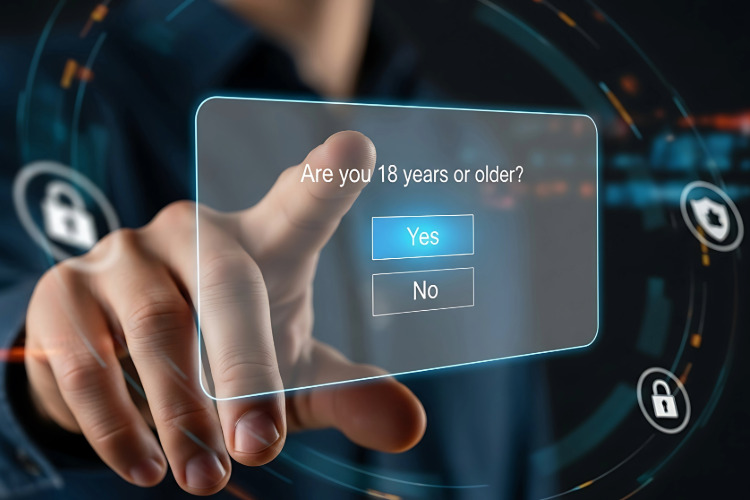
Online Identity and Age Verification – A Disaster Waiting to Happen
A sweeping wave of age verification laws threatens to turn personal devices into government-supervised access points — and the push is accelerating globally.
Various new laws are being implemented in the United States and some other nations that will require age verification, and thus the need for identity verification at the device/operating system level. These new laws have snuck up on us and will quickly become Big Brother on steroids.
These laws amount to a direct attack on personal freedoms wrapped in ill-conceived child protection frameworks. I am not saying child protection is not a worthy objective, but this is not the way to achieve a good result.
The US federal government have introduced a bill at the US national level that will, in fact, affect everyone who uses a computer, phone, or other device (potentially your smart fridge, ring doorbell, car GPS, etc.). Don’t expect the Australian Federal government to be far behind in expanding the scope of our laws.
This is a very fresh and fast-moving topic — US H.R. 8250 was only introduced on 13 April 2026, just a few days ago. Here’s a thorough breakdown of the bill and the personal freedom concerns it raises.
My career background is in Business and IT, with a particular focus on IT security. I have worked for government, defence, and various private sector companies, including a role as a Software Architect with IBM. I write this article with great concern from this professional background.
Refer: Please have a look at this video by The Lunduke Journal for some details of how US H.R. 8250 will work, and its huge problems.
What is H.R. 8250?
H.R. 8250, filed on 13 April 2026, is titled “To require operating system providers to verify the age of any user of an operating system, and for other purposes.” It was introduced by Rep. Josh Gottheimer (D-NJ) and Rep. Elise Stefanik (R-NY), and has been referred to the House Committee on Energy and Commerce.
Under the bill, if a user is under 18, a parent or legal guardian must verify the user’s date of birth. The bill also requires the development of a method allowing app developers to access age information for users of their applications. The Federal Trade Commission (FTC) would be responsible for enforcement, and regulations would take effect one year after enactment. How the FTC will do this is undefined; this is a major issue with the law.
At this stage, GovTrack estimates the bill has roughly a 3% chance of getting past committee and about a 1% chance of being enacted. However, it is part of a broader legislative trend worth taking seriously.

The Key Freedom & Privacy Concerns
1. Mass Surveillance Infrastructure at the Operating System Level
This is arguably the most significant concern. The bill requires every operating system provider to verify user ages and expose that data through APIs — and this isn’t limited to social media apps. It targets the core software running PCs, smartphones, and smart home devices.
Under these laws, apps and websites would query your OS for age bracket information, meaning your identity status would be broadcast passively to third-party developers across the ecosystem — not just to one gatekeeper.
2. Mandatory Identity Verification to Use a Computer
Historically, you could turn on a computer and use it without proving who you are to any authority. This bill ends that principle. Every adult user would be required to submit verified personal data simply to use an operating system — a device they own.
3. Threats to Anonymity and Free Expression
Anonymous use of computers has long been a cornerstone of free expression — for journalists, activists, abuse survivors, political dissidents, and anyone who simply values privacy. Commentators have noted that state actors would benefit greatly if computing without ID became a niche activity, with concerns that agencies could leverage this infrastructure beyond its stated purpose. This impacts sharing the Gospel or making a stand for Godly values online.
4. Impact on Open Source and Linux
The open-source community is wrestling with how to comply with such laws while not violating core privacy principles. Some open-source projects have simply opted to restrict access for users in states with such laws, with one project’s legal notice stating it “does not, cannot and will not implement age verification.” A federal law would make this kind of non-compliance legally untenable nationwide.
5. Chilling Effects on Information Access
Apps would default to the most restrictive settings when operating systems cannot provide age signals, meaning that any gap in verification — a new device, a fresh install, a privacy-focused OS — would result in adults being treated as potentially underage and having their access curtailed by default.
6. Data Security Risks
Centralising age and identity data at the OS level creates an enormously attractive target for hackers. Every major OS vendor — Apple, Microsoft, and Google — would need to modify their systems to collect and transmit this data, and a breach of any one of them could expose the identity records of hundreds of millions of people.
7. Cost and Fragmentation
If H.R. 8250 passes, device costs are expected to rise as manufacturers build compliance infrastructure, and operating systems might fragment between “verified” and “unverified” versions. Those unwilling or unable to verify (the elderly, the privacy-conscious, those without government ID) could find themselves with a degraded computing experience.
8. Questionable Effectiveness
This approach won’t protect children in practice, as tech-savvy teenagers already use virtual machines and false birthdates to bypass restrictions, while legitimate adult users bear the burden of privacy invasion and restricted access to information. This has been proven by the ineffectiveness of our Australian age verification laws. Almost every Aussie under 16 years old has circumvented this law.
The Broader Context
H.R. 8250 follows existing state-level initiatives. Colorado’s SB26-051 requires operating systems to collect age information at account setup, and California’s AB 1043 similarly mandates age-bracketing systems for operating systems and app stores beginning in 2027.
The Electronic Frontier Foundation and researchers have written open letters noting the many pitfalls of ill-thought-out verification methods, joining social media companies, privacy advocates, and the open source community in opposing such laws.
Bottom Line
While the stated goal — protecting children online — is genuinely worthy, albeit ill-conceived, the mechanism proposed is extraordinarily broad.
Requiring identity verification at the operating system level is qualitatively different from, say, age-gating a specific website. It redefines the relationship between citizens and their personal computing devices, turning them from private tools into government-supervised access points.
Whether the child safety benefits would justify these trade-offs is a serious and unresolved question, and one that deserves much more public debate than it has received so far.
Current Laws and Proposed Laws
Here is a comprehensive overview of countries that have enacted or are actively pursuing online age and identity verification laws, as of April 2026. To em this is a chilling situation worthy of prayer and action.
Laws Already in Force
Australia — Australia has arguably the strongest age verification laws in the world. In January 2026, it required social networks — including TikTok, YouTube, and Instagram — to ban users under 16 altogether or pay heavy fines. As of March 2026, the ban also applies to porn sites and the online aspects of explicit video games. Platforms face fines up to AUD 49.5 million for non-compliance.
Note: We know this law has been largely ineffective in that any under-16-year-old Aussie circumvents this law by very simple mechanisms, and anecdotally, the youth of our nation treat this law as a joke.
United Kingdom — The UK’s Online Safety Act was passed in 2023. Services like social media, websites, search engines, online forums, and dating services are now required to implement stricter age verification systems. Even if a service is located abroad, it must comply if it has a large number of UK users or if the UK is a target market. Users can no longer simply click a box to confirm they are over 18.
Germany — In Germany, the requirement for age verification for pornography and similar online content has been in place for years. Simple checkbox confirmations are not sufficient for such websites.
France — France passed a law in 2023 requiring age verification to restrict social media use by children under 15, though it was never enforced as it conflicted with broader EU guidelines. France is now trying again, planning to introduce social media age verification by September 2026.
Brazil — In September 2025, Brazil passed a law requiring social media companies to implement age verification and link accounts under 16 with their parents. It also requires parental consent to download apps for minors aged between 12 and 18, and bans loot boxes in video games. Non-compliant platforms can be fined up to 50 million BRL.
Indonesia — On 28 March 2026, Indonesia banned social media for children under 16, becoming the first country in Southeast Asia to enforce a social media ban. Platforms such as YouTube, TikTok, X, Facebook, Instagram, Threads, Roblox, and Bigo Live were among the first targeted.
United Arab Emirates — A new child digital safety law, effective January 2026, requires all platforms operating in the UAE to verify user age and apply parental controls for users under 13.
Argentina — Since 2024, online gambling operators in Argentina must verify users through biometric ID checks, including validation against the national ID database and face verification for every login.
United States (State Level) — No federal law yet mandates age verification across all digital services, but 25+ states have enacted laws requiring age verification for content deemed “harmful to minors,” especially adult content. Louisiana was first, in January 2023. Two more states saw social media age verification laws go into effect in 2026 — Virginia (January 1) and Nebraska (July 1).
Laws Passed but Not Yet Fully In Force
Spain — In February 2026, Spain announced plans to ban social media access for users under 16. Prime Minister Pedro Sánchez described the online environment as a “digital wild west” and committed to mandatory age verification systems. Spain is also developing a national digital identity tool to conduct these checks.
Malaysia — Malaysia originally planned to ban all users under 16 from social media on 1 January 2026, but pushed that date back while debating the best age verification methods. The ban is now slated for sometime in the second quarter of 2026.
Denmark — In November 2025, Denmark’s government announced an agreement to ban social media access for anyone under 15, one of the strongest steps taken by an EU government. Enforcement may rely on Denmark’s national electronic ID system.
Portugal — Portugal’s parliament approved a law banning under-16s from social media sites, though children above 13 may use them with verified parental consent.
Norway — Norway has been working on a ban on social media for under-15s since 2024. A public consultation in 2025 drew over 8,000 comments.
Canada — Canada’s Bill S-210 passed the Senate in 2023 and began committee review in the House of Commons in 2024. It would prohibit organisations from making sexually explicit material available to under-18s without age verification, and has been criticised for privacy implications and freedom of expression concerns. Canada also published a national age assurance standard, CAN/DGSI 127:2025, in August 2025.
United States (Federal) — H.R. 8250, filed April 13, 2026, targets operating system providers directly, requiring them to verify user ages at the OS level. It has been referred to the House Committee on Energy and Commerce.
Proposed / Under Consideration
European Union — In November 2025, the EU Parliament voted in favour of a non-legislative report proposing a minimum age of 16 for social media, with parental consent for those aged 13–15, and bans on infinite scrolling and auto-play for minors. The EU is also developing its Digital Identity Wallet, due in 2026, which the EFF has warned could enable mission creep beyond age verification into broader identity surveillance.
The Netherlands — The Dutch government wants under-15s banned from social media, and is also pushing for similar regulation at the EU level.
Austria — In March 2026, Austria’s Vice Chancellor said the country was considering a social media ban for users under 14, with a draft expected by end of June 2026.
Germany (social media) — German ruling parties CDU and SPD are in favour of banning minors from social media, but a decision has been postponed until mid-2026.
Poland — Poland wants to launch a tool by end of 2026 to prevent children from accessing social media platforms.
New Zealand — New Zealand is considering similar rules to Australia’s, though legislation has not yet passed.
UK (social media-specific) — Since early 2026, there has been heated discussion in the UK about putting social media apps behind age verification checks similar to Australia’s. The House of Lords has already voted in favour of such a ban.
The Big Picture
The global trend is unmistakable — and accelerating. What began as isolated laws targeting pornography sites has rapidly expanded to cover social media, app stores, and now even operating systems.
Age verification substantially increased in 2023–2024, with the passage of the UK’s Online Safety Act, laws in France, laws in eight US states, and proposals at the national level in the US, Canada, Denmark, and the EU. The pace has only increased since then.
Privacy advocates like the EFF (Electronic Frontier Foundation) warn that once the infrastructure for identity-linked age checks is in place, the potential for mission creep — expanding ID checks beyond age verification to other purposes — is a serious and underappreciated risk.
What Can We Do?
Here are some very simple suggestions:
- Pray! Always take these things to the Lord.
- Become better informed, do some research for yourself.
- Lobby politicians, write emails, etc.
- Debate online, socialise the issue to your friends, pastors and other leaders.
- Follow the EFF.
This is the beginning of a big fight for freedom.
1 Corinthians 9:18 ~ What is my reward then? That when I preach the Gospel, I may present the Gospel of Christ without charge, that I may not abuse my authority in the Gospel.
Matthew 9:36–38 ~ When he saw the crowds, he had compassion for them, because they were harassed and helpless, like sheep without a shepherd. Then he said to his disciples, “The harvest is plentiful, but the labourers are few; therefore pray earnestly to the Lord of the harvest to send out labourers into his harvest.”
___
Image courtesy of Adobe.
4 Comments
Leave A Comment
Recent Articles:

13 October 2026
2.6 MINS
Allegra Spender’s proposed bill reignites debate over discrimination protections, religious freedom and the right of faith-based schools to uphold their beliefs and values.

13 October 2026
3.9 MINS
Tasmania’s proposed conversion practices law raises serious concerns for churches, parents and faith-based schools, with broad definitions, severe penalties and uncertain protections for religious freedom.

13 October 2026
5.5 MINS
Stephen Baldwin’s journey from drug addiction to sobriety, Christian faith and family life reveals how surrender, daily discipline and renewed hope transformed his life.

13 October 2026
2.1 MINS
Victoria’s assisted dying deaths have surged by 300 per cent since legalisation, while a disturbing case involving a patient’s partner raises urgent questions about safeguards.

13 October 2026
1.8 MINS
Australia faces mounting geopolitical, economic and defence threats, but its political leaders lack the statesmanship, bold vision and decisive communication needed to prepare the nation.

13 October 2026
2.8 MINS
The church in Ephesus had so much going for it. Yet despite their hard work, perseverance, endurance, and discernment, there was something deeply wrong: they had left their first love.

12 October 2026
4.6 MINS
Learn how journalists use loaded language, selective quotes and misleading headlines to shape public opinion, using a controversial report about James and Joanna Howe as a case study.



Great article. Having said that i believe the internet needs more accountability. Has to be done wisely.
Thanks mate. Free expression, Open access, Privacy, Anonymity, Connection, and access to Knowledge are key values of why the Internet exists.
They are somewhat in competition with each other and draconian government controls.
If push comes to shove I always side with openness and freedom; because that means the Gospel can be preached freely.
That means I must allow some things I don’t want or like.
The best protection for Children is good parenting, not relying on governments or technology.
I don’t want to end up like China, North Korea, or Iran.
Sobering article – especially as the EFF (Electronic Frontier Foundation) agrees with you and warns that once the infrastructure for identity-linked age checks is in place, the potential for mission creep — expanding ID checks beyond age verification to other purposes — is a serious and underappreciated risk.
Thanks Kym for your herculean effort in compiling all this information.
Thanks Ian, I don’t think most people realise how draconian governments are becoming.