


Australia’s ‘No Religion’ Count May Be Inflated by a Third, Hiding 2.9 Million Christians in Upcoming Census: Analysis
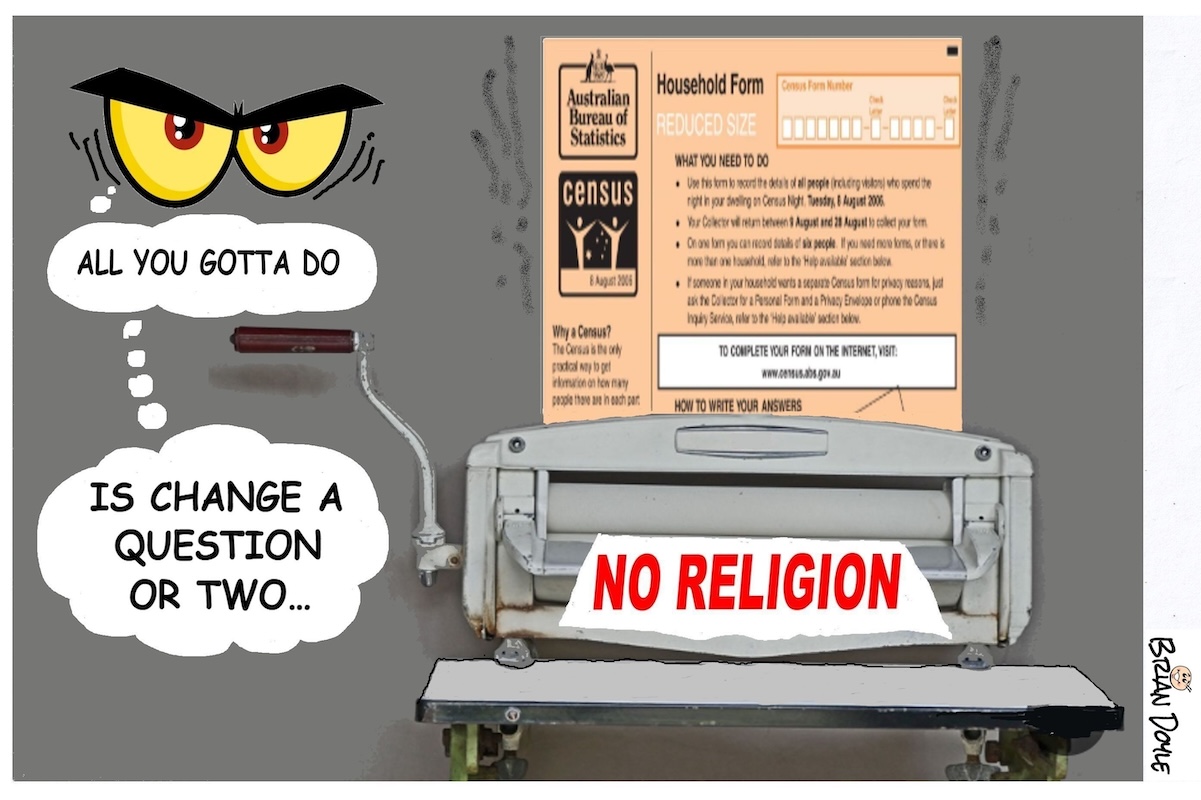
Christians without a listed denomination may be among millions miscounted as having “no religion” in the 2026 census, modelling from a Sydney analytics firm suggests.
Australia’s census may be overstating the number of non-religious Australians by a third, according to new research by a Sydney-based polling firm that puts the figure closer to 26 per cent than the 39 per cent recorded in 2021.
Speaking with the national broadcaster, the analyst behind the study said the wording of the religion question is to blame for the possible 13-point gap, in an interview that aired just days before Australians will fill out their 2026 Census forms.
Applying that gap to Australia’s current population suggests as many as 2.9 million Australians who tick “no religion” this Tuesday could be Christians who are miscounted due to the question’s wording, The Daily Declaration calculates.
“The result was shocking for me,” Dr Dorian von Freyhold told ABC Radio National’s Religion and Ethics Report on Wednesday. “As a guy who’s run thousands of experiments, this one stands out as one of the most remarkable.”
Von Freyhold, Managing Partner at analytics firm Compass Polling, ran the experiment on a sample of 5,012 Australians. He and his team randomly assigned each respondent one of four historical wordings the ABS has used for the religion question since Federation, in order to model what today’s “no religion” figure would be had the question never changed.
“The experiment was to see to what extent the question framing had distorted people’s responses,” he said.
The sample they used was representative of the Australian population on all key demographics — a methodology von Freyhold described as meeting “the gold standard of causal attribution research”.
His modelling put the percentage of non-religious Australians at 26 per cent — “a third lower than in the most recent census,” he explained, referring to the 39 per cent officially recorded in 2021.
Von Freyhold added that responses across the four groups ranged from 20 to 47 per cent citing no religion — before modelling narrowed that to the 26 per cent estimate.
“Our key takeaway would be that while secularisation is real, the speedometer is broken,” he told host Andrew West.
Von Freyhold, who regularly works with large Australian businesses and institutions, was not commissioned by any church or advocacy group. “This was professional curiosity,” he explained, noting that Compass Polling uses census data “for weighting purposes [and] for normalisation of our models.”
Crunching the Numbers
Applying von Freyhold’s findings, The Daily Declaration calculates that as many as 2.9 million Christians may be miscounted as having “no religion” this Tuesday.
Australia’s population stood at 27.8 million in the ABS’s most recent count in December 2025.
The 13-point gap identified by von Freyhold points to roughly 3.6 million Australians who would be counted as non-religious under the current question, but who would likely have named a religion under the open-text format used before 1971.
Of that group, roughly 81 per cent could reasonably be expected to identify as Christian, based on the ratio of Christians to all religiously affiliated Australians in the 2021 Census — yielding the 2.9 million estimate.
The Daily Declaration’s calculation holds the 13-point gap constant and does not account for any further genuine decline in religious affiliation since 2021 — meaning the number of Christians missed in the 2026 census could exceed the 2.9 million estimate.
How the Question Has Changed
Von Freyhold pointed to the number of times the ABS has revised the religion question as central to the problem. “The peculiarity here is that we’ve changed our question a lot of times,” he said.
“Due to the quadruple changes of the question, it’s difficult to look at that as a continuous time series,” he said. “Every time you change the question, people’s answers may be changing, which is something the ABS acknowledges.”
Until 1971, the question was a simple open text box that asked “What is the person’s religion?”
In 1971, the ABS added a prompt for non-religious Australians: “If no religion, enter none.”
By 1991, the question had become a checkbox list, with “no religion” placed last.
In 2016, the ABS moved “no religion” to the top — a redesign the ABS said it implemented following complaints of bias against secular Australians. An ABS spokesperson told The Daily Declaration the change followed “many submissions” warning the earlier format produced “potential underestimates of the number of people who stated they had ‘No Religion.'”
The ABS reviewed its religion question ahead of the 2026 Census but ultimately retained the same wording and format used in 2021. The decision followed consultation showing “strong benefits for comparability of religious affiliation data” with previous censuses, and that testing a new question within the 2026 timeframe was not feasible, an ABS spokesperson told The Daily Declaration.
Von Freyhold noted that the order in which options appear on a form is well documented in survey research to skew responses.
With the current wording of the ABS’s religion question, he said, “you run straight into what’s called the primacy effect” — the tendency for whatever option appears first to receive “a disproportionate share of people’s eyeballs and attention”.
He said this effect had never been measured for the census religion question specifically. “Nobody had quantified to what extent it influences the response, which is exactly my domain,” he said.
When The Daily Declaration asked the ABS whether the current placement of “no religion” might itself introduce a bias, the ABS did not directly address the question, saying only that the ordering “adhere[s] to the ABS Forms Design Standards.”
Von Freyhold said his finding wasn’t a challenge to the trend of secularisation itself — with the share of Australians recording “no religion” climbing steadily from around one per cent in 1911 — but that the instrument measuring the shift was faulty.
“It’s not that the trend isn’t real,” he said. “It’s how you frame the question and then how people answer it. Framing, as a guy with a background in consumer psychology, I can tell you, can have massive implications.”
Von Freyhold pointed to a comparable pattern overseas. In the Czech Republic, the share of the population recording no religious belief fell from 59 per cent in 2001 to 34.5 per cent in 2011, according to Czech Statistical Office data.
That shift coincided with the Czech census religion question becoming voluntary for the first time — a change academics have linked to a surge in non-response rather than a religious revival.
A Gap With Real Consequences
Host Andrew West raised one possible source of the gap during the interview, wondering aloud whether there are “people of no fixed Christian denomination who tick ‘no religion’” for want of a better option.
Von Freyhold agreed the distinction between religion and religiosity deserved closer study but said it sat outside his experiment’s scope.
The ABS told The Daily Declaration it was “not in a position to comment on another individual or organisation’s research” when asked about von Freyhold’s findings.
Census night falls on Tuesday 11 August.
Von Freyhold said the goal of his research was not to settle the religious debate but to sharpen the measurement behind it.
“The ripple-on effect of the census results is considerable,” he said, adding that it “serves the purpose of best informing the media, best informing commentators, who in part shape the public narrative that flows through to politicians who set policy agendas”.
“It’s very important for both sides of the debate to have true numbers that aren’t distorted by small measurement effects like this,” he said.
___
This article was updated on 10 August 2026 to include responses from the Australian Bureau of Statistics.
10 Comments
Leave A Comment
Recent Articles:
21 September 2026
4.4 MINS
Forgiveness is a choice, not a feeling. That was the message Danny Abdullah brought to London's ARC conference, sharing how he and his wife chose to forgive the man who killed three of their children.
21 September 2026
4.4 MINS
On September 11, the Archbishop of Canterbury gave an interfaith award to a man who called Osama bin Laden the "Sword of God" and blames Jews and Christians for the war on Iran. The award was rescinded after public backlash.
21 September 2026
8.5 MINS
After a 20-week scan revealed possible heart abnormalities and genetic concerns, medical staff twice offered to abort a Christian couple's baby. Six weeks of fervent prayer later, the heart defect was gone — and their son is nearly ready to be born.
21 September 2026
2.4 MINS
It is truly concerning that this sort of incursion into free speech can even be suggested. Labor's Digital Duty of Care Bill is about controlling the narrative online, and must be defeated.
21 September 2026
3.2 MINS
Something special happens when men step out of the everyday and focus on being fully present. Dads4Kids recent Men’s Summit and the upcoming Courageous Online Fathering Course create space for presence.
18 September 2026
4.4 MINS
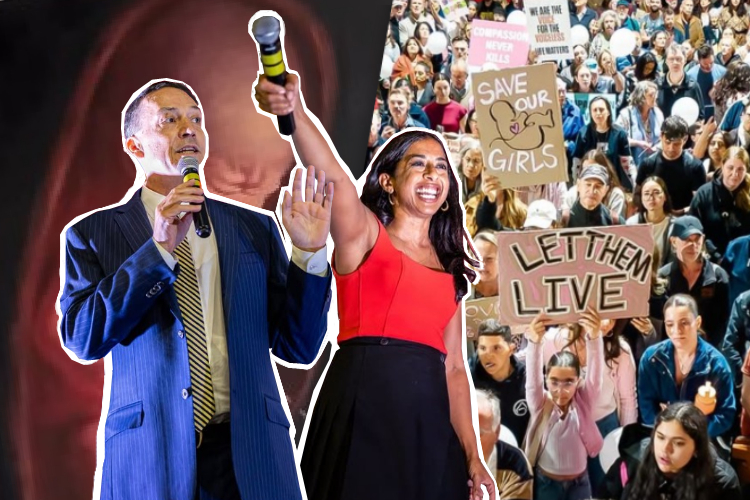
Up to 10,000 rallied in Sydney for a ban on sex-selective abortion. Twenty-four hours later, the NSW Legislative Council defeated John Ruddick's bill 21–16. The fight, says Dr Joanna Howe, is just beginning.
18 September 2026
3.5 MINS
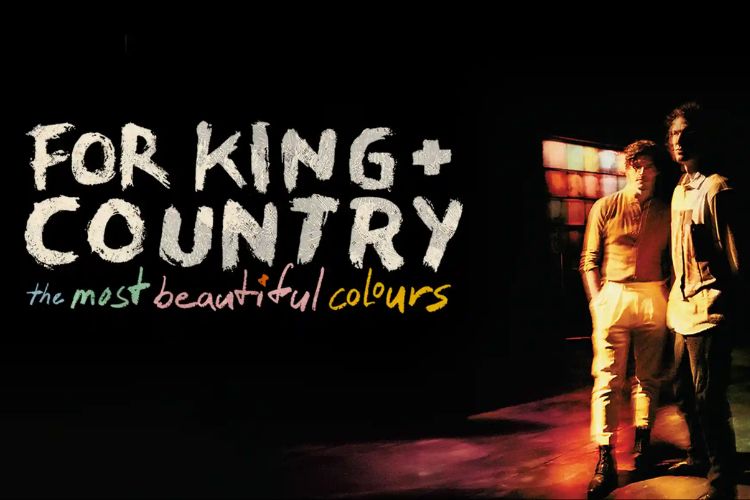
Brothers Luke and Joel Smallbone have become one of the world's most loved Christian pop acts. As For King & Country, they have won four Grammys, 15 GMA Dove Awards and billions of song streams. And today they releasing their latest album.



Census designed to reduce allocation of monies to church schools, charities, hospitals, etc, so, please , advise every one you know to identify their religious affiliation whether Lutheran, Catholic , etc. I am very perturbed that my name and address (and everybody’s ) will be held until sometime in 2029, as in early 2025 I received a Death Threat to behead me . It is common knowledge that NONE of our details are private, and are hacked and available for purchase on the Dark Web, etc. After the recent disclosure of $20 billion Fraud committed , by including ATO Staff, who can have faith in our Public Servants and our govt.? Australia is Corrupt.
Thank you for your timely word on the censor and how to answer I was able to choose other and specify I am Christian. At present I have moved out of being Anglican and simply be a devoted follower of Jesus Christ without the rules and regulations
WOW.!!! What we all suspected and what we knew deep down has been proven by scientific statistical analysis by an independent researcher!!!! This census makers the beginning of a campaign for truth with the Australian Census bureau. We reject the Census Bureau lies and antichristian bias in Jesus Name!!!!
Couldn’t agree more Warwick!
Thanks for makign this issue clear Kurt. There is a growing awareness that the census is skewed but we must pray many more hear of the bias in the questions on the census time as Aug 16 is the cut off date for sending it in. May God protect the data information comng in and not allow it to be altered (since its not a paper edition -this means its not secure) and may God protect it from sinister hands.
Thank you Kurt!!! Many have been trying to bring this deception to the attention of the Bureau for years, yet despite letter after letter they have consistently refused to include Christianity on the census form, deliberately ignoring the fact that Christianity is the largest religion in the world. I believe the truth will show that at least 70% of Australians would still hold Christianity as their preferred religion if Christianity was an option on the census. Praise God that the blatant misinformation about the so-called demise of Christianity is finally beginning to be addressed. I stand also with Warwick, let’s reverse the curse.
I personally believe that if we only fill out the “other” boxes as Christian, they will go into the”other” amalgam and not be counted as “Christian”. It seems to me it better to fill out a denomination and also write Christian underneath. A few letter to the ABS may also help. They have, after all, invited feedback.
Thanks For this article ABS is not neutral, never has been. May we all be aware
Some great comments here!!!!!!
The form should be set up so that ticking “Other” requires that something be written in the box .