


Aussie Nuclear Innovation Rejected Here Finds a Home in the US
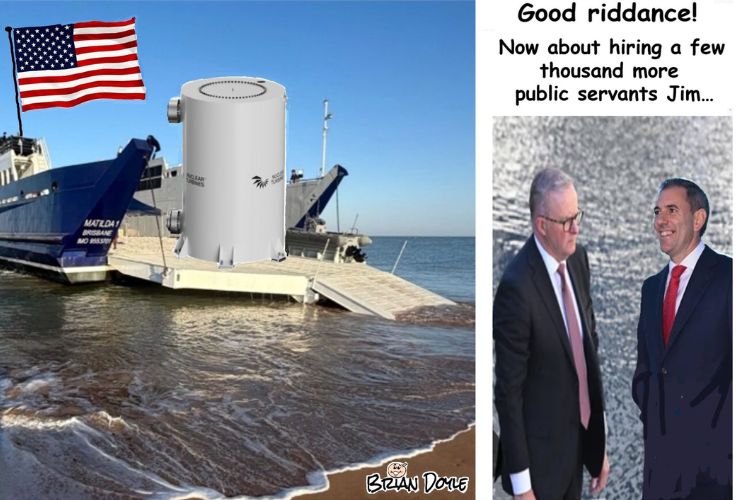
A new source of safe nuclear power, called the Unity Nuclear Battery, has been developed in record time at the ANSTO Lucas Heights nuclear facility in Sydney, together with Queensland engineers. In 150 days, they devised a nuclear-powered generator small enough to be carried on the back of a utility truck. But due to the aversion of federal and state governments to nuclear power plants, the technology has been sold offshore.
The Unity Nuclear Battery uses a one-megawatt microreactor that can run for five years without needing to be refuelled. It uses standard and already available materials and industrial processes, and can be readily scaled up for use in a range of applications, which the company claims will be at a competitive cost.
Crucially, it does not require huge amounts of water for cooling, implying it is safe. It requires very little land – unlike other technologies that produce an equivalent amount of power – and can be buried underground.
Rebuild Industry
The technology has been bought by US company Deployable Energy. The Australian engineer who managed the project, Bobby Gallagher, was one of three founders or chief executives standing behind US President Donald Trump at a White House event in July celebrating advanced nuclear reactor startups, part of the Administration’s aim to quadruple US nuclear capacity by 2050.
Authorisations by the Idaho National Laboratory, the US Department of Energy’s lead facility for nuclear energy research and development, have begun and are expected to be completed next year. Approval of a commercial licence by the US Nuclear Regulatory Commission is anticipated in 2028, with manufacturing to begin shortly after. The company claims it has already generated more than $US100 billion ($A142 billion) worth in commercial interest.
The likely success of the Unity Nuclear Battery starkly underlines the economic and commercial cost of Australia’s federal and state bans on the construction and operation of nuclear power plants, including small modular reactors (SMRs). As the law stands, a nuclear project cannot be submitted for environmental or safety approval.
It is another blow to Australian manufacturing, the shrinking of which is well-documented. As a proportion of the economy, it has, since 1990, contracted by almost two-thirds to only 5 per cent of GDP, and there is no sign of a change of orientation in the bureaucracy or political circles.
A federal inquiry is being proposed to assess how well the Australian economy is prepared for the impacts of war, reflecting “a growing concern among senior ministers about the risk of conflict breaking out in the region.” This is the first inquiry to come near to considering making Australia industrially self-sufficient, especially in maintaining supply chains, for national-security purposes. Rebuilding strategic industries to keep the nation functioning in wartime to a high level of resilience will take a long time.
A Pattern of Missed Opportunity
The Unity Nuclear Battery failure was the consequence of another misstep: a refusal by Australian Defence bureaucrats and the Royal Australian Navy to back an innovative Australian approach to a revolutionary new landing craft.
Instead, the decision was made to spend $4 billion using Dutch designs. Yet the Australian version was lower cost and better configured.
Embarrassingly, US Marines are leasing the Australian-designed craft, called the Stern Landing Vessel (SLV) to tour the Pacific Islands. They will demonstrate how it can help in the management of cyclones and storms.
The SLV features an ocean-crossing tri-hull that prevents a suction effect that traps standard flat-bottomed models in mud and sand. It has a 4,000-nautical-mile range and can travel through rough deep water instead of having to stay close to the coast.
It can land, unload, and reverse back out to sea in under 60 seconds. The propulsion and steering gear are also configured to stay safe from shallow shore debris and rocks.
The Unity Nuclear Battery project came into being because the designers of the landing craft realised that it required a small, nuclear-driven generator rather than a diesel motor for optimal operation.
The indifference shown by those holding the purse strings towards Australian inventiveness has a long and disgraceful history. The Australian car industry was closed down in 2017, ending nearly 70 years of large-scale domestic vehicle production, despite Australian engineers at Ford and Holden having earned global renown for their designs.
Yet evidence of Australian world-leading innovation continues to accumulate – and sometimes it breaks through. The Australian-made Ghost Bat, an autonomous, stealth, uncrewed combat aerial vehicle developed by Boeing Australia for the Royal Australian Air Force, is moving to become fully operational after the Federal Government invested $1.4 billion.
___
Republished with thanks to News Weekly. Image credit: Brian Doyle.
2 Comments
Leave A Comment
Recent Articles:

12 October 2026
4.6 MINS
Learn how journalists use loaded language, selective quotes and misleading headlines to shape public opinion, using a controversial report about James and Joanna Howe as a case study.
12 October 2026
3.1 MINS
The proposed livestream of Nidal Hasan’s execution has reignited debate over justice, deterrence and public accountability, with critics comparing American justice to ISIS propaganda.

12 October 2026
3.7 MINS
An EU court case over baptismal records could pit data protection laws against religious freedom, raising serious questions about whether governments can compel churches to erase sacramental history.

12 October 2026
3.3 MINS
In the week leading up to Christ’s crucifixion, Jesus' soul was troubled. He responded with a bold prayer, and his example challenges us to that same boldness.

11 October 2026
2.6 MINS
Jesus offers us intimate friendship, which produces great joy as we walk closely with him.

10 October 2026
4.1 MINS
When Jesus rebuked the Laodicean church, this was not a sign of his lack of love, but proof of it and how greatly he longs to reward and bless us. He is knocking — will we answer?

9 October 2026
5 MINS
During a recent dialogue between high profile legal experts, a top Australian constitutional law expert was asked if Australia should have a Bill of Rights. His answer may surprise you.



Lord have mercy
The labor/teals/greens marxists agenda in full play