


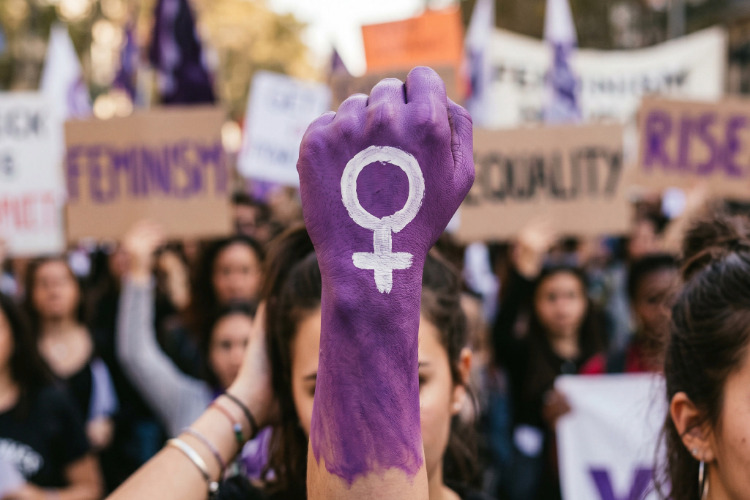
The Feminist Revolt Against Givenness
How feminism taught the West to distrust sexual difference, moralise female-coded virtues, and forget that both men and women are fallen.
When Gloria Steinem died on 2 September 2026 at age ninety-two, many eulogies were predictably kind. Steinem had been one of America’s most visible feminist icons for over fifty years. She co-founded Ms. magazine. She helped found the National Women’s Political Caucus. She was many things to many millions of people.
She was the recognisable face of a cultural revolution that liberated women from ways society had previously, and unnecessarily, restricted them. But if we are to honour her legacy, we must also grapple with not only what feminism liberated women from, but what kind of anthropology it installed in its place.
Women were oppressed; we do not need to spiritualise or glorify every cultural construct that existed before second-wave feminism. Turning away a qualified woman from a job or education on the basis of her sex just because she is a woman is “tradition” that must be rejected, not preserved.
But there is a difference between tearing down oppression and erecting an ideology that then interprets virtually every instance of sexual differentiation, hierarchy, unequal outcomes, authority, and yes, even inevitable human frailty primarily through a paradigm of power.
I think the latter development is feminism’s unfortunate long-term legacy. If feminism helped us see that women deserved equal dignity and equal opportunity, it also asked Western culture to mistrust things that should be a given rather than chosen: sex itself, embodied difference, inherited roles and responsibilities, authority, limitation, and eventually even the legitimacy of any unequal outcome that wasn’t obviously the result of oppression. What started as resistance to certain structures became a rejection of takenness itself.
Christianity is incompatible with the latter development for reasons I cannot go into here, but there’s a theological issue hidden in this rebellion that Christians should be paying more attention to. Feminism grew extremely adept at noticing every way that male-coded instincts could turn toxic in a fallen world, yet Christianity has no corresponding doctrine of female moral purity.
To be fair, feminism offered no full-blooded doctrine of sin applicable to female instincts, either. Maleness became associated with aggression, competition, hierarchy, authority, emotional repression, and status-seeking.
Femaleness became associated with empathy, care, relationality, inclusion, and emotional expressiveness. To the feminist mind, the former list filled you with suspicion, while the second list endowed you with moral credibility. Christianity starts with neither assumption.
When Protest Became Pedagogy
The truly revolutionary event was when feminism went from protesting to the university. SDSU credits itself with offering the first Women’s Studies program in America in 1970, launched directly from campus women’s liberation activism.
Dedicated faculty lines were added within years, and programs proliferated throughout higher education almost exponentially. Feminism had established something far stronger than a platform to protest from: it had inserted mechanisms into society for reproducing itself.
The great feminist institutional achievement was consequently astonishingly simple: protest was transformed into pedagogy.
But it also installed a hermeneutic of suspicion, under which difference itself came to be tried in the court of politics and made to justify its existence.
When Difference Became Suspicious
This is when equality started to morph in meaning. Equal dignity before God and equal treatment under law does not necessitate identical choices between men and women in personality, occupation, or life-patterns.
However, once differences became suspect, inequality demanded explanation by institutions. Difference became disparity, disparity became proof of structural inequality, and inequality justified intervention meant to bring equity.
Jordan Peterson is secondary to the research surrounding these topics. Psychologists Rong Su, James Rounds, and Patrick Armstrong conducted a major meta-analysis including 503,188 participants and found a moderately-large average difference in vocational interests on the people-thing dimension: men had higher average interest in things and women showed higher average interest in people.
The distributions of course overlap, and statistics like these say nothing deterministic about the gifts or calling of any particular man or woman. They do cast doubt on the idea that every occupational difference is and can only be the residue of past discrimination.
Disparity, however, should be where investigations begin, rather than where they end.
The Revolt Against Givenness
Ideologically, beneath all these political debates swirls a much more basic disagreement over what it means to be a human being. Christianity starts with creation. We do not begin life choosing; we begin by having been given things we did not choose.
We did not choose to have bodies, or parents, or biological sex, or mortality, or dependence or relationships or insertion into generations that precede us. Biblical freedom, therefore, has never entailed our self-creation ex nihilo. Biblical freedom means learning to live faithfully within a reality we did not choose, and could not ultimately make, but which we receive from God.
Radical autonomy has a harder time with that last point. If freedom is above all self-definition, then whatever we find ourselves did not choose begins to sound like an imposition. Much of feminism rightly critiqued restrictions that were socially imposed; feminism’s radical impetus also encouraged Western culture to erase the distinction between unjust social constraint and natural human limitation. Remove that line, and liberation starts to seem as if it has no logical conclusion.
Look at the distinction. When a woman is told she cannot be a physician because she is female, she faces a restriction created by other humans, and thus, humans can remedy the problem. When a woman finds she cannot become a biological father, she faces the reality of male and female. Politics can’t change that reality without changing the meaning of words. A healthy culture maintains the ability to recognise the difference between discrimination and creation.
Yet ideas create new possibilities, possibilities future thinkers can expand upon.
From Second-Wave Feminism to Identity Politics
Kimberlé Crenshaw’s formulation of intersectionality took on particular salience in this transition. Crenshaw made the case that traditional frameworks tended to overlook individuals who existed at the intersections of multiple marginalised groups, like women of colour who faced both racial and gender oppression. In turn, intersectionality offered a lens through which to view how multiple identities converge in contexts of social hierarchy.
Though intersectionality was developed specifically through legal studies and analysis of race, rather than as an overarching framework of feminist theory, it quickly became a major influence in feminist theory itself and later in diversity practices in institutions.
This transition continued and grew even stronger in what is known as fourth-wave feminism, starting in the 2010s. Facilitated by the rise of social media, feminist activism took on a scope and pace that would have been unthinkable to previous generations. As a result, the personal testimonies of individuals were able to be transformed into social action with unprecedented speed.
Fourth-wave feminism also coincided with queer theory and transgender rights movements gaining considerable momentum. Building off the prior feminist separation of sex and gender, gender identity started to be understood by many activists and even institutions as separate from, or even superior to, sex assigned at birth.
However, many of these ideas can find their origin in earlier feminist movements. Concepts like the sex-gender distinction, questioning of social roles, power analysis of social differences, and privilege of the marginal as political perspectives were developed by second-wave feminists and then expanded upon by later feminists in more radical ways. The result has been a continual moving away from feminism as purely about equality of opportunity, and towards a focus on identity and social restructuring.
Feminism’s Asymmetrical Doctrine of Sin
But for Christians, I think feminism’s biggest blind spot has actually been theological. For me, feminism’s most troubling misunderstanding centres on human moral nature. Much of feminist critique rightly condemned corrupted expressions of masculinity: physical aggression can be toxic as violence, authority can become domination, competition can become cutthroat ambition, and male sexuality can become objectification. Christianity doesn’t ask us to reject any of those things. Men are sinful, and masculine virtues are dangerous when left unchecked by virtue.
Where feminism went wrong was in its relative unwillingness to scrutinise traits we often associate with femininity. Feminism reoriented us toward empathy, care, emotional intelligence, relationality, cooperation, and conflict-avoidance in ways that were desperately needed.
Too often, though, these traits were not merely offered as correctives to sinful institutions, but were implicitly celebrated as moral, while masculinity-coded traits were blamed for social sin. Feminine virtues weren’t the problem? They’re the solution. This is not Christian anthropology.
Christianity doesn’t teach female moral purity any more than it teaches male moral superiority. Women and men are both image bearers, and equally corrupted by sin. The Fall affected men and women equally.
There is no Biblical basis for thinking that aggression is cursed in men but blessed in women, or that hierarchy and authority are shameful while empathy and cooperation are holy. Every human strength can be leveraged toward sin or toward love, whether we culturally label them masculine or feminine.
Aggression, rightly ordered, isn’t just brutality. It can also be courage. Or protecting your neighbour. Or standing up to evil. Authority rightly exercised isn’t simply tyranny; it’s what allows churches, schools, families, and countries to care for those in their charge.
But what about our feminine virtues? Empathy is beautiful when it produces compassion. Too often, our empathic capacities can lead us to privilege those immediately around us, at the expense of what’s objectively right. Peace is good until dealing with conflict becomes cowardice because you value “convos” over truth. Conflict, rightly managed, can produce growth.
To me, one of feminism’s most pernicious side effects has been the feminisation of institutional morality. To be clear, the issue isn’t women in positions of leadership. Women aren’t an ideology, and many of feminism’s harshest critics are women.
But we do have a problem when institutions prize only empathy and listening, when they become impatient with authority and discipline, when they treat competition and “edge” as inherently toxic. Healthy societies embody both masculine and feminine strengths, each ordered toward virtue.
Gad Saad and Suicidal Empathy
Gad Saad has recently given us helpful language for one aspect of this challenge. In a 2026 article for Theory and Society, Saad diagnoses how certain disciplines within the social sciences have conflated truth-seeking with social-justice activism and what he terms “suicidal empathy.” Saad juxtaposes truth-seeking against an “epistemology of care”, where worry over the social/emotional fallout from certain conclusions ends up limiting our ability to pursue them.
Whether or not you agree with Saad’s wider polemic, his contrast here is worthy of our serious consideration.
Weakness masquerading as love. Fallen human beings can misuse compassion just as surely as they can misuse authority.
“We ought to be compassionate towards __________.” can quietly become, “Who will feel harmed if this reality is stated?” “___________ is a boundary that shouldn’t exist.” can become, “Who feels oppressed by this?” Soon enough, disagreement gets relabelled as offence taken, and affirmation appears as the only loving thing to do.
I like to refer to this as compassion without anthropology. It cares about suffering, but hasn’t adequately addressed what human flourishing looks like, if all desires ought to be affirmed, or if certain painful limits might actually correspond to reality. Removed from an accurate understanding of what a human person is, compassion inevitably degrades into sentimentalism.
When Ideas Change Institutions: Social Consequences of Feminism
Ideas become institutions. Institutions become societies. Feminism didn’t invent every feature of contemporary woke politics, but it did develop some key categories through which politics is increasingly organised: identity, oppression, lived experience, representation, social construction, autonomy, liberation from givenness.
From there, they could be borrowed by adjacent disciplines and deployed to racial, sexual and gender differences, colonial encounters, religious experience, and pretty much any other sort of hierarchical relation you care to mention. The results combine into what we loosely think of as woke ideology. Obviously, politics does not equal feminism, but feminism was where part of its thinking was developed.
Abortion also makes sense in my argument. Feminism asks you to question your assumptions about who has power and who doesn’t; whose experience has been marginalised; whether disparities can be traced back to structural inequalities; whether our inherited conceptual vocabulary masks ways of dominating other people; and so on.
Intersectionality then trained us to think about placing individuals in the context of overlapping identities and matrices of advantage and disadvantage. Together, the ideas furnished us with an intellectual infrastructure where justice came to mean not just judging individuals fairly, but understanding and disrupting the structures we think produce unequal identities and experiences.
Intersectionality thus encourages you to think of individuals less as self-defining moral agents, and more as bundles of socially constructed identities shaped by larger historical forces.
The result is what we now call woke identity politics. When those categories then leave campus and enter broader society, they begin to reshape how we understand politics, public policy, crime, human rights, interpersonal relations, economics, and so forth.
One consequence is what we now call intersectionality. Intersectionality taught us to understand individuals as multiply situated within overlapping systems of oppression and privilege, making the self increasingly dependent upon group identities and socially constructed systems. Notice how easily justice can move from fairness to system-reconstruction when you begin to analyse individuals this way.
Read all of that last paragraph again, slowly. It’ll help you understand the larger pattern.
Feminism placed immense moral weight on the category of autonomy. As applied to women’s liberation, autonomy began with reproductive freedom: women would never be equal to men until they could decide whether, when, and with whom to have children. Unlike automobiles and financial independence, you can’t simply choose not to be pregnant.
Pregnancy and motherhood are also central to the inequality women experience, imposing constraints and responsibilities upon them that most men cannot readily share. Feminism, therefore, had to confront a deep philosophical dilemma: do women remain (in some meaningful sense) autonomous if pregnancy imposes significant obligations that they did not choose?
Abortion places the feminist commitment to autonomy in tension with the givenness of the female body.
A final point about transgender activism. I’m not arguing that transgender ideology was created by second-wave feminists in a lab. But once feminists separated sex from gender in order to show that women’s social roles were not dictated by biological sex, it became possible for later theorists to disconnect gender identity from biological sex altogether to bring about what they see as gender justice.
Many feminists object to this development, as they should. But there is an historical irony here: feminist theory intentionally created an intellectual space where the social category of women could eventually be detached from female bodies.
As applied to transgender rights and identity, feminism politically empowered a group of people who feel oppressed by being born into the wrong biological sex. Racism works similarly: white people are born into a privileged racial identity, whereas non-whites are not.
Transgender activism is also connected, and here’s how: modern feminism invented “woke ideology”. Again, it didn’t do it by itself.
Transgender rights and gender theory cannot be understood apart from feminism.
To borrow an example of the concept from the scholars quoted in Jenkin’s book: if racism means that white people are born into privilege whereas black people are not, why isn’t Jewishness similarly disconnected from chosen belief? If Jewish people suddenly discover their Jewishness through geopolitical events rather than religious practice or conscious choice, why doesn’t that make Judaism essentially the same as white skin?
This essay is getting a little long, but antisemitism is the fourth development I want to discuss.
The fourth ramification is also the most unexpected: feminism and antisemitism. Feminism didn’t give rise to antisemitism, of course. Antisemitism predates the modern women’s movement by millennia, and only sexist Jews could credibly make the argument that “most feminists” hate Jews. Nonetheless, feminist academic Kara Jesella explains in her 2026 book Feminist Antisemitism: An Intellectual History how anti-Jewish and anti-Zionist sentiments became embedded in some feminist ideologies.
She demonstrates how Jewish people and Israel could come to be seen as “privileged” in feminist and adjacent discourses. Jesella traces these trends from Second Wave Feminism to Womanism to Intersectionality to Queer Theory to current Identity Politics, documenting how evolving understandings of race, Whiteness, colonialism, and power created ideological space to place Jewish people and Israel on the oppressor side of an oppressor/oppressed dichotomy.
Why does this matter? Jews present a problem for any ideology that organises individuals’ moral authority according to their social power. Jews have been targets of persecution, expulsion, pogroms, and genocide for centuries. Today, Jewish people in Western countries are also disproportionately wealthy, highly educated, and often considered “white”.
Israel further upends this paradigm, because Jewish people can now claim both a unique history of vulnerability while also exercising significant political and military force through a Jewish-majority state. Jesella’s work elucidates how strands of modern feminism came to see Jewish privilege instead of Jewish vulnerability as the defining characteristic of Jewish identity.
The ramifications of this ideological development became apparent shortly after October 7th, 2023. Jesella dedicates a large portion of her book to explaining how certain sectors of the feminist community reacted to accusations of sexual violence against Israeli women with indifference instead of the solidarity feminists had previously demanded on behalf of other women.
Jesella isn’t arguing that individual feminists are hypocrites. Instead, she illustrates how the feminist community at large had already categorised Israelis and Zionists as “colonial”, “wealthy”, or “privileged” to such an extent that Jewish suffering didn’t fit into its moral framework.
A social justice movement that popularised the notion that society should believe women when they speak up about sexual violence suddenly faced a moral dilemma when Jewish Israeli women began speaking up about their abuse.
According to Jesella’s research, portions of the feminist community struggled with these claims not because their supporters were anti-Semitic, but because their ideology had previously dictated that Jewish women would be relatively unlikely to experience sexual violence at the hands of Palestinian soldiers.
Here we return to the critique of feminism I’ve developed across multiple platforms. When identity comes to define where individuals “fall” inside ideological understandings of privilege and oppression, data about human suffering becomes secondary to an ideology’s preexisting moral categorisation of the victim.
The oppressed must appear weak, while powerful people can have their pain excused, explained away, or recontextualised as something else. Kara Jesella’s scholarship demonstrates what can happen when any ideological movement lets its analysis of power trump its commitment to moral equivalency.
What Happened in Evangelical Institutions
It also helps us understand what happened on Christian campuses. Throughout the 1980s and 1990s, evangelical seminaries and colleges began asking questions about women’s representation on their faculties, women’s recruitment and institutional barriers to their recruitment, women and leadership, women and language, and women’s experience.
Again, the issue is not women on campus. The interesting question is whether, gradually, Christian institutions began learning to think about themselves through categories with intellectual assumptions that had often been developed elsewhere.
At Asbury Theological Seminary, for instance, committees “recommended that the Seminary attempt to recruit female students and identify female faculty prospects” by 1980. Further student newsletters address “women in ministry,” Women’s Studies, “women’s concerns,” and inclusive language.
None of these marks a line in the sand, and some grew directly out of sincere concerns about whether women were being treated equitably. Taken together, however, they mark a shift: gender became a category through which Christian institutions were encouraged to think about their language, authority structures, and demographics.
Kristin Kobes Du Mez is a recent and especially instructive example of this phenomenon at work. The Calvin University historian, who recently published the massively successful Jesus and John Wayne: How White Evangelicals Corrupted a Faith and Fractured a Nation, trained in women’s history and religious history, and researches gender at the intersections of religion and politics. Accordingly, she reads large swaths of recent white evangelical history through the lenses of constructions of masculinity, power, authority, politics, patriarchy, and abuse.
Du Mez’s argument is subtler than evangelical men did X, Y, and Z badly. She argues that evangelicalism helped construct and reinforce a particularly violent and militant style of masculinity, which it then rewarded. One can agree or disagree with Du Mez’s book in whole or in part. My point here is that even if one grants almost all of her specific conclusions, her work represents the extent to which questions of gender and power are accepted interpretation lenses for understanding evangelical Christianity from inside evangelical higher education.
The problem was thus never female faculty on evangelical campuses. The problem is that some Christian colleges and universities have been socialised to understand themselves through feminist-informed categories such as representation, marginalisation, “lived experience”, inclusion, gender, and structural oppression/power.
Such categories are useful for identifying real issues (Du Mez is certainly correct that leaders can abuse their authority and that Christian communities should evaluate how they react to abusive leaders). But they are not neutral categories.
When gender and power become primary lenses through which one interprets all reality, hierarchy starts to look suspicious, demographics start to look like they require ideological explanations, and traditional forms of masculine leadership are painted in solely or primarily negative terms.
Many Christian institutions are vulnerable to this sort of critique because Christianity already has a strong tradition of speaking about taking care of the vulnerable. We speak about caring for the poor, the orphan, the widow, the oppressed, those who’ve been abused, and strangers. But even as we care about these categories of people, the Bible never treats power as inherently suspect or virtue as the sole province of the oppressed.
Egypt can oppress Israel and weeping move the Lord, but Israel can still sin mightily against God when freed from Egyptian oppression. Hagar can be mistreated and then insist her son become a mighty ruler over his brother. Both are eventually under God’s judgment, not because power is bad but because both powerful and powerless alike must submit to the moral law God gives.
Recovering a Christian Anthropology
Our response to feminism cannot be a longing for the 1950s. We shouldn’t pretend every past gender norm was wise, every man who held authority was virtuous, or every woman who bucked convention was rebellious. As Christians, we should oppose real discrimination wherever it is found. What we need to recover is the ability to tell the difference from injustice, and limitations from oppression.
Christian anthropology starts with the profound yet uncomplicated statement: “In the beginning God created.” The world is prior to the self, and creation had meaning before our preferences met it. Our bodies matter. Biological sex matters. Male and female, motherhood and fatherhood matter.
Limits do not necessarily equal oppression, and the roles assigned to us by our Creator are not automatically injustices from which we need to be liberated. Men and women can have equal dignity without having to be interchangeable.
Christianity can also provide a more robust and honest account of moral formation than feminism’s skewed version. Corrupt masculinity is not healed through the feminisation of men, and corrupted femininity is not corrected by making women more like men. Both are sanctified. Strength and empathy, courage and tenderness, judgment and compassion, authority and service, boundaries and mercy all need to be disciplined by truth and ordered to love.
Ultimately, our deepest objection to feminism is quite simple: Human freedom doesn’t depend on us being the authors of our own existence. Civilisation forgets these truths at its peril. Eventually, it will trade genuine freedom for the delusion of escaping reality altogether.
Feminism sold us on the dream of being liberated from unjust restraints, and some of those restraints did need to fall. The problem is feminism’s more extreme iterations could no longer tell an unjust restraint from the meaningful boundaries of our humanity.
When we lose sight of that distinction, liberation will never be able to say it has done its work, for there will always be something about us left unchosen. We were not made to be our own gods, masters of creatures we once were. May we learn to be faithful creatures once again.
___
Sources
Crenshaw, Kimberlé W. “Demarginalizing the Intersection of Race and Sex: A Black Feminist Critique of Antidiscrimination Doctrine, Feminist Theory and Antiracist Politics.” University of Chicago Legal Forum 1989: 139–167.
Danielson, Robert A. “A Brief History of Women at Asbury Theological Seminary.” The Asbury Theological Journal 81, no. 1 (2026): 118–159.
Du Mez, Kristin Kobes. Jesus and John Wayne: How White Evangelicals Corrupted a Faith and Fractured a Nation. New York: Liveright, 2020.
Jesella, Kara. Feminist Antisemitism: An Intellectual History. 1st ed. Routledge, 2026.
Munro, Ealasaid. “Feminism: A Fourth Wave?” Political Insight 4, no. 2 (2013): 22–25.
Oakley, Ann. Sex, Gender and Society. London: Maurice Temple Smith, 1972.
Saad, Gad. “The Revival of the Social Sciences—Inoculation against Parasitic Ideas and Suicidal Empathy, and the Quest for Consilience via the Evolutionary Lens.” Theory and Society 55 (2026): Article 26.
Su, Rong, James Rounds, and Patrick Ian Armstrong. “Men and Things, Women and People: A Meta-Analysis of Sex Differences in Interests.” Psychological Bulletin 135, no. 6 (2009): 859–884.
San Diego State University, Department of Women’s, Gender, and Sexuality Studies. “About Us.” Accessed September 5, 2026.
Calvin University. “Kristin Kobes Du Mez.” Accessed September 5, 2026.
Reaney, Patricia. “Feminist Activist Gloria Steinem Dies at Age 92.” Reuters, September 3, 2026.
___
Image courtesy of Adobe.
Recent Articles:
29 September 2026
15.9 MINS
Western Christians must carefully consider Palestinian Christian claims about Israel, the legacy of dhimmitude, and how fear and persecution may shape today’s political narratives.
29 September 2026
3 MINS
New research suggests more Britons, especially younger men, are attending church—but growing numbers need solid biblical teaching to understand the faith they are exploring.

29 September 2026
4 MINS
The Murray-Darling Basin faces mounting food, water and environmental pressures, prompting calls to replace flawed policies with practical engineering and strategic planning.

28 September 2026
6.1 MINS
Australia’s proposed Digital Duty of Care bill promises greater online safety, but its sweeping surveillance, speech and regulatory powers raise serious questions about liberty.
28 September 2026
4.3 MINS
The NSW Government has rejected proposed hate speech law expansions, following pressure from the ACL and others defending free speech and religious liberty.
28 September 2026
2.2 MINS
A Royal Commission into the Bondi terror attack must confront every plausible source of antisemitism, while Christian leaders should not retreat from difficult questions.
25 September 2026
6.7 MINS
Monica Smit celebrates the abolition of Victoria’s Group Voting Ticket system while setting her sights on mandatory voting, sparking a fresh debate over electoral reform.


