


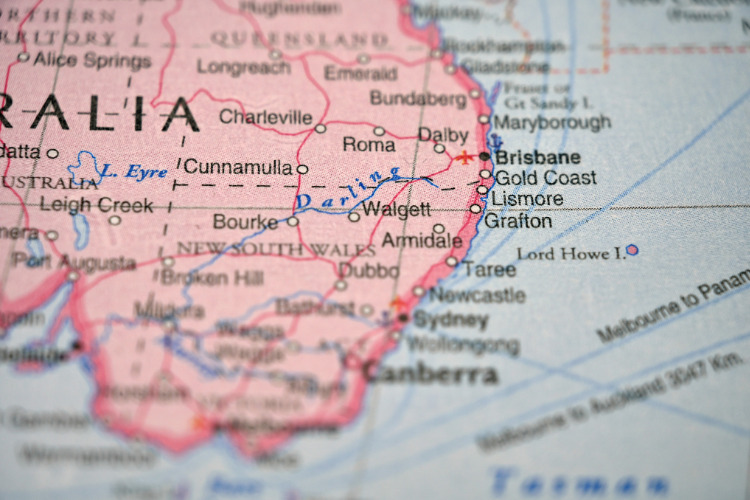
2026 Basin Review Relies On Dumped Warming Scenarios
To justify huge water buybacks, and to suggest more buybacks may be needed, the Murray-Darling Basin Authority (MDBA) continues using a worst-case scenario model which 49 IPCC scientists say has “become implausible”.
The 2026 MDBA review of the Basin Plan is primarily focused on anticipated impacts of climate change on the environment of the Basin.
A recent MDBA Discussion Paper issued for the Basin Plan Review Consultation summarised three modelling stories. The Discussion Paper relied on the MDBA’s 2025 Sustainable Yields Report, which considers three climate-change “storylines”, showing the Basin getting:
- Warmer and slightly wetter around 2030, becoming hotter and slightly wetter around 2050.
- Warmer and drier around 2030, becoming hotter and drier around 2050.
- Warmer and much drier around 2030, becoming hotter and much drier around 2050.
These “storylines” are based on different IPCC climate simulations that make varying assumptions about future increases in carbon-dioxide levels and global temperature changes, and how these will impact the Basin.
The MDBA rated the first option, “warmer and slightly wetter”, as highly unlikely, giving it only a 10 per cent chance of happening. In contrast, the MDBA says the third option, “warmer and much drier” had a 90 per cent chance of occurring.
In adopting the third “warmer and much drier” conclusion, the 2025 Sustainable Yields Report used what is known technically as the IPPC’s SSP5-8.5 simulation. It proposed the most extreme future carbon-dioxide-induced temperature increase.
The Report used this IPCC simulation not only to justify the huge water buybacks that are crippling irrigation agriculture in the Basin, but went further to suggest that after current targets are met, as a last resort, more buybacks may be necessary.
Problems
There are two extraordinary problems with the MDBA’s conclusions.
First, in April, almost 50 climate scientists responsible for laying out the range of possible future scenarios for the IPCC scrapped the SSP5-8.5 worst-case climate scenario.
In essence, they argued that efforts to tackle climate change have made a tangible difference, thereby averting the worst climate future once thought possible.
Their research was published by the European Geoscience Union. The scientists said that, at the low end, many scenario trajectories “have become inconsistent with observed trends during the 2020-2030”; at the high end, anticipated high emissions levels “have become implausible, based on trends in the costs of renewables, the emergence of climate policy and recent emission trends”.
There is also a feedback mechanism moderating global warming. A 2020 NASA review of research carried out on their satellite surveys showed that the earth is greening. Entitled, “Global Green-Up Slows Warming”, it pointed to “an interesting consequence of this global green-up: as vegetation consumes some of the heat-trapping carbon dioxide it also performs evapotranspiration – a function similar to sweating – which can have a cooling effect on the air.
“Scientists say that global greening since the early 1980s may have reduced global warming by as much as 0.2 to 0.25 degrees Celsius.”
The rejection of the SSP5-8.5 simulation by the scientists who shape the IPCC climate projections means that the MDBA’s dire climate projections for the Basin are based on IPCC modelling that its scientists have discarded as being “no longer plausible”.
Second, the persistent claim that the MDB will become hotter and drier does not accord with the historical facts. The Bureau of Meteorology has average temperature and rainfall data for the MDB on its website beginning in 1910 and 1900 respectively. Over the period to 2025, the maximum temperature has increased at a rate of 1.2 degrees Celsius per century, and the rainfall has increased at a rate of 28.7 millimetres, or 6 per cent, over a century.
This increased rainfall has an “evaporative cooling” effect that mitigates any rising Basin temperatures, as was pointed out in a 1966 research paper by Bill Priestly, a former chief of the CSIRO Division of Meteorological Physics. His paper, “The limitation of temperature in hot climates by evapotranspiration”, published in the International Journal of Agrometeorology, showed that essentially, the wetter the surface, the more evapotranspiration, and the less that the surface temperature could rise.
Questions:
Why is the MDBA basing its justification for water buybacks on the very IPCC modelling that IPCC scientists have rejected as no longer being plausible?
Why has the MDBA chosen to ignore historical rainfall data showing that, as the Basin warms, it has also been getting wetter?
Where is the planning for new dams to harvest water for both the environment and for food production to feed Australia’s growing population?
___
Republished with thanks to News Weekly. Image courtesy of Adobe.
Recent Articles:
8 October 2026
3.6 MINS
John Anderson warns that Australia’s decline is rooted in spiritual and cultural disintegration, calling for a recovery of Christian foundations, social cohesion and national purpose.

8 October 2026
1.6 MINS
A blackout at Australia’s $150 million Pre-COP climate summit in Fiji delivered an awkward lesson in energy reliability to delegates preaching the renewable transition.

8 October 2026
4.1 MINS
Aboriginal communities in Central Australia already know the gospel message. What they need now, Robyn Murray writes, is discipleship, encouragement and Christians willing to pray and participate.

8 October 2026
4 MINS
Christ’s authority and concern is not limited to the four walls of the church. They extend to the life of the nation, and we are called to take up our part in seeking its righteousness.

7 October 2026
3.6 MINS
Victoria’s 18th March for the Babies will bring families together to peacefully affirm the value of every human life and call for a cultural change towards life.

7 October 2026
6 MINS
What can Tucker Carlson’s interview with Jacob Rees-Mogg teach us about political disagreement? Their clash over war, Russia and national defence highlights the importance of listening carefully and understanding an opponent’s position before attempting to refute it.

7 October 2026
8.5 MINS
Gerald McDermott’s work challenges Christians to approach Israel through Scripture first, exploring God’s covenant faithfulness, Christian Zionism, Jewish identity and antisemitism.


