


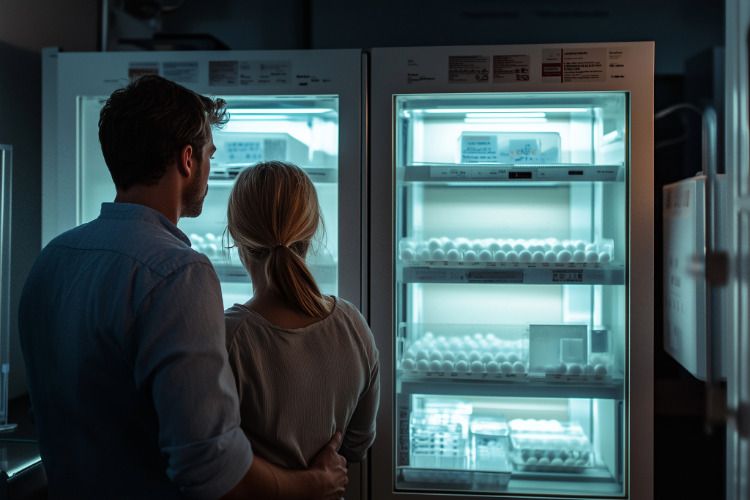
What Should We Do with Millions of Frozen Embryos?
It used to be science fiction, but now it’s science fact. An embryo created more than 30 years ago in an IVF clinic has been born. At 11,148 days (just over 30 years and six months), this is a world record.
The healthy baby boy, Thaddeus Daniel, is nearly as old as his parents, Lindsey and Tim Pierce, aged 35 and 34 respectively. He entered the world already having a 30-year-old twin sister and a 10-year-old nephew.
Everyone involved in this story has a Christian background, beginning with Lindsey and Tim, an Ohio couple who had been struggling to have children for several years.
The genetic mother of Thaddeus is a 62-year-old woman named Linda Archerd, who had undergone IVF treatment in 1994. This resulted in a daughter and three frozen embryos. She was hoping to have another child, but divorce put paid to that. Years later, she discovered the possibility of embryo adoption. As a pro-life Christian, she was interested. It was a better outcome than discarding the embryos or donating them for research.
She contacted Snowflakes, a program run by an agency called Nightlight Christian Adoptions. Her preferred parents for the embryos were a married, white, Christian couple residing in the United States. “I didn’t want them to go out of the country,” Archerd told MIT Technology Review, the magazine which broke the story. “And being Christian is very important to me, because I am.”
A Chance at Life
The clinic which took charge of transferring the embryos was Rejoice Fertility, an IVF clinic in Knoxville, Tennessee. Its head, Dr John Gordon, is a Christian who strives to minimise the number of frozen embryos. That’s not a bad idea, because a million or more are in storage in US clinics.
“Every embryo deserves a chance at life,” he says. “The only embryo that cannot result in a healthy baby is the embryo not given the opportunity to be transferred into a patient.”
Of Archerd’s three embryos, two failed to grow. The third became Thaddeus Daniel. “He is so chill,” said Lindsey. “We are in awe that we have this precious baby!”
This seems like a good news story all around.
But is it? Aren’t there any moral complications?
Professor Margaret Somerville, a bioethicist at the University of Notre Dame Australia, told The Catholic Weekly in an email that there certainly are.
“It’s estimated there are nine million frozen embryos ‘left over’ from IVF. It sounds like leftovers from dinner,” she wrote.
“I have a friend who is a leading IVF physician in New York who is ethically sensitive, and I confronted him with the view it was unethical to create these embryos. I argued the number should be limited to what could reasonably be assumed would have a chance at life by transfer to a uterus. He explained that high numbers were required to get the best results (a baby!) from IVF.”
Suspended
The existence worldwide of possibly 10 million embryos in canisters of frozen nitrogen is an ethical disaster.
Pope John Paul II said in 1996 that “there seems to be no morally licit solution regarding the human destiny of the thousands and thousands of ‘frozen’ embryos which are and remain the subjects of essential rights and should therefore be protected by law as human persons.”
The US$140 billion global IVF industry has a financial interest in storing embryos, Somerville pointed out. Globally, egg freezing and embryo banking constitute a sliver of IVF revenue–but it is a $6 billion sliver.
“All options involve ethical problems, but we can’t undo the fact that the embryos exist, and that’s the fact we have to deal with,” says Somerville.
“I believe the research option is the most unethical, and I’ve argued that the natural death one, while unethical, is probably the preferable one ethically. However, I’m far from sure whether giving the embryo a chance at more life (it’s already alive) is not the most ethical. As in adoption, the embryo is a child needing a home, not an adult wanting a child as the progenitors are in IVF.”
In any case, the number of adopting parents will always be negligible compared to the millions of ice-bound children. Adoption cannot solve this insoluble conundrum.
___
Republished with thanks to The Catholic Weekly. Image courtesy of Adobe.
One Comment
Leave A Comment
Recent Articles:
12 October 2026
4.6 MINS
Learn how journalists use loaded language, selective quotes and misleading headlines to shape public opinion, using a controversial report about James and Joanna Howe as a case study.

12 October 2026
3.1 MINS
The proposed livestream of Nidal Hasan’s execution has reignited debate over justice, deterrence and public accountability, with critics comparing American justice to ISIS propaganda.
12 October 2026
3.7 MINS
An EU court case over baptismal records could pit data protection laws against religious freedom, raising serious questions about whether governments can compel churches to erase sacramental history.

12 October 2026
3.2 MINS
Your support has helped us change the world for the better, as Dads4Kids has poured our heart, soul and finance into the global promotion and celebration of International Men’s Day.

9 October 2026
1.8 MINS
Pen Power Australia has been busy confronting antisemitism and double standards, lodging letters, pursuing accountability and celebrating several important wins along the way.

9 October 2026
3.3 MINS
New South Wales healthcare workers who object to abortion and voluntary assisted dying face growing pressure, raising serious questions about conscience rights, employment and moral injury.

8 October 2026
3.6 MINS
John Anderson warns that Australia’s decline is rooted in spiritual and cultural disintegration, calling for a recovery of Christian foundations, social cohesion and national purpose.



A 10 million ethical disaster.