


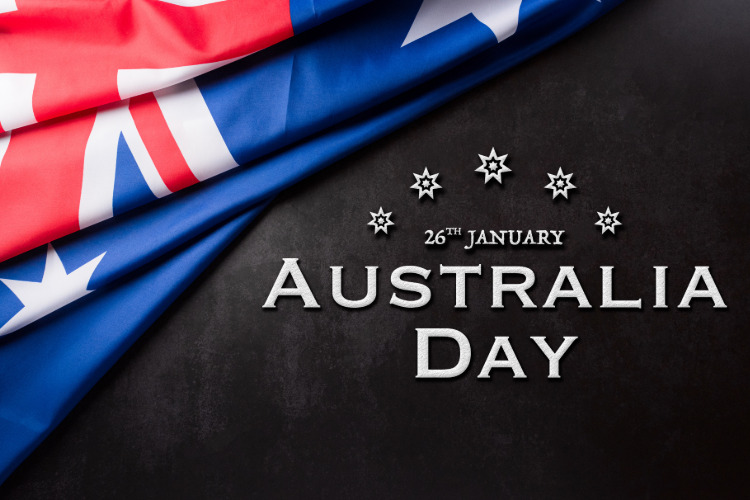
Australia Day or Invasion Day?
Australia Day reflects Christian heritage, Western law, and hard-won freedoms, not national shame—offering a moment for gratitude, unity, and honest reflection instead of ideological division and historical distortion.
The radical left has never been a fan of Western civilisation. It seeks at every turn to deride, attack, criticise and undermine the values and achievements of the West. So it comes as no surprise that each year, when Australia Day is celebrated, all the usual suspects of the ever-offended left come out to pick a fight.
Calling this “invasion day” and the like, and seeking to change the date of the day, may make these folks feel good, but there is little substance to their claims. The First Fleet that arrived at Sydney Cove in present-day New South Wales was not an invasion fleet. But in so much of the mainstream media, all you will hear is the angry, disaffected and raucous voices of those who refuse to celebrate the day.
The Western Roots of Australian Freedom
Since it is now getting hard to hear an alternative viewpoint to that of the leftist historical revisionists, it is worth citing a few here. Kevin Donnelly wrote a great piece:
The arrival of the First Fleet is one of the most important events in Australian history as it represents the first step in our development as a liberal, Western democracy based on English common law and a Westminster Parliamentary system.
The rights and freedoms we now take for granted, including freedom of assembly and speech, the right to a fair and timely trial, and the right to vote and elect a representative government, trace their origins to events that occurred on January 26, 1788.
As argued by the Perth legal academic, Augusto Zimmerman, “When the penal colony of New South Wales was established in 1788, the laws of England were transplanted into Australia” and “As a result, the legal sociopolitical institutions of Australia found their primary roots in the legal and sociopolitical traditions of England”…
The arrival of the First Fleet, in addition to bequeathing the nation with an English legal and political system also heralded the arrival of Christianity. According to the 2011 census Christianity, at approximately 61 per cent, is the largest religion and around Australia parliaments begin with the Lord’s Prayer.
While we are a secular society, where the constitution forbids favouring one religion over another, it is also true that without Christian hospitals, schools and charitable organisations Australian’s education, health and welfare sectors would collapse.
Christian concepts like the dignity of the person, the right to individual liberty and a commitment to social justice and the common good also underpin our legal and political systems and way of life.
He concludes:
While geographically a part of Asia, our heritage and traditions can only be understood in the context of western civilisation.
Australia is an egalitarian society where respect has to be earned instead of being granted by birth. Australians also distrust bludgers and those who believe it’s OK to rort the system or that the world owes them a living.
Given the chance and freed from government restraint, Australians are also entrepreneurial and risk-takers. Australians, on the whole, are independently minded and happy to give newcomers the benefit of the doubt unless they are hostile to our way of life.
Instead of denigrating Australia Day, we should all recognise that it’s only because of the First Fleet that we are such a peaceful, prosperous and stable country — that’s why so many migrants want to live here.
Voices Calling For Unity Instead of Division
Sara Hudson reminded us that we can either let this day unite us or divide us:
While people are free to do what they like on Australia Day, focusing on past injustices and portraying Aboriginal people as victims does little to empower Aboriginal people.
Contrast the ‘us’ and ‘them’ mentality that organisations such as Warriors of Aboriginal Resistance and First Nations Liberation embody with the words of Bess Price’s daughter, Jacinta Price — who wrote, in a recent Facebook post that has gone viral:
“Instead of teaching our kids to feel pain and resentment… and painting white people as oppressors and racists and black people as victims…let’s teach them love, strength and acceptance.”
As the daughter of an Aboriginal mother and a white father, Jacinta is acutely aware she would not exist if it weren’t for Australia’s history. Instead of emphasising people’s differences, she advocates focusing on what Australians have in common.
“Ultimately we are all human beings and our physical differences should not set us apart.”
John Slater wrote this:
Recasting Australia Day as ‘invasion day’ promotes the idea that spending a day celebrating what it is to be Australian is inherently hostile to Indigenous people. Quite apart from raising awareness about Indigenous disadvantage, this actually politicises the issue. It signals that to be patriotic is to be unfeeling, even defiant of the wrongs committed against Australia’s first people.
Is this kind of thing likely to create political momentum that sees governments doing more to alleviate Indigenous disadvantage? It might, if the invasion day rent-a-crowd actually named any manner of tangible policy objective save for decolonising the entire continent. But let’s not pretend heaping scorn on Australia’s settlers does anything at all to address Indigenous life expectancy, unemployment or educational achievement.
In fact, the Indigenous people afflicted most by these problems won’t be seen anywhere near a protest rally on Australia day. They’ll be out in remote communities, hundreds of kilometres away from the hessian sack-wearing beatniks you’re likely to see shrieking into a megaphone on the 6 o’clock news.
Truth be told, if you’re goal is to divide Australia into victims and oppressors, this is probably a fairly effective way to go about it.
We can navel gaze all we like about how much moral blameworthiness to apportion to the forbears of the Australian colonies for the death and disruption inflicted upon traditional Indigenous life in 1788. But for the motley crew of poseurs whose sole contribution to the plight Indigenous disadvantage is just that, it’s time to stop pretending you’re engaging in some noble act of civil disobedience.
Unless you genuinely want Indigenous Australia to secede and form its own nation – in other words, instate a 21st century Australian apartheid – you aren’t helping reconciliation by choosing January 26th to pontificate about the original sin of Australia’s colonisation; you’re actually hindering it.
This critique cuts to the heart of the issue: symbolic outrage is no substitute for practical help.
He concluded as follows:
Are there parts of our history that are challenging and regrettable? Absolutely. Yet if you look across the globe, it’s striking to note how few countries and civilizations haven’t been blighted by conquest at some point in history. Even Great Britain, the greatest colonial power the world has ever seen, endured a period of bloody occupation by the Romans early in its history.
Most countries take at least one day a year to celebrate their nationhood, often with far more fuss and officialdom than we do to mark ours. Yet far fewer seem to feel a growing need to spend that day sulking in cultural self-flagellation.
Those who pretend that celebrating Australia Day counts is tantamount to re-committing the sins of our forebears like to think they are doing Indigenous Australia a service. But if in the future Australia Day does become a day mired by division, the race-baiters will only have themselves to thank.
Inevitable History and Providential Outcomes
Even if we are to think in terms of “invasion”, we need to have some historical and political context here. Leo Maglen nicely offers us this in his article, “Why Australia Day Matters”. Let me quote parts of it here:
It is, of course an article of faith amongst Aboriginal activists and the grievance industry generally to see things in a different, much darker, more doom-laden way, to view the running up of the Union Jack by Phillip on that day as the beginning of the end, the start of an invasion, one that would lead to the subjugation of the first inhabitants and the destruction of their culture and way of life.
What this view overlooks, of course, is that such an ‘invasion’, or even a succession of them, was inevitable. On no other continent have the original inhabitants been successful in holding on to their lands and traditional ways of life. Through waves of invasion, conquest, migration, settlement, by people ever more technologically and organisationally advanced, similarly nomadic hunter-gatherers either adapted, or were forced into ever more remote, inaccessible and inhospitable terrain, as in Asia, Africa and the Americas, or driven to extinction, as in Europe and the Middle-East. What is remarkable in the case of Australia is that it hadn’t happened earlier, and that the first inhabitants were able to enjoy their idyll for as long as they did.
So if it hadn’t been the British, it would have been someone else, or a bunch of others, contesting the terrain, carving it up, claiming it as their own. Given the location of ‘the Great South Land’, there was, however, only a shortlist of likely contenders, with the requisite technological and organisational capacity, the global reach and the territorial ambitions, to accomplish the feat, either on a full-scale or piecemeal basis…
So, all in all, the country could have done worse than have Arthur Phillip plant the Union Jack on its soil 226 years ago. Although they didn’t appreciate it at the time, Phillip probably gave the first inhabitants as good a chance of surviving in, and adapting to, the global world as any ‘invader’ could have given them, and the waves of immigrants that subsequently came, and are still coming, to these shores, a much freer, safer, fairer, equitable, open, tolerant and prosperous place in which to start a new life than might otherwise have been the case.
January 26 1788 is well worth commemorating, and celebrating, as Australia’s Day.
I fully agree. Happy Australia Day.
___
Republished with thanks to CultureWatch. Image courtesy of Adobe.
7 Comments
Leave A Comment
Recent Articles:

14 October 2026
6.7 MINS
A national poll challenges claims that pro-life Australians are extremists, revealing broad support for abortion restrictions, protections for unborn babies and safeguards for vulnerable women.

14 October 2026
2.8 MINS
Queensland recorded 1,082 assisted suicide and euthanasia deaths in 2025–26, as the review board called for consultation on potentially widening eligibility criteria.
14 October 2026
5.5 MINS
As Christianity fades from public life, Marxism or Communism offers a substitute faith built on oppression, liberation and political salvation — but at what cost?

14 October 2026
5.3 MINS
Marco Rubio’s Athens speech celebrates the Greek, Roman and Christian foundations of Western civilisation, warning that cultural self-loathing and radical ideologies threaten its future.
14 October 2026
2.8 MINS
Australia needs a courageous Church that never separates courage from Christian love — the courage of Peter and John, who, when ordered to cease speaking about Jesus, responded: “We can't stop.”
13 October 2026
2.6 MINS
Allegra Spender’s proposed bill reignites debate over discrimination protections, religious freedom and the right of faith-based schools to uphold their beliefs and values.

13 October 2026
3.9 MINS
Tasmania’s proposed conversion practices law raises serious concerns for churches, parents and faith-based schools, with broad definitions, severe penalties and uncertain protections for religious freedom.



I didn’t bother to read everything, your opening statements were enough to know of your continuous ignorance which is in the heart of the people who identify as Australian amd who refuse to listen, acknowledge and understand what this day actually means for First Nations people, who are not playing the victim.
It’s your mentality which is causing the division. First Nations people want to celebrate Australia as a Nation together, we’re not saying not to have this day at all. We are asking for this day to be celebrated together, on another day, because this date holds a lot of hurtful memories.
Christian values don’t treat any human race the way you are talking about or your view of First Nations people. How are you showing love, respect and empathy to First Nations people who are created in the image of God, who deserve honour and love. That’s how I see everyone. Jesus spoke the truth with love, I don’t see this from your post. May God shine His light, His truth, His perspective into your heart so that you will clearly see how Jesus would want you to love everyone as He does.
Hi Alice. It would be interesting to hear your take on Kathy Freeman accepting the highest Australia day honour!
Alice if I could ask just one more question.
I have been watching on TV early Australia day celebrations with Aboriginals doing smoking ceremonies and dancing as part of it.
What please as an Aboriginal yourself do you feel or think of seeing or knowing they are doing that being not just involved in the celebrations but also dressed and including their culture in it, celebrating this day which you say is causing division.
I am only seeing activists hating the day and not all Aboriginals. I remember last yr seeing a telecast from in the NT where hundreds of aboriginals, full blood, were celebrating it with some even wearing Australia flag Tshirts.
I don’t see your ideology represented as a whole by aboriginals here at all. I don’t believe you speak for all of our Aboriginal Australians and I definitely am not personally seeing it. I see it in biased twisted agenda setting media but not in reality. My late great Aboriginal mate had no issues with it. I don’t believe your views represent them fully at all.
I hope you one day find peace and forgiveness in the Lord.
Hi Jon,
I know I don’t speak on behalf of all Aboriginal people, I should of stated this, but majority of Aboriginal people would agree with this day being a day of hurtful memories. The key word majority.
I can’t speak on behalf of Cathy Freeman or the other mob who are choosing to join in on today’s celebration.
My main point is the continuous narrative of ignoring this Countries history and the injustices experienced by First Nations people.
Thank you for what you hope for me, I can assure you I do have the Lords peace and I know I am completely forgiven through my Lord and Saviour Jesus Christ.
The Lord knows I mean well for all, not just for First Nations people.
Thanks Alice for taking time to reply so graciouly.
I understand what you now say. We may not agree on all but I get your stance. We are all allowed to see things from our own perspective.
My meaning for you is for personal peace and your forgiveness of things others you perceive or believe they have done past or present.
Thanks for replying so thoughtfully.
Take care.
Wow, how good are the memories of the first nations people. 200 years ago… I can’t remember what i dd 2 weeks ago. How many 200 year old first nations people are actually living today?
It is incorrect to state First Nations which most of the present-day Indigenous are told. Anthropologists say there were various migrations to Australia before the present mob. Murrayians, Negritos and Carpentarians to name three.