


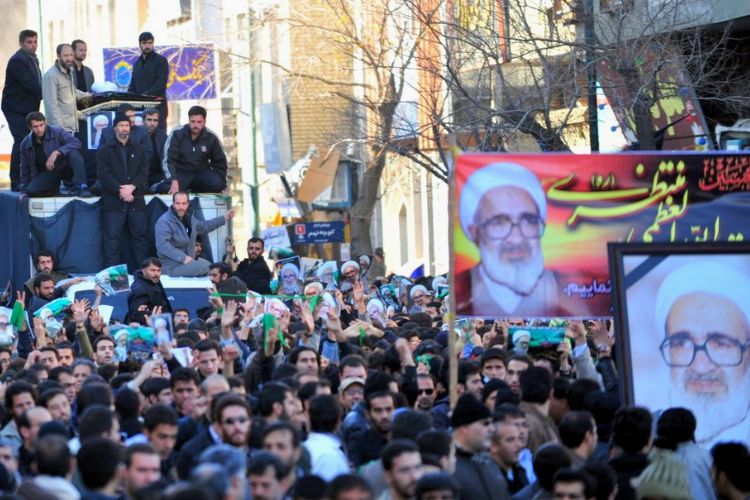
U.S.-Iran Hostilities Continue with No End in Sight
The conflict between the U.S. and Iran is escalating once again, as in recent days American forces reimposed a naval blockade and struck several Iranian targets in response to the Islamist regime’s persistent attacks on U.S. military bases, civilian ships in the Strait of Hormuz, and other countries in the region.
Experts say the Trump administration must keep steady military pressure on Tehran in order to further weaken it and keep the door open for regime change.
U.S. and Iranian Strikes
Tuesday saw U.S. forces launch “precision munitions against Iranian missile and drone sites, naval capabilities, and coastal defence systems during the seven-hour wave to further degrade Iran’s ability to threaten commercial shipping and civilian crews,” according to U.S. Central Command.
The strikes came in response to Tehran’s continued violation of the previously agreed upon memorandum of understanding that called for a ceasefire.
At least one Indian civilian was killed after Iran struck two oil tankers in the Strait of Hormuz, and the regime carried out new drone strikes on the Al-Azraq Air Base in Jordan. It has also attacked U.S. military sites in Kuwait, Bahrain, Qatar, the UAE, and Oman in recent days.
In addition, the U.S. announced that it would reinstitute a naval blockade of all Iranian ports within the Strait of Hormuz (which had previously lasted from April 13 to June 18) to further squeeze the Islamist regime’s weak and struggling economy. President Trump also threatened to strike infrastructure targets such as power plants and bridges within the Middle Eastern country unless Tehran agreed to resume ceasefire negotiations.
‘Iran Is Thirsty for War’
Experts like Jonathan Schanzer, who serves as executive director at the Foundation for Defense of Democracies, say that the Trump administration should not be surprised by Iran’s obstinance and backhandedness in the face of overwhelming military inferiority.
“[W]e all saw it coming,” he insisted during “Washington Watch with Tony Perkins” Tuesday.
“There was no way that the Iranians were going to stay true to their word. That’s not what this regime does.
“They’re a duplicitous regime, a terror-backed regime, and they have been thirsty for war. They were not interested in reaching any sort of compromise.”
As for the economic costs that have occurred due to the continued disruption of shipping lanes in the Strait of Hormuz, Schanzer highlighted how the damage to the world’s economy should be taken with a grain of salt.
“[W]e produce our own [oil], and we’re actually quite self-sufficient,” he pointed out.
“I’m more concerned about Europe. I’m more concerned about East Asia and a number of other regions that are more heavily dependent upon the oil coming out of the Strait of Hormuz.
“I don’t know if there’s an easy answer here.
“I would say, though, that we’re already beginning to see the market sort of correct itself and do adapt. We’re seeing more oil being brought over land, and we’re watching new markets emerge, new ways of bringing oil to market. That’s a good thing.
“But [it is still] a concern as we move on to this next phase of the war.”
Rising Concerns over Turkey
At the same time, Schanzer argued that Trump’s recent friendly overtures toward Turkey on lifting sanctions and selling F-35 fighter jets are sure to be costly for peace in the Middle East.
“[T]he Turks are, in fact, a terrible ally of the United States,” he underscored.
“… They’re a NATO ally in name only. This is a regime that has been supporting Hamas. They have been supporting ISIS. They are Muslim Brotherhood supporters.
“They’ve laundered $20 billion on behalf of the Islamic Republic of Iran at the height of our effort to try to halt the Iranian drive to a nuclear weapon.
“This is an Islamist regime through and through, and right now I’m more concerned than I ever have been.”
Schanzer continued, “I’ve been sounding the alarm about Turkey now for more than 10 years, and the reason for that is as the Islamic Republic gets weaker, … the Turks are the ones to benefit.
“They’re the second largest army in NATO. They have a significant military. They’ve got a significant and high-end arsenal. They continue to call for war against Israel. They continue to slam the United States in the Turkish press.
“This is a regime that we cannot trust.
“It is really surprising to me to see Donald Trump, our president, who’s been quite good on the Middle East, come out and support the Turks in this way.
“I’m concerned that it actually probably… tracks back to [U.S. Ambassador to Turkey] Tom Barrack … who seems very smitten with the Turkish regime, seems to want to appease them in every way. It is a dangerous, dangerous thing to do.”
Ongoing Talks Between Lebanon and Israel
Schanzer further contended that a bright spot in the evolving Middle East conflict are the talks currently taking place between Lebanon and Israel, which could have far-reaching implications for peace on Israel’s northern border with the Hezbollah terrorist group.
“I am actually quite optimistic about what we’re seeing between the government of Lebanon and Israel, these talks ongoing in Rome right now,” he related.
“… They’re now taking this international, which I think is probably a good sign that… other countries want to be involved in this process.
“But let me just say, success is not guaranteed.
“We need to see a process that will permanently disarm Hezbollah. The army in Lebanon is not quite ready to do it.
“The Israelis, of course, are more than ready, but the Lebanese government does not want to invite the Israelis in to finish the job. So it’s a delicate process that’s playing out.”
“But if we get to a successful conclusion here and we can establish peace between Lebanon and Israel, and we can find a process through which Hezbollah will be disarmed or exiled from Lebanon, we are looking at the dawn of a new era in the Middle East,” Schanzer added.
An End to the Iranian Regime: Possible?
As for how the U.S. can orchestrate a successful end to its war with Iran, Schanzer maintained that a steady and unrelenting approach could pave the way for possible regime change.
“I think the U.S. just needs to stay the course with the Iranian regime,” he urged.
“I think we have an opportunity through this low-level conflict to truly weaken them further. Their military is in disarray. … [T]he leadership has been eviscerated. Their economy is in bad shape.
“The people at some point will rise up again, and so if we can just keep that flame on low but still keep the flame going, I think this war could still bring down the regime.
“I know the president hasn’t said so outright, but I do think that this should be the goal, and I think it might even quietly be the goal among those in the White House.
“And as we weaken the regime, those [terrorist] proxies are going to get weaker, too.”
___
Republished with thanks to The Washington Stand.
Image adapted via Wikimedia Commons.
One Comment
Leave A Comment
Recent Articles:

2 November 2026
1.6 MINS
If “love is love”, as we were told during the same-sex marriage campaign, then why would a paedophile's attraction towards children be any different? That’s where the Albanese Government has come to, and it’s pure evil.
2 November 2026
7.1 MINS
Too many conservative students, too many Christians, too many Australians are oppressed by the leftist monoculture on university campuses. I could have walked away quietly — but here's why I couldn't do that.
2 November 2026
6 MINS
Sometimes Christians ignore elections and who to vote for, because there are no perfect candidates. But this thinking is unrealistic. When we avoid voting for the lesser of two evils, it only helps elect the greater of two evils.

2 November 2026
5.4 MINS
An Aboriginal elder in Western Australia has called for abused children to be taken away from “bad parents”, asking why responses of neglect and abuse of children differ across Australia. There is no place for a “hands-off culture” when children’s lives are at stake.
30 October 2026
4.5 MINS
A Tasmanian Christian reflects on 42 years of faith, warning that proposed conversion practices laws could threaten prayer, parenting and religious freedom, while reaffirming his hope in Christ.

29 October 2026
2.7 MINS
If passed, the Digital Duty of Care Bill 2026 will almost certainly lead to censorship of Bible-based convictions about marriage, abortion, gender, Islam and more. Here's why it should be rejected and how to make a submission by 30 October.

29 October 2026
3.4 MINS
Professor of Law Dr Joanna Howe is taking her employer to the Federal Court after an alleged 11-month in-house investigation into her public pro-life advocacy.



So, at last the truth is out that Turkey, which has the 2nd biggest army in NATO , is not our friend , but, the protector of the dreadful psychotic Iranian Regime whose dream is to nuke Israel and achieve the Islamic conquest of Europe:- – that it launders Iranian money, is ISIS, Hamas and The Muslim Brotherhood. The old , progressive , Westernised Turkey of Ataturk of the last 100 years is being replaced, against the wishes of at least half the good Turkish people ,by Erdogan, who is busy funding the building of numerous mosques in previously Aetheist Albania , etc. Please wake up , President Trump and end the Iranian Regime once and for all , especially as the Houthis are now threatening shipping access to the Suez Canal to bring down the West economically. Ataturk, the great Founder of Secular Turkey , who replaced Arabic with Latin script, reduced the power of imams, did away with the veil , promoted university education for females (one of his daughters was a Fighter Plane pilot revered in the USA to this day ), would be rolling in his grave in horror at Erdogan trying to turn the clock back from a secular Turkey to a regime similar to Iran’s.