


Don’t Regulate Surrogacy — Abolish It, Says Daughter of Surrogate Mother
Surrogacy is often discussed through the hopes of adults seeking children. Meet the woman, born to a surrogate herself, who says the debate should begin instead with the experiences of surrogate mothers and children separated at birth.
The Australian Law Reform Commission (ALRC) has completed a review of the nation’s patchwork of state laws on surrogacy. It will be tabled in Parliament in November.
The most controversial issue is whether or not commercial surrogacy should be legalised — that is, whether Australian women should be compensated for bearing other people’s babies. Currently, both gay and straight couples typically engage women overseas in countries such as the United States, Colombia, Ukraine, Kenya, or Georgia.
This often involves legal complications because the child is not automatically an Australian citizen. Proponents say the process would be much simpler and safer if commercial surrogacy were permitted here.
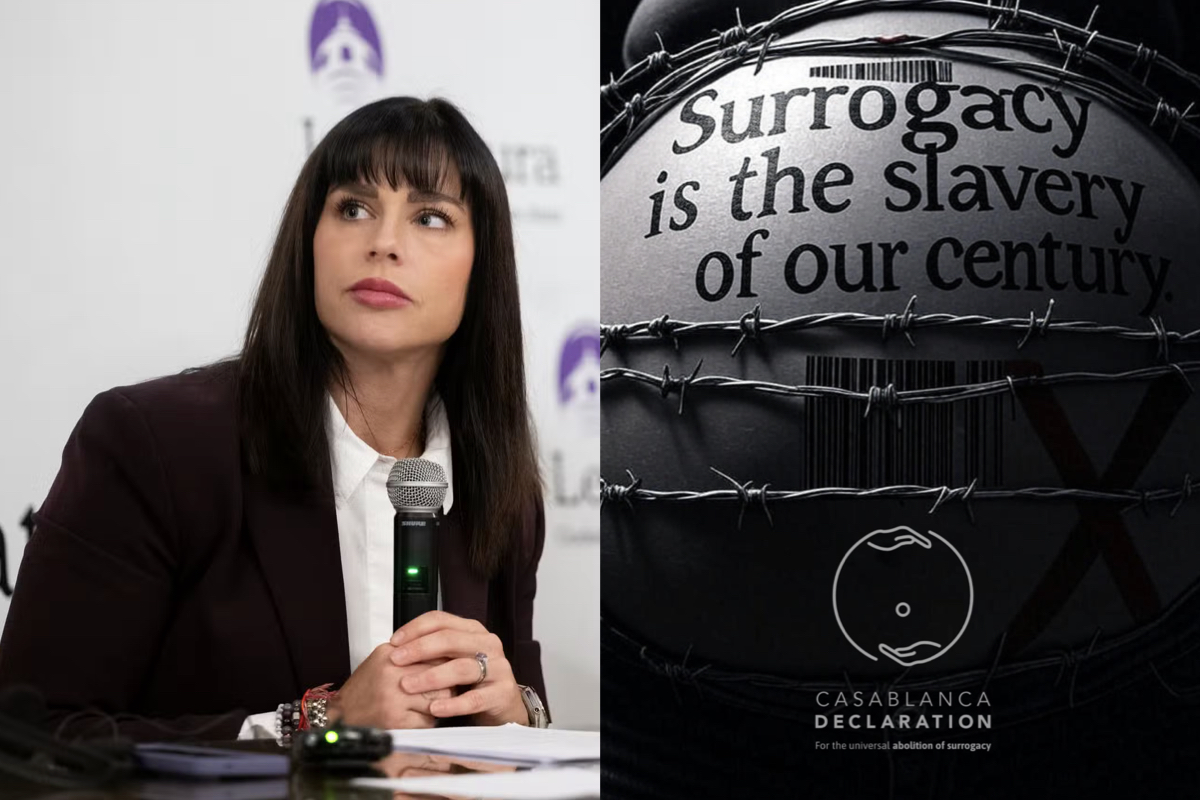
One of the world’s leading opponents of commercial surrogacy is Olivia Maurel, a product of the first generation of children born after IVF enabled a worldwide US$14 billion surrogacy industry. She was born to an American surrogate mother engaged by a French couple.
Today Maurel is a 34-year-old married mother of three living in southern France and the executive director and spokesperson of The Casablanca Declaration Association, an international coalition of opponents of surrogacy. Spinifex Press, an Australian imprint, has just published the first English edition of In Search of My Mother.
She is campaigning for the complete abolition of surrogacy. In some circles, this sounds extreme.
But as she contends in her book, “Fifty million people are currently still enslaved, worldwide. Does this mean we should bring back laws regulating slavery? No. Never. Even if abolition remains imperfect, it is still our aim. And the same goes for surrogacy.”
Joyful couples and gurgling, smiling babies feature in most articles published about surrogacy.
Olivia Maurel’s story is different. She writes from a place of pain and darkness. Harrowing is the best word to describe the psychological, moral, and physical trauma which ensued after her discovery of her origins.
Olivia Maurel’s Story
Maurel was born in 1991 in Kentucky but grew up in Florida. Her parents were wealthy and indulgent but distant. She had an intuition that something about their family was amiss and eventually discovered that her legal mother was not her birth mother.
She fell into a spiral of drug and alcohol abuse, self-harm, promiscuity and abusive relationships. When she confronted her parents about the circumstances of her birth, their relationship collapsed. In her memoir, she explains why.
“I was born with a gaping wound that my parents believed either did not exist, or would heal through my resilience. They were encouraged in these beliefs by a complicit society.
“My entire body bears scars that will never go away. No matter what I do, they will be with me for the rest of my life,” she writes.
“No surgery, psychotherapy or medication will ever be able to erase [them]. Anyone who thinks otherwise has no understanding of what those of us born to surrogate mothers around the world — thousands and thousands of us — are going through.”
Eventually Maurel finished a Master’s degree in taxation law in France and rebuilt her life, thanks in part to the kindness and strength of her husband.
She finally felt ready to track down the mother who had been erased from her life — a Kentucky woman named Catherine who had carried her for nine months for the money.
“Dispossessed of her own body, she was nothing but a slave,” Maurel comments. Catherine used her fee to take her kids to Disneyland.
“How could they all have done this? I was disgusted. I was not a handbag but a baby, a living being with conscious mind and a soul! How could these adults have played with me?” Maurel writes.
An Interview with Olivia Maurel
The Catholic Weekly recently interviewed Maurel by email. We asked her why finding the missing half of her parental heritage was so important for her.
“For years, I felt that a piece of me was missing without really knowing what that piece was,” she said.
“When I found my biological relatives, I suddenly saw things in other people that I recognised in myself, and there was something incredibly grounding about that,” she responded.
“A loving family can give you love and security; however, it cannot give you your biological roots. For some of us, knowing those roots is an important part of knowing who we are.”
The commissioning couples who engage surrogate mothers often give their child a comfortable home and a good education. Why isn’t that enough, we asked.
Maurel said that she was grateful to her legal parents for her privileged upbringing, but children need something more.
“A child also needs truth, identity, a coherent understanding of where she comes from and, I believe, the right not to have fundamental relationships decided for her by contract before she is even born,” she said.
But a child brings so much happiness, supporters of surrogacy argue. It seems wrong to frustrate that longing to be a parent. As a mother, Maurel is sympathetic, but she disagrees.
“I completely understand the desire for a child, but no one can have a right to another human being. A child cannot become the remedy for an adult’s suffering, however genuine that suffering may be,” she says.
“For me that is one of the central problems with the surrogacy debate: the story usually begins with the adults who desperately want a baby.
“I think it should begin with the woman and the child whose bodies and relationships make fulfilling that desire possible.”
Beginning Life as a Commodity
In the process of preparing its review of surrogacy, the ALRC received several submissions from young teenagers. They all said that the best thing about surrogacy was that “I exist”.
Maurel said she is happy those children exist, as well.
“I am glad I exist, too! But saying ‘I exist’ does not prove that surrogacy is right,” she added.
“When I criticise surrogacy, I am not saying that children born through surrogacy should not exist. I am saying that adults should not have the right to organise in advance a pregnancy, the separation of a child from the woman who carried him, and his transfer to other adults.
“We also have to be careful not to listen only to the children who say they are happy with their story. Their experience matters, but so does mine, and so does the experience of others who have struggled with what was decided for them before they were born.
“Being happy to be alive is not the same thing as approving of surrogacy.”
One of the most painful things for Maurel was the realisation that she had begun life as a commodity.
“It touches something very deep,” she said, “the feeling that my value, at the very beginning of my life, was linked to what adults wanted from me.
“To discover that money had been paid as part of the arrangement that led to my birth made me feel less like a person who had simply been welcomed into the world, and more like the result of a transaction.
“That is a very difficult thing to carry. It affects the way you look at your own origins and even the way you ask yourself: was I loved for who I was, or was I first something that had been wanted, arranged and obtained?”
Surrogacy is novel, but children have been torn apart from their birth families for decades — through adoption, anonymous sperm donation, or policies like the Stolen Generation in Australia. We can learn from their experiences, says Maurel.
“Adults and institutions have repeatedly underestimated how important origins, kinship and identity can be to a child,” she says.
“Being loved and well cared for does not necessarily erase the loss of knowing where you come from or who you belong to.
“I think there is an important lesson there for surrogacy: we should be very cautious about creating, deliberately and in advance, a separation that we already know can matter deeply to some people.”
___
Republished with thanks to The Catholic Weekly. Images courtesy of The Casablanca Declaration.
6 Comments
Leave A Comment
Recent Articles:
12 October 2026
4.6 MINS
Learn how journalists use loaded language, selective quotes and misleading headlines to shape public opinion, using a controversial report about James and Joanna Howe as a case study.

12 October 2026
3.1 MINS
The proposed livestream of Nidal Hasan’s execution has reignited debate over justice, deterrence and public accountability, with critics comparing American justice to ISIS propaganda.
12 October 2026
3.7 MINS
An EU court case over baptismal records could pit data protection laws against religious freedom, raising serious questions about whether governments can compel churches to erase sacramental history.

12 October 2026
3.2 MINS
Your support has helped us change the world for the better, as Dads4Kids has poured our heart, soul and finance into the global promotion and celebration of International Men’s Day.
12 October 2026
3.3 MINS
In the week leading up to Christ’s crucifixion, Jesus' soul was troubled. He responded with a bold prayer, and his example challenges us to that same boldness.
11 October 2026
2.6 MINS
Jesus offers us intimate friendship, which produces great joy as we walk closely with him.
10 October 2026
4.1 MINS
When Jesus rebuked the Laodicean church, this was not a sign of his lack of love, but proof of it and how greatly he longs to reward and bless us. He is knocking — will we answer?



So profoundly true and well expressed. Thank you Olivia Maurel for having the courage and depth of knowledge of yourself to express this so clearly. I pray that people will listen and understand. The tragedy of separation of mother and child is enormous for both mother and child but when this separation is intentional and treats both mother and child as commodities, not humans the violation is utterly callous.
Why is she so different from an adopted child. I have an adopted grand daughter She is now an adult . very clever and a beautiful, thoughtful caring person, currently at university. No hang ups.
Like every other aberration in society, this boils down to putting man’s will before the Will of God.
Great article Michael my dear friend!!!
I agree and the same goes for adoption the child is left without their full identity and never really fits in where they were raised.
This is a wild take. The surrogate is not related biologically to the child. For goodness sake! So many of you are truly uneducated and need to take biology and genetic courses. Unless the woman acting as the surrogate is also donating her eggs, there is no relation. Look up gestational surrogacy. As cold as this sounds, the surrogate is merely acting as an incubator. The child is biologically related to the parents, given that the sperm and egg were used to create an embryo, which was then inserted/implanted into the surrogate (through IVF). Traditional surrogacy is pretty rare; but this would be a situation where the surrogate was the child’s mother (i.e., surrogate’s egg combined with donor or actual father). In situations of traditional surrogacy, I could absolutely understand the child wanting to know about their birth mother and the maternal side of the family. However, this would be similar to adoption and foster children. The woman in this article needs some serious therapy. Just because she isn’t happy with her parental lineage, that doesn’t give her the right to tell other people that they cannot use a surrogate or a be a surrogate. This woman needs help! She has three children: What if one them cannot have a child and needs/wants a surrogate? What if one of her children wants to adopt and/or foster. Yikes. This woman sounds awful. And no one gets to bring religion or God into this. Why? Because not everyone is religious or believed in God, and not everyone has to. What you do is your business. Remember: Separation of Church and State. Plus, the argument of God and religion is weak anyways. God clearly created science and the humans who figured out how to create embryos, IVF, and surrogacy. If God didn’t want this, this wouldn’t exist. Also, you religious zealots are happy to use medicine, surgery, science, etc., when it suits you! But, as soon as it doesn’t, here you are! It’s exhausting. If someone wants to be a surrogate, let them. If someone needs to use a surrogate, let them. I think there should be very clear guidelines and laws on surrogacy.
Surrogacy is not the same adoption. The woman in this story sounds like she had crappy parents. If her parents had loved her properly, I bet she would be praising surrogacy and would be advocating for its legalization. However, because her parents sucked, she’s blaming that on the practice of surrogacy. No one should be treated as a factory or taken advantage of. I think it’s awful that there are women who agree to be surrogates – or donate eggs – because they are desperate and need money. However, there are women who are so happy to be able to do something so selfless for others, and are willing to do it without being paid.