Tucker Carlson vs Jacob Rees-Mogg: A Lesson in Virtuous Disagreement
What can Tucker Carlson’s interview with Jacob Rees-Mogg teach us about political disagreement? Their clash over war, Russia and national defence highlights the importance of listening carefully and understanding an opponent’s position before attempting to refute it.
In a recent interview that has been widely discussed online, American commentator Tucker Carlson clashed with former Tory MP and British conservative commentator Sir Jacob Rees-Mogg over war, national defence, and Russian expansionism.
The conversation exposed a significant divide within what is commonly referred to as the political “right” — especially in the United States — with Carlson advocating a more isolationist foreign policy while Rees-Mogg defended a more conventional conservative position.
Regardless of where one stands on the highly charged issues discussed, the debate also highlighted two distinctive approaches to modern political discourse. While Tucker repeatedly misrepresented his opponent’s position during the interview (whether unintentionally or otherwise), Rees-Mogg exhibited self-control, restraint, and subtlety in his arguments and conduct.
There are, I think, two very foundational dialectical virtues (namely, virtues that can be applied in a conversational context) that we can take away from this debate.
If you have not watched the episode, it is well worth viewing in its entirety (it runs for just over one hour, so it is comparatively short by modern podcast standards).
Tucker Carlson’s Misrepresentation of Jacob Rees-Mogg’s Arguments
Tucker Carlson is undoubtedly an intelligent man. Yet in his debate with Jacob Rees-Mogg, he repeatedly failed to understand and accurately represent the latter’s positions.
Not only did Carlson fail to do so throughout the conversation, but his team’s marketing of the episode also misrepresented Rees-Mogg’s case — using sensationalisation, mischaracterisation, and black-and-white language to frame the discussion in Carlson’s favour.
In logic, this is an informal fallacy known as “Strawmanning”, which is where one refutes an argument that one’s opponent does not in fact hold, or which is not under discussion.
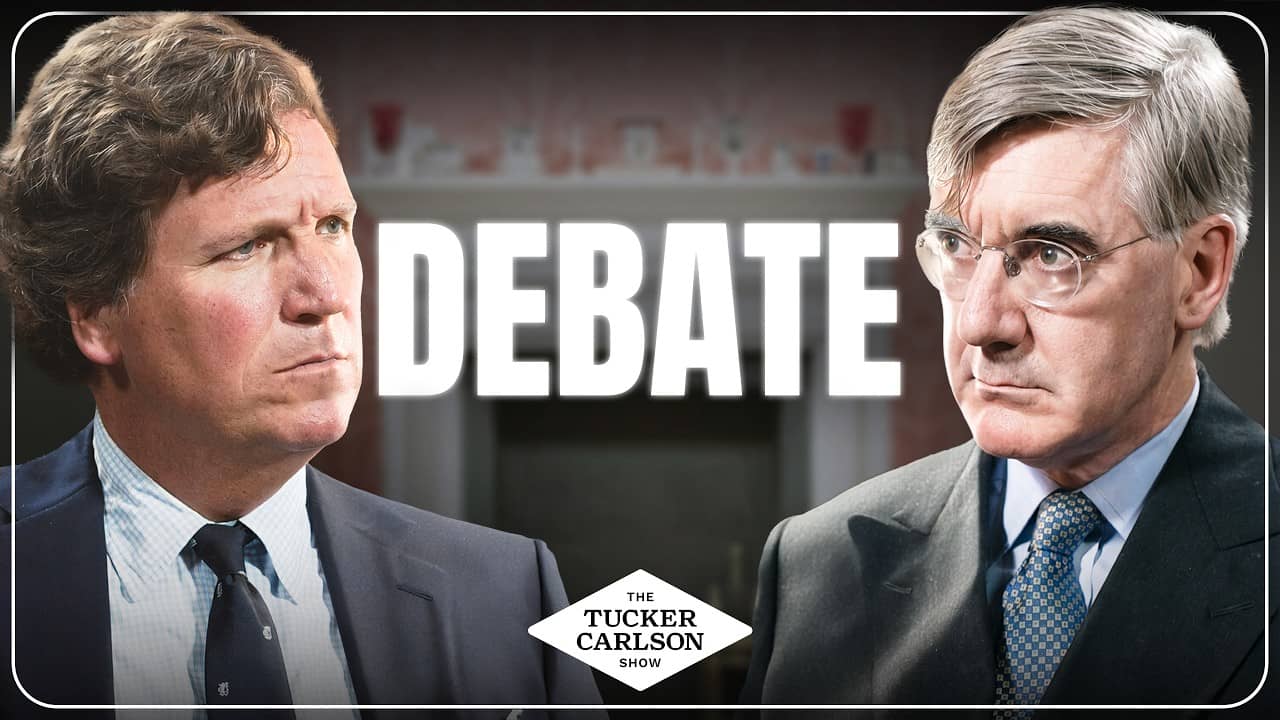
When considering whether to watch the Rees-Mogg episode on YouTube, viewers would see a fairly neutral thumbnail with the word “debate”, featuring an image of Carlson facing a picture of Rees-Mogg. However, the video’s title reads as follows: “‘Prepare for War’ — Tucker Confronts Britain’s Most Pro-War Advocate”.
There are several immediate problems with the title, the most obvious of which is that Rees-Mogg is not a pro-war advocate (let alone Britain’s “most pro-war advocate”) and, therefore, he cannot be fairly confronted about a position that he does not hold.
Carlson’s team combined the inflammatory and inaccurate term “Pro-War Advocate” with what is presented as a direct quote (ostensibly attributable to Rees-Mogg) to frame the discussion in black-and-white, us-versus-them terms, and leave the impression that Rees-Mogg wants Britain to launch an aggressive war on Russia.
In reality, it appears (from a transcript search) that Carlson was the only one in the debate to use the direct phrase “Prepare for War” (he was describing what he saw as Rees-Mogg’s position).
The closest that Rees-Mogg came to using the phrase was when he said, “The way to avoid war is to prepare for it, and if you’re prepared for war, it doesn’t happen.” (emphasis added)
Evidently, the assumption behind Rees-Mogg’s argument is not that war is good and should be pursued, but, on the contrary, that war is bad and should be avoided. On the basis of that assumption, Rees-Mogg was arguing that the best way to deter conflict — and thereby prevent it from occurring in the first place — is to prepare for war.
Rees-Mogg’s argument here is not an extreme one. It is a very old foreign policy principle encapsulated in the Latin dictum Si vis pacem, para bellum (“If you want peace, prepare for war”), a later development of an idea that can be traced back to the Roman writer Vegetius.
The phrase was perhaps most famously used by George Washington, an American Founding Father and the first US President, who said:
“If we desire to avoid insult, we must be able to repel it; if we desire to secure peace, one of the most powerful instruments of our rising prosperity, it must be known that we are at all times ready for war.” (George Washington)
This is a very different position from the one Carlson and his team apparently believe Rees-Mogg holds.
Even in the opening sentences of the conversation, Carlson shows that he does not understand (or is unable to fairly represent) his interlocutor’s position.
He remarks that Rees-Mogg’s house (in which they are conducting their interview) is “really pretty”, saying that he is “sad to think of it being destroyed in the war you described”, and then he asks his first question:
“What is this war, and why do you have to fight it?”
Rees-Mogg instantly corrects Carlson, pointing out that he had not — and did not — advocate for war, but rather for additional investment in British military strength to deter any possible conflict with Russia:
“What I’ve said is that the United Kingdom needs to be prepared for war, that we are coming under attack in various ways from Russia… and the way to avoid war is to prepare for it, and if you’re prepared for war, it doesn’t happen. So that’s what I’m talking about. It’s the preparedness which I’m worried we don’t have.”
Despite Rees-Mogg’s clear clarification, Carlson persisted in misrepresenting Rees-Mogg’s position throughout the dialogue, sometimes in quite rhetorical terms — prompting further corrections and clarifications and often derailing otherwise fruitful lines of conversation.
Rees-Mogg’s Two Steps to Constructive Debate
Baptised as he has been in the fires of British parliamentary politics, Rees-Mogg never lost his cool during the conversation. Yet there were several occasions where some frustration was discernible, and two of these offer practical suggestions for constructive disagreement.
We might call them “dialectical virtues”.
“You don’t always listen if I may say so, Mr Tucker.” (Jacob Rees-Mogg to Tucker Carlson)
The first dialectical virtue is extremely straightforward — and is the key to any successful relationship or marriage — namely, listening.
Especially if you hold strong opinions, it is far too easy to be quick to speak and slow to listen. One can very quickly think, “I’ve heard this before,” and jump in to refute a position before you have given your interlocutor the opportunity to make their case.
Not only is this disrespectful, but it robs you of the opportunity to consider whether you are listening to a stronger or weaker form of the argument than you have previously heard.
Moreover, if you make a habit of speaking over a debate opponent or conversational partner, you will soon find that you are simply responding to trigger phrases and words, rather than carefully and soberly weighing up an argument on its own terms.
Indeed, you may soon find that you are refuting positions that are not held by your opponent or arguments that he or she has not made.
This leads us into the second virtue.
“You seem to be devoid of nuance. The two questions are not the same.” (Jacob Rees-Mogg to Tucker Carlson)
The second dialectical virtue is only possible if the first is in place.
Once you have sympathetically listened to your opponent, it is crucial to seek to fully understand the subtleties of their position and arguments. It is crucial to avoid conflating their position with a different position that they may not hold.
This kind of conflation can be easy to do as different positions frequently look similar — or exhibit certain similar characteristics.
For example, arguing for a military build-up in the interests of securing peace and security is different from advocating for aggressive war. Of course, if someone is advocating for an aggressive war, they would likely also advocate for a military build-up.
Yet just because both positions share a characteristic (i.e., they both likely desire a stronger military capability) does not mean that they approach the question of aggressive war in the same way.
Failing to understand this nuance often leads to strawmanning and will likely cause frustration and prevent fruitful discourse.
It appeared towards the end of the episode that Carlson began to realise that his opponent was acting as a good-faith interlocutor — that he appeared genuinely interested in the truth.
This may have been brought home by Rees-Mogg’s willingness to agree with Carlson on common concerns — whether it be free speech, abortion, immigration, or government overreach. He did not approach the conversation in an excessively adversarial and black-and-white manner, with the aim of disagreeing with whatever Carlson said. Instead, he was quick to assert agreement where it was appropriate, find common ground when it was justified, and attack Carlson’s ideas, rather than his person or intentions.
This was, in fact, the kind of nuance that would have served Carlson well earlier in the discussion.
Nevertheless, by the end of the debate, it was too late.
Many strawmen had been made and destroyed over the course of the interview. Similarly, many fruitful avenues for constructive dialogue had been ignored or shut down. And Carlson still didn’t seem to understand the subtleties of what Rees-Mogg was advocating concerning war and military defence.
Disagreement is inevitable.
Yet as we disagree, let’s practice the virtues of listening carefully to our opponent and understanding the subtleties of their perspective before seeking to refute their position.
Image taken from Tucker Carlson Network thumbnail via YouTube.
Recent Articles:

7 October 2026
3.6 MINS
Victoria’s 18th March for the Babies will bring families together to peacefully affirm the value of every human life and call for a cultural change towards life.
7 October 2026
1.5 MINS
Across the Middle East, North Africa and Anatolia, Christianity once shaped entire civilisations. Could Britain’s Christian heritage likewise become a memory rather than a reality?

7 October 2026
8.5 MINS
Gerald McDermott’s work challenges Christians to approach Israel through Scripture first, exploring God’s covenant faithfulness, Christian Zionism, Jewish identity and antisemitism.

6 October 2026
3.4 MINS
Christians cannot afford to let headlines and social media shape their view of Israel. Scripture provides a foundation for understanding Israel, God’s promises and our response.

6 October 2026
6.7 MINS
Fresh revelations about the foiled FlyDubai terror plot expose the attacker’s alleged extremist history, while a courageous pilot’s actions prevented an unthinkable catastrophe.
6 October 2026
6.2 MINS
Britain’s grooming gang scandal exposes a devastating failure to protect vulnerable children, raising urgent questions about political correctness, accountability, immigration and the loss of moral courage.

6 October 2026
3.8 MINS
A grandmother’s disputed death has put Canada’s euthanasia regime under fresh scrutiny, as the Medical Assistance in Dying (MAiD) program passes 100,000 deaths with a further expansion slated for 2027.