



Religious Freedom and Religious Schools: Allegra Spender’s Proposed Legislative Challenge
Allegra Spender’s proposed bill reignites debate over discrimination protections, religious freedom and the right of faith-based schools to uphold their beliefs and values.
Independent MP for Wentworth, Allegra Spender, is preparing to introduce a private member’s bill into the Australian Parliament that would seek to strengthen protections against discrimination in religious educational institutions.
The proposal concerns students and teachers who may face discrimination on the grounds of sexuality, gender identity or marital status. Its proposed changes would reopen a longstanding debate over the relationship between anti-discrimination protections, religious freedom and the autonomy of faith-based schools.
As highlighted by OUTinPerth, “The MP said she supported religious-based organisations having exemptions that allow them to hire people whose faith aligns with that of the institution.” This distinction is central to understanding the proposal.
Spender’s Proposal Reopens a Contentious Debate
The debate is not simply about whether religious organisations should be permitted to employ people who share their faith, but about the extent to which religious educational institutions should be able to make decisions concerning students and staff on other grounds, including sexuality, gender identity and marital status.
The precise legal implications will depend on the wording of the proposed amendments and any exemptions they retain. The proposal also emerges against the background of the federal government’s continuing attempts to reconcile protections against discrimination with the religious character of faith-based education.
In its response to the Senate Legal and Constitutional Affairs Legislation Committee, published on 19 March 2026, the government stated: “Every Australian, no matter their race or religion, should be able to enjoy their life in any Australian community, without prejudice or discrimination.”
However, the government’s response also recognised the important role of faith-based schools and maintained that reform must balance protection against discrimination with their ability to operate according to their religious ethos. It further argued that achieving reform requires a bipartisan approach.
Balancing Anti-Discrimination Laws and Religious Freedom
Religious freedom is an important principle in a democratic society because it protects not only an individual’s right to hold and practise religious beliefs, but also the ability of religious communities to establish institutions and conduct their affairs in accordance with their convictions.
For faith-based schools, this may include maintaining a distinct religious ethos through their teaching, pastoral care and expectations of staff. Restrictions on the decisions these institutions can make, therefore, raise broader questions about the extent to which religious communities should be permitted to preserve their identity within an increasingly pluralistic society.
At the same time, religious freedom does not automatically override the rights of others, and the question of how far religious institutions should be exempt from anti-discrimination laws remains contested. The challenge for legislators is to determine where a legitimate protection against discrimination ends and an unjustified interference with religious autonomy begins.
Can Faith-Based Schools Preserve Their Religious Identity?
Australia’s Sex Discrimination Act 1984, particularly sections 37 and 38, already provides certain exceptions for religious bodies and educational institutions. Any proposed changes must therefore be assessed against the precise legal protections currently available, rather than assumptions about what religious schools can or cannot lawfully do.
The significance of Spender’s proposal, therefore, extends beyond the immediate question of discrimination in schools. It raises a fundamental question about religious freedom in Australia: can Parliament strengthen protections for individuals while ensuring that religious institutions retain a meaningful capacity to operate according to their beliefs?
For Christians and other religious communities, this question concerns not simply institutional policy, but the freedom to preserve and practise their convictions within public life. The ultimate assessment of the bill should therefore consider both its intended protections and its implications for the religious communities whose institutions it would affect.
The proposal’s eventual success will depend on whether Spender can secure sufficient parliamentary support to advance it. Its introduction would mark a further stage in a debate that has persisted through successive parliamentary inquiries and legislative attempts. Whether it ultimately becomes law remains uncertain.
“Stand fast therefore in the liberty wherewith Christ hath made us free,
and be not entangled again with the yoke of bondage.”
— Galatians 5:1 (KJV)
___
Image courtesy of Adobe.
One Comment
Leave A Comment
Recent Articles:

2 November 2026
1.6 MINS
If “love is love”, as we were told during the same-sex marriage campaign, then why would a paedophile's attraction towards children be any different? That’s where the Albanese Government has come to, and it’s pure evil.
2 November 2026
7.1 MINS
Too many conservative students, too many Christians, too many Australians are oppressed by the leftist monoculture on university campuses. I could have walked away quietly — but here's why I couldn't do that.

2 November 2026
6 MINS
Sometimes Christians ignore elections and who to vote for, because there are no perfect candidates. But this thinking is unrealistic. When we avoid voting for the lesser of two evils, it only helps elect the greater of two evils.
2 November 2026
5.4 MINS
An Aboriginal elder in Western Australia has called for abused children to be taken away from “bad parents”, asking why responses of neglect and abuse of children differ across Australia. There is no place for a “hands-off culture” when children’s lives are at stake.

2 November 2026
3.4 MINS
Regardless of your background, dad, you can break the cycle of fatherlessness and become the best father you can be. It often starts with small steps, not big ones.

31 October 2026
3.8 MINS
Awakening begins when we remember the love that awakened our hearts in the first place.
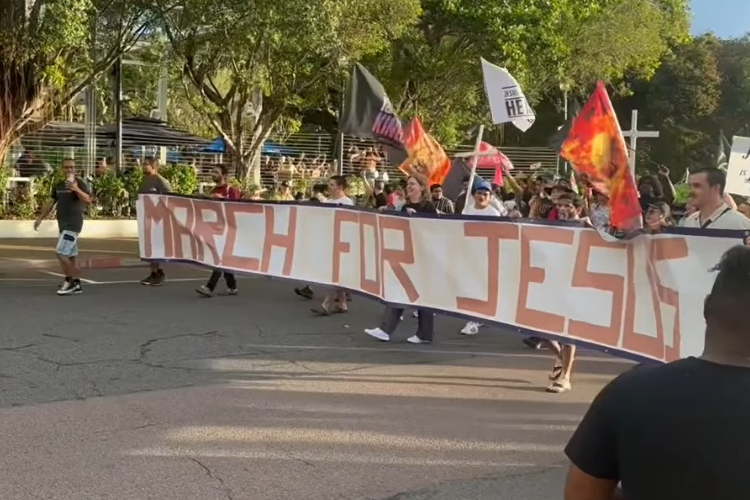
“Un-Australian”: NT Minister Condemns Darwin Council’s Ban on Christian Group from Christmas Pageant
30 October 2026
2.4 MINS
NT’s Attorney General Marie-Clare Boothby has labelled Darwin Council's decision “un-Australian”, “an outrage”, “completely unacceptable and against everything that Christmas stands for.”



The elephant in the room is, of course, the fact that any institution that relies on government funding is hardly in a position to resist any sort of government demand
Albeit the fact that the respective politicians are well aware that if they push their luck too far more parents will simply opt to home-educate – as many are already doing – a trend that took off in the 80s,a movement that has always remained largely hushed, no guesses as to why