Tasmania’s proposed conversion practices law raises serious concerns for churches, parents and faith-based schools, with broad definitions, severe penalties and uncertain protections for religious freedom.
By Friday, every member of Tasmania’s Parliament would have had a detailed legal analysis of the Conversion Practices Prohibition Bill.
It is signed by 17 church and faith leaders, and written and coordinated by Freedom for Faith. Their message is clear: this Bill should not proceed in its current form.
The Bill is meant to stop coercive, harmful attempts to change someone’s sexual orientation or gender identity. But its definition doesn’t require coercion or harm, disregards consent, and can capture a single conversation.
Even after its revisions, this Bill is at least as restrictive as Victoria’s law, and in important respects goes further.
It protects prayer as an “expression of belief”. But it doesn’t clearly protect praying with someone, at their request, for strength to live by their convictions. Parents are protected when they “discuss” faith and sexuality with their children, but not clearly when they guide, decide or choose a school.
And the consequences are severe. Any conversion practice directed towards a child becomes “child abuse”, even if it was consensual and caused no harm. A reasonable suspicion alone can require a church or school to notify the regulator within three business days. Organisations must take steps to eliminate conversion practices, and can be held criminally responsible for offences by their employees, contractors and volunteers.
The criminal offence needs only “injury”, including temporary harm to mental health, and negligence. It carries a maximum of 21 years’ imprisonment, more than twice Victoria’s maximum for serious injury.
A law no-one can explain should not pass. Parliament returns within weeks, and your support is putting this analysis in front of every MP before they vote.
Executive Summary
The signatories support laws that protect people from coercive, abusive and genuinely harmful practices directed towards their sexual orientation or gender identity. The Greens’ bill goes far beyond that objective. It combines an uncertain and exceptionally broad definition of “conversion practice” with serious criminal, civil, institutional and regulatory consequences.
The central problem is that the bill does not clearly distinguish harmful conversion practices from ordinary religious practice, parental guidance, counselling and support freely sought by adults. A single interaction can fall within the definition; “suppression” and “inducing” are undefined; consent is expressly disregarded; and there is no requirement for coercion or harm before conduct becomes a “conversion practice”. The exclusions for religious practice, parents and supportive care contain important protections, but leave significant uncertainty about their practical boundaries.
The principal concerns are:
- Religious practice and parental guidance remain uncertain. The bill protects “expressions of belief” and parental “discussion”, but does not clearly protect requested spiritual guidance, the practical application of religious teaching and parental decision-making. Many of the protections apply to conduct “of itself”, raising uncertainty about multiple conversations or prayers.
- The criminal threshold is too low for an indictable offence. Sections 12 and 14 require injury — including temporary harm to mental health — and negligence concerning that injury. New South Wales and South Australia require serious or substantial harm. The Tasmania Law Reform Institute (TLRI) recommended serious harm together with knowledge or recklessness. The Greens’ bill instead exposes defendants to the Criminal Code’s general maximum of 21 years’ imprisonment.
- The broad s 5 definition is carried into child-safety and child-abuse laws. Conversion practices directed towards children become reportable conduct and are incorporated into institutional child-abuse provisions without requiring the injury necessary for a criminal offence. Conduct falling within the broad s 5 definition may therefore trigger child-safety reporting, investigation and organisational liability even where no harm has been established.
- The bill imposes extensive obligations and liability on churches, schools and other organisations. Section 11 creates a positive duty to take reasonable and proportionate measures to eliminate conversion practices. Employers and principals can be deemed to have committed offences committed by employees, contractors and volunteers, while separate civil attribution provisions and child-abuse duties create further overlapping liabilities.
- The bill creates substantial exposure to claims and legal costs. It expressly removes limitation barriers for qualifying historical childhood personal-injury claims, including claims already time-barred. Churches and other institutions may also face Tribunal compensation proceedings, civil claims, criminal proceedings, child-safety investigations and regulatory enforcement arising from the same alleged conduct.
- The Commissioner is given extensive coercive powers. Reports may be made by people with no direct involvement. The Commissioner may initiate investigations, compel documents and answers, issue compliance notices, accept enforceable undertakings and publish findings. The bill removes the privilege against self-incrimination, subject to direct-use immunity, and does not expressly provide derivative-use immunity.
- Substantive amendments to other laws are presented as consequential changes. These include a new definition of sexual orientation throughout the Anti-Discrimination Act 1998 and a broader non-discrimination principle under the Health Complaints Act 1995. Their effects extend well beyond conversion practices and should be separately scrutinised.
Comparison with Other States
The Greens’ bill is NOT equivalent to that of other states. Even after the changes made following consultation, the Greens’ bill remains at least as restrictive as Victoria’s — and in important respects goes even further. On parental rights and freedom of religion, conscience and speech, it is substantially more intrusive than the more recent laws adopted in New South Wales and South Australia.
The differences are not minor drafting details. They include the breadth of the definition, the treatment of consent, the criminal threshold and penalties, child-abuse and reportable-conduct provisions, organisational liability, the positive duty, retrospective claims and the powers given to the Commissioner.
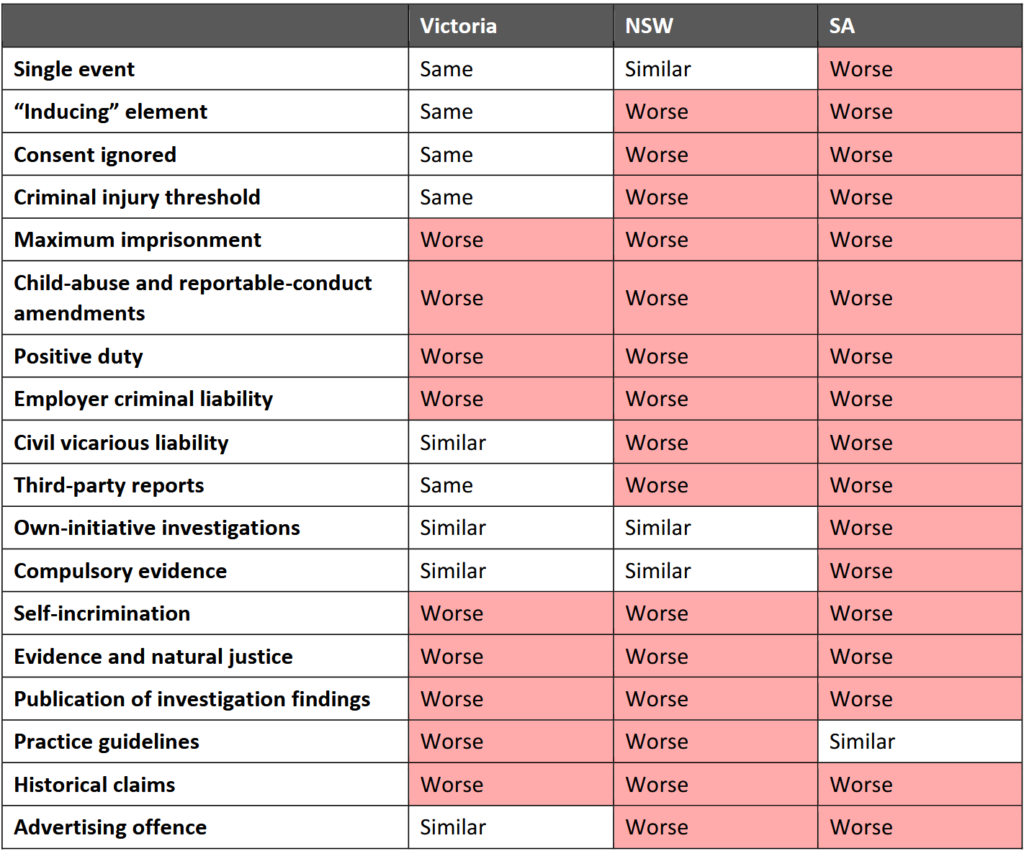
Legislation Compared
- Tasmania: Conversion Practices Prohibition Bill 2026, Bill 45, as introduced; Criminal Code Act 1924, sch 1, s 389(3).
- Victoria: Change or Suppression (Conversion) Practices Prohibition Act 2021, version 002.
- New South Wales: Conversion Practices Ban Act 2024, No 19.
- South Australia: Conversion Practices Prohibition Act 2024; Equal Opportunity Act 1984 (including the conversion-practices amendments).
The bill will be voted on from 27 October.
Please pray:
-
For Tasmania’s MPs — that they read the analysis carefully and refuse to pass a law whose meaning no-one can explain.
-
For Tasmanian parents, pastors and churches — that they are not left exposed to complaints and investigations over ordinary care and guidance.
___
Republished with thanks to Freedom for Faith.






Tasmania: The Most Radical Conversion Practices Bill in Australia
13 October 2026
3.9 MINS
Tasmania’s proposed conversion practices law raises serious concerns for churches, parents and faith-based schools, with broad definitions, severe penalties and uncertain protections for religious freedom.
By Friday, every member of Tasmania’s Parliament would have had a detailed legal analysis of the Conversion Practices Prohibition Bill.
It is signed by 17 church and faith leaders, and written and coordinated by Freedom for Faith. Their message is clear: this Bill should not proceed in its current form.
The Bill is meant to stop coercive, harmful attempts to change someone’s sexual orientation or gender identity. But its definition doesn’t require coercion or harm, disregards consent, and can capture a single conversation.
Even after its revisions, this Bill is at least as restrictive as Victoria’s law, and in important respects goes further.
It protects prayer as an “expression of belief”. But it doesn’t clearly protect praying with someone, at their request, for strength to live by their convictions. Parents are protected when they “discuss” faith and sexuality with their children, but not clearly when they guide, decide or choose a school.
And the consequences are severe. Any conversion practice directed towards a child becomes “child abuse”, even if it was consensual and caused no harm. A reasonable suspicion alone can require a church or school to notify the regulator within three business days. Organisations must take steps to eliminate conversion practices, and can be held criminally responsible for offences by their employees, contractors and volunteers.
The criminal offence needs only “injury”, including temporary harm to mental health, and negligence. It carries a maximum of 21 years’ imprisonment, more than twice Victoria’s maximum for serious injury.
A law no-one can explain should not pass. Parliament returns within weeks, and your support is putting this analysis in front of every MP before they vote.
Executive Summary
The signatories support laws that protect people from coercive, abusive and genuinely harmful practices directed towards their sexual orientation or gender identity. The Greens’ bill goes far beyond that objective. It combines an uncertain and exceptionally broad definition of “conversion practice” with serious criminal, civil, institutional and regulatory consequences.
The central problem is that the bill does not clearly distinguish harmful conversion practices from ordinary religious practice, parental guidance, counselling and support freely sought by adults. A single interaction can fall within the definition; “suppression” and “inducing” are undefined; consent is expressly disregarded; and there is no requirement for coercion or harm before conduct becomes a “conversion practice”. The exclusions for religious practice, parents and supportive care contain important protections, but leave significant uncertainty about their practical boundaries.
The principal concerns are:
Comparison with Other States
The Greens’ bill is NOT equivalent to that of other states. Even after the changes made following consultation, the Greens’ bill remains at least as restrictive as Victoria’s — and in important respects goes even further. On parental rights and freedom of religion, conscience and speech, it is substantially more intrusive than the more recent laws adopted in New South Wales and South Australia.
The differences are not minor drafting details. They include the breadth of the definition, the treatment of consent, the criminal threshold and penalties, child-abuse and reportable-conduct provisions, organisational liability, the positive duty, retrospective claims and the powers given to the Commissioner.
Legislation Compared
[Contact Your MP]
The bill will be voted on from 27 October.
Please pray:
___
Republished with thanks to Freedom for Faith.
About the Author: Mike Southon
Australia / Children / COMMENTARY / Fairness & Justice / Faith / Family / Freedom / Gender / Sexual Integrity
SHARE >
We need your help. The continued existence of the Daily Declaration depends on the generosity of readers like you. Donate now. The Daily Declaration is committed to keeping our site free of advertising so we can stay independent and continue to stand for the truth.
Fake news and censorship make the work of the Canberra Declaration and our Christian news site the Daily Declaration more important than ever. Take a stand for family, faith, freedom, life, and truth. Support us as we shine a light in the darkness. Donate now.
Recent Articles:
Religious Freedom and Religious Schools: Allegra Spender’s Proposed Legislative Challenge
13 October 2026
2.6 MINS
Allegra Spender’s proposed bill reignites debate over discrimination protections, religious freedom and the right of faith-based schools to uphold their beliefs and values.
From Cocaine to Christ: Why Stephen Baldwin’s Sobriety Stuck
13 October 2026
5.5 MINS
Stephen Baldwin’s journey from drug addiction to sobriety, Christian faith and family life reveals how surrender, daily discipline and renewed hope transformed his life.
VAD Deaths in Victoria Surge
13 October 2026
2.1 MINS
Victoria’s assisted dying deaths have surged by 300 per cent since legalisation, while a disturbing case involving a patient’s partner raises urgent questions about safeguards.
Wanted: A Statesman Like Roosevelt, Churchill and Zelenskyy
13 October 2026
1.8 MINS
Australia faces mounting geopolitical, economic and defence threats, but its political leaders lack the statesmanship, bold vision and decisive communication needed to prepare the nation.
Day 13: Return to Your First Love
13 October 2026
2.8 MINS
The church in Ephesus had so much going for it. Yet despite their hard work, perseverance, endurance, and discernment, there was something deeply wrong: they had left their first love.
Anatomy of a Hit Piece: How the Howes Were Stitched Up by the ‘News’
12 October 2026
4.6 MINS
Learn how journalists use loaded language, selective quotes and misleading headlines to shape public opinion, using a controversial report about James and Joanna Howe as a case study.
“He Will Judge the World with Righteousness”: Why We Should Celebrate God’s Judgement
12 October 2026
12.9 MINS
God’s judgement can seem difficult to reconcile with His goodness. But Scripture presents God’s perfect justice as something we can celebrate — and His present offer of mercy through Jesus as the good news.
Use your voice today to protect
Faith · Family · Freedom · Life
MOST POPULAR
ABOUT
The Daily Declaration is an Australian Christian news site dedicated to providing a voice for Christian values in the public square. Our vision is to see the revitalisation of our Judeo-Christian values for the common good. We are non-profit, independent, crowdfunded, and provide Christian news for a growing audience across Australia, Asia, and the South Pacific. The opinions of our contributors do not necessarily reflect the views of The Daily Declaration. Read More.
MOST COMMENTS
GOOD NEWS
HALL OF FAME
BROWSE TOPICS
BROWSE GENRES