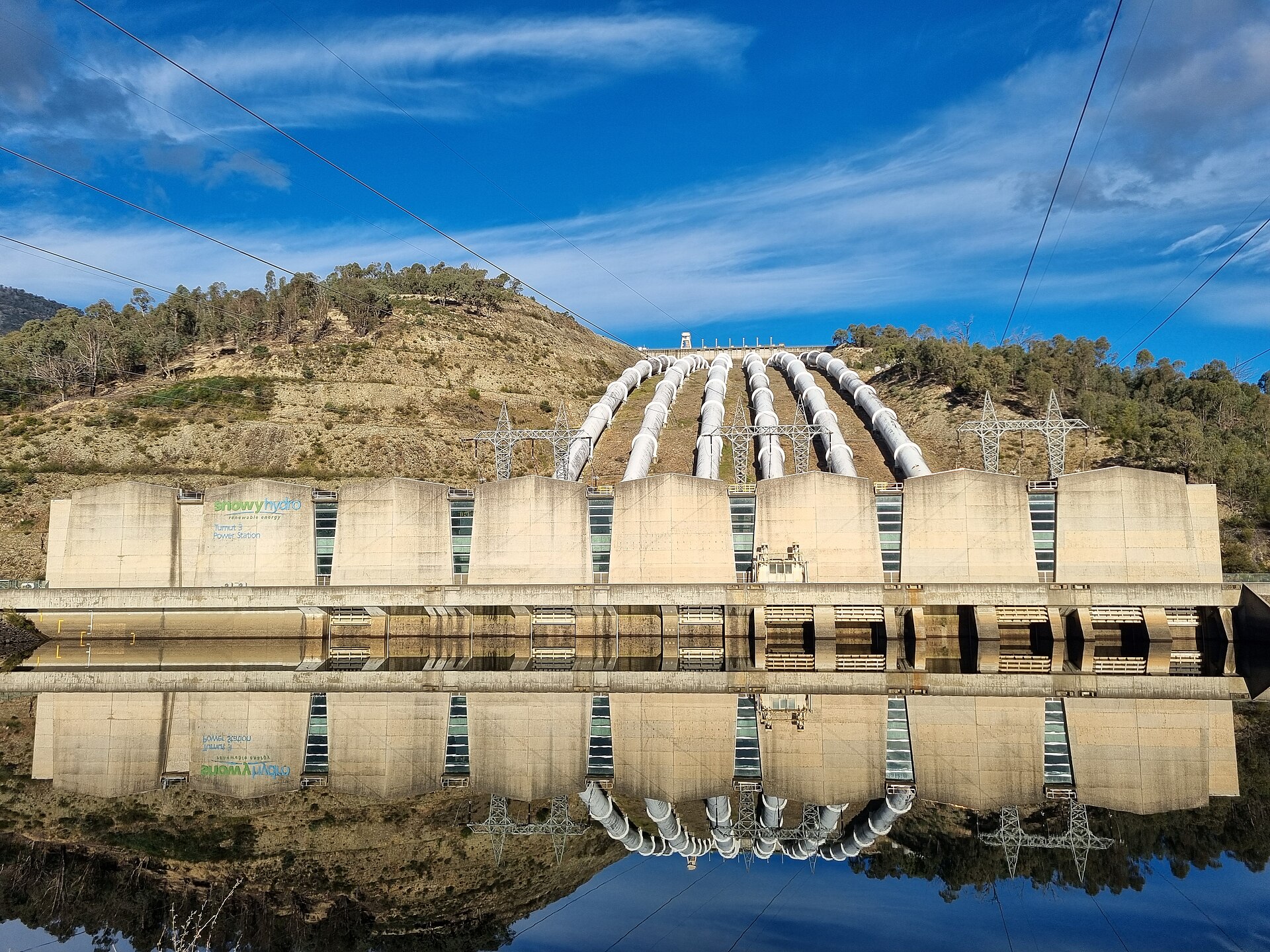
How Snowy Hydro’s Costs Snowballed By Billions
The Snowy Hydro scheme has ballooned from a $2 billion nation-building promise to a potential $42 billion financial disaster, exposing serious failures in planning, governance and accountability.
Before he entered politics, Malcolm Turnbull was an investment banker, first with his own firm and then with Goldman Sachs. This should presumably have given him some familiarity with financial analytics of potential projects.
So, it comes as something of a surprise that his announcement in 2017 of a $2 billion expansion to increase by half the generation capacity of the Snowy Hydro scheme using pumped-hydro technology is looking extremely unsound.
That initial $2 billion has blown out to $25 billion. According to energy economist Bruce Mountain and the Victoria Energy Policy Centre, once factors like direct construction, associated infrastructure, critical grid transmission lines, and financing costs are taken into account, the number balloons to $42 billion.
To put that latter figure into context, it equates to 4.2 per cent of Australia’s federal gross debt. It equates to about two-thirds of the annual defence budget, over one-third of the annual health budget and more than the annual federal education budget.
The finances get worse when the projected returns on investment are considered. The official business case was updated in 2024. It estimated the projected net present value (NPV), the future value of the asset discounted back to the present to take into account inflation and the cost of capital, to be $3 billion. That was before the core budget jumped to $25 billion.
Capital expenditure of $25 billion would mean costs would exceed the projected revenue streams, so Snowy Hydro executives have admitted that they have not even calculated a new NPV for the project because standard cost-return metrics are unviable. At $42 billion, the project could not even cover its debt servicing costs.
When Turnbull oversaw the original case, the business model relied on arbitrage — buying cheap solar or wind power during the day to pump water uphill, and releasing it to sell expensive electricity during peak demand. That has not proven to be valid.
The Australian Financial Review is arguing that it is cheaper to close it than to go ahead. “The monument still needs more to be spent to finish it than has already been spent. The one piece of good news is that policymakers can still resist the sunk-cost fallacy.”
What Went Wrong?
A raft of things has gone wrong, some to do with engineering, some with industrial relations and some related to financial assumptions. The project was approved, and construction began before complete designs, soil testing, and feasibility studies or business cases were finished.
Excavating deep beneath the rugged terrain of the Snowy Mountains and Kosciuszko National Park has brought unwanted geological surprises. Labour costs surged, with the CFMEU, AWU, and AMWU adding nearly a billion dollars directly to the bill. A move away from fixed-price contracts to more flexible or incentive-based agreements drove up public costs.
Post-pandemic material shortages, general construction inflation, and the logistical difficulties associated with operating in a remote alpine environment further increased costs. Many billions more will be required for long-distance transmission infrastructure to connect the remote scheme to the main energy grid, the main reason some estimates are as high as $42 billion.
The only comparable federal government infrastructure debacle — there have been several large cost blowouts with state government road projects — was the Inland Rail Project, which was designed as a 1,700-kilometre inland rail corridor to connect Melbourne and Brisbane directly, bypassing the congested coastal rail network and Sydney’s urban bottleneck.
The project was cut short, with the line finishing at Parkes. This followed two scathing reviews.
As Tony O’Brien reported in News Weekly (“Inland Rail Runs Out of Steam in NSW’s Backyard,” 13 June 2026 edition), “The Delivery of Inland Rail: An Independent Review” by Kerry Schott AO said there were “significant deficiencies” around issues of monitoring, reporting, governance and management and that “there is insufficient certainty about the completion date and the final cost to have confidence in the current estimates”.
Bucketloads of money were squandered on land acquisitions, bonuses paid, and there was a failure to appoint a chief executive for two years. There were failures in governance, unclear lines of responsibility, Inland Rail was established as a separate entity with huge overheads and duplication of roles from the Australian Rail Track Corporation (ARTC), and specialist oversight was lacking.
These debacles raise questions about the ability of Australian politicians and planners to make realistic assessments of costs and to implement sound risk management strategies.
What we do know, though, is that there is never any shortage of marketing hype. Launching the project, Turnbull said, beaming into the camera: “I am a nation-building prime minister, believe me. And this is a nation-building project.”
If anyone did believe him, they should not have.
___
Republished with thanks to News Weekly. Image courtesy of Wikimedia Commons.
Recent Articles:

20 November 2026
4 MINS
Israelis are calling for a boycott of Australian products following Labor’s latest sanctions against Israeli settlers, while reports suggest Israel may consider counter-sanctions.

20 November 2026
7.7 MINS
A revised edition of "Unhumans" examines the history, tactics and ideological foundations of communist revolutions, warning of socialism’s growing influence and its hostility to Christianity.

20 November 2026
2.1 MINS
A satirical legal battle exposes the absurdity of separating Hamas’s political and social activities from its military wing, using Hitler’s imagined defence to make the point.

20 November 2026
4.5 MINS
Christ’s authority extends over every sphere of society. The church must reclaim its prophetic voice and challenge ungodly civil governance.

19 November 2026
4.5 MINS
Amanda Flavell is campaigning for Swiss-style direct democracy in Australia, giving citizens greater power to challenge legislation and influence decisions on climate policy, censorship and women’s rights.
19 November 2026
3.8 MINS
John Anderson and Konstantin Kisin challenge Western leaders over economic decline, mass immigration and censorship, arguing that honest debate and truth-telling are essential to good government.
19 November 2026
5.5 MINS
Influential Christian artist Steve Camp, who passed away at age 71, believed that Christian music could become incredibly successful at serving believers while simultaneously losing its power to reach the rest of the world. He explained exactly why in a striking interview back in 1988.