


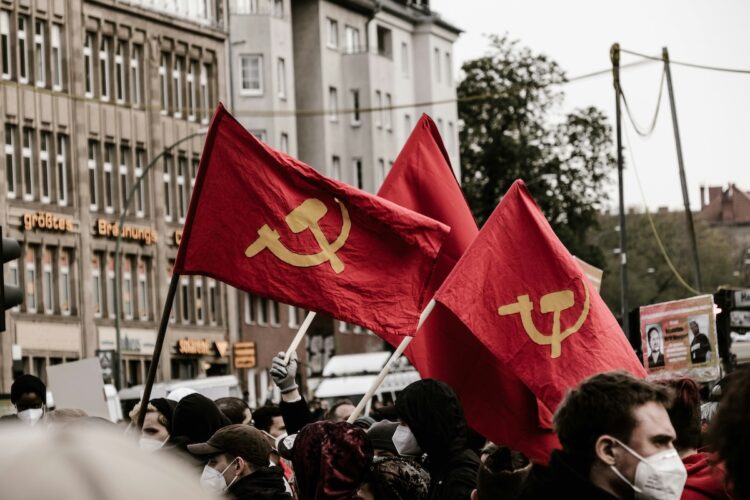
How Communism Is Quietly Reshaping the Modern West
Despite the Cold War’s end, the ideology of Communism persists — reshaping politics, governance, and freedoms across the globe today.
The ominous final line of an important new history of Communism says this: “Far from dead, Communism as a governing template seems only to be getting started.”
I refer to the 530-page book, To Overthrow the World: The Rise and Fall and Rise of Communism by American historian Sean McMeekin (Basic Books, 2024).
There are, of course, entire libraries filled with books about socialism, Marxism, the Soviet Union, and related topics. In my own library I have several hundred volumes on these subjects. But this one — To Overthrow the World — stands out as both one of the newest and most compelling. It offers a sweeping yet carefully detailed history of Communism covering the past 175 years or so.
To demonstrate the relevance of this book, let me begin by noting two recent events that have taken place in America. Zohran Mamdani just became the Democratic nominee for Mayor of New York City. A hard-core socialist, Mamdani is right up there with Bernie Sanders and AOC in radical progressivism. President Trump has rightly branded him a “Communist Lunatic.”
In contrast, the Texas government just passed a Bill — 89(R) SB 24 — that requires the school curriculum to teach about the history and horrors of Communism, contrasting this godless ideology with the vision of the American Founding Fathers.
That’s a commendable move, and a volume like Sean McMeekin’s would fit well within such a curriculum. It covers all the major themes, with detailed, well-documented chapters on the early socialist utopians, Karl Marx, the Bolshevik coup, the terror reigns of Lenin, Stalin, and others, the Red Guards, the Khmer Rouge, and so much more.
Communism Back From the Dead
I’ll return to this important volume in future articles, but here I want to focus on the Preface and Epilogue, where McMeekin highlights the central theme reflected in the title: the issue of control in Communist societies. In the opening paragraphs of the Preface, he explains:
It is now more than three decades since the fall of the Berlin Wall and subsequent collapse of the USSR prompted Francis Fukuyama to proclaim the “End of History.” Like most Americans who lived through those heady and exciting times, I felt a surge of pride as one Eastern Bloc country after another discarded single-party Communist rule for pluralism and political freedom — even Russia itself, which for a time seemed just as eager to embrace the West. For the first time, Soviet archives were thrown open to Western researchers such as myself, who happily descended on them to probe the secrets of Soviet and global Communism. Confident postmortems of Communism then filled the airwaves, with a sense of relief and “goodbye to all that.” At the height of American triumphalism in 2001, the historian Richard Pipes described his short Communism: A History as not only “an introduction to Communism” but also “at the same time, its obituary.”
Twenty years later, things look rather different. Russia may no longer be Communist, but it is ruled by Vladimir Putin, a proud and unrepentant former KGB officer. Joseph Stalin is more admired in Russia today than at any other time since his death in 1953, his manifold crimes against the peoples of the Soviet Union now either forgiven or forgotten. Since the Ukraine crisis of 2019 and the Russia-Ukraine war that broke out in February 2022, relations between Russia and the West have been thrown into the deep freeze, frostier by some measures than at the height of the Cold War, with nearly all trade and travel cut off. Meanwhile, thrown off its perch by the 9/11 attacks, ineffectual “forever war” military interventions, deindustrialisation, and debts eroding the value of the dollar, the United States has bled prestige in uncanny parallel with the return of Russian military power to the world stage and the rise of Communist China in economic power and global influence. With the COVID-19 lockdowns of 2020-2022, the China model spread globally, as once inviolable rights, from freedom of speech and dissent to freedom of movement and travel, were temporarily abandoned in the West. For many young westerners, Communism is no longer a cause banished from mainstream discourse for its association with totalitarian regimes, for they have no living memory of them. Liberal democratic capitalism seems bereft of energy, if not moribund, while Chinese Communism rapidly assimilates much of the world. How did this happen, and why did no one see it coming?
What follows is an attempt to grapple with this question, and to approach it with a greater sense of humility than I might have done in those heady early years of the post-Communist era. Owing to several decades of historical research in partly open Chinese, mostly open Eastern Bloc, and until recently relatively open Soviet archives, we also know far more today than in the past about how Communism worked in practice, and about why, and exactly how, so many Communist regimes fell — while others endured — between 1989 and 1991. There was nothing fated about the collapse of Soviet power that allowed the Eastern Bloc Communist satellites and the three Baltic Republics to spin free from Moscow’s orbit in 1989, and that prompted the collapse of the USSR itself two years later — the cause of Fukuyama’s premature gloating — nor in the violent reassertion of Chinese Communist Party (CCP) control in Tiananmen Square earlier in 1989, which should have rendered his thesis null on arrival. Much as we like to imagine that Communism failed because of a cascading groundswell of heroic popular opposition from below, it was actually the disappearance of coercion from above that counted. More than any other system of government known to man, Communist rule required the strong hand of the military and heavily armed security services, all under strict party control. Once the regime’s sword was lifted, Communist parties crumbled quickly; if the sword remained, the party did too.
Communism and the COVID-19 Connection
In the Epilogue, McMeekin looks at the “Strange Non-Death of Communism”. There, he reminds us of how recent developments in Communist China along with the West’s response to Covid proves that the ugly allure of Communism is alive and well. He shows how closely connected the two in fact are. His book is again worth quoting from at length:
With the COVID-19 lockdowns of 2020-2022, the China model of Communist statist surveillance crashed into Europe, the United States, Canada, Australia, and New Zealand as once inviolable Western freedoms — of movement, travel, and association, of speech and robust debate over controversial public policies — were abandoned one by one. Even “social distancing,” the now much-mocked craze of 2020 — which, by making it illegal for humans to sit or congregate closer than six feet (in the United States) or one metre (most of Europe), shut down public schools and all but destroyed social industries, from cinemas, concert halls, and theatres to churches, gyms, restaurants and nightclubs — was a CCP import… [It] was a Chinese Communist policy imposed in 2002-2003 in response to outbreaks of avian flu and severe acute respiratory syndrome (SARS). It was quietly, owing to CCP influence, incorporated into pandemic guidelines by the World Health Organisation (WHO) and the American Centres for Disease Control and Prevention (CDC) in 2004, reversing decades of progressively more humane — and scientifically sound — policies on mitigating disease outbreaks. “Lockdown” had absolutely no basis in the Western tradition, not even in the more credulous times of the Black Death, when sick people might have been quarantined against their will, but never the entire healthy population.
Social distancing lockdown, however, was a logical outgrowth of the statist population controls embraced by twentieth-century Communist regimes, such as the one in China where it first emerged…
Further Examples of Communism’s Modern Allure
McMeekin continues:
After heady moments in 1989 and 1991 when it appeared that the fall of Communism would usher in an era of greater civil liberties and freedoms worldwide, most of the Western world is now converging instead on a hybrid Chinese Communist model of statist governance and social life. Private (or semi-private) social media and other tech companies are harnessed by the state to track, monitor, censor, and control private communications, speech, and political activity, mostly behind the scenes, although with periodic high-profile crackdowns to scare would-be dissidents into compliance. The CCP’s social credit system, which sees those who fall afoul of the government or social media consensus denied access to schooling, travel, banking, or credit, has already been applied en masse to the “COVID unvaccinated” across the Western world, along with other dissidents. Such restrictions have now begun to extend into the banking system in the West. Funds raised to feed Canadian truckers participating in an outdoor winter protest against COVID vaccine mandates in early 2022, for example, were frozen by Canadian authorities in early 2022. When former Brexit Party chairman and European Parliament member Nigel Farage faced closure of his bank accounts, or “debanking,” in the summer of 2023, he believed it was because of his political views. Similar crackdowns affected British and American journalists critical of the West’s Ukraine policy in 2023.
It is not hard to imagine “debanking” or other types of persecution being applied in the near future to people whose views dissent from the approved consensus of Western social and governing elites on a wider range of topics, such as “climate change,” immigration, race, sexual orientation, or gender identification. It might once have sufficed for intellectual orthodoxy-enforcers that dissenters had trouble finding employment in government, in academe, or at white shoe corporate and law firms, but social access can now be restricted to many other areas of public life: not only the closure of bank accounts or refusal of service, but also social media bans, the seizure of funds collected via online platforms such as GoFundMe, the denial of passport or travel rights, or even, in some cases, interrogation and arrest. Americans have thus far been spared the cruder Communist injustice of “expropriation” of their assets, and the horrors of Stalin- or Mao-style Gulag camps and state-induced famines. In the social and intellectual sphere, however, the echoes of Cultural Revolution-style Communist totalitarianism have become too powerful — and painful — to ignore. Because modern-day thought commissars often work in the private sector (or for companies aligned with state intelligence), these new Western forms of social control may be more insidious than the cruder methods of physical intimidation and violence deployed by the NKVD, the Stasi, and Mao’s Red Guards: many victims deprived of their jobs, funds, reputations, or basic civil rights may not even know who their accusers are. Far from dead, Communism as a governing template seems only to be getting started.
If McMeekin is correct, then the eternal vigilance required to ensure the continuation of freedom is needed now as much as ever. And a book like this is part of what we need to make sure we remain free.
___
Republished with thanks to CultureWatch. Image courtesy of Unsplash.
One Comment
Leave A Comment
Recent Articles:
11 October 2026
2.6 MINS
Jesus offers us intimate friendship, which produces great joy as we walk closely with him.
10 October 2026
4.1 MINS
When Jesus rebuked the Laodicean church, this was not a sign of his lack of love, but proof of it and how greatly he longs to reward and bless us. He is knocking — will we answer?
9 October 2026
5 MINS
During a recent dialogue between high profile legal experts, a top Australian constitutional law expert was asked if Australia should have a Bill of Rights. His answer may surprise you.

9 October 2026
1.3 MINS
Season 6 of The Chosen is releasing next month, and until 15 November, your church has the opportunity to host a free pre-release screening of Episode 1. Here's how.

9 October 2026
2.9 MINS
Angus Buchan’s remarkable journey from farmer to evangelist is brought to life in a new documentary now streaming, revealing the faith, family and challenges behind his public ministry.

9 October 2026
1.8 MINS
Pen Power Australia has been busy confronting antisemitism and double standards, lodging letters, pursuing accountability and celebrating several important wins along the way.

9 October 2026
3.3 MINS
New South Wales healthcare workers who object to abortion and voluntary assisted dying face growing pressure, raising serious questions about conscience rights, employment and moral injury.



Thanks for this Bill. The big questions for me still remains though. Who is orchestrating it and why; and why are we ordinary people accepting it?