


The Rabbit: Australia’s Perennial Pest
by Brian Coman
There have been several recent reports in the media concerning what seems to be a resurgence in rabbit populations in Australia. Some foreshadow a return to the bad old days of rabbit “plagues” and “the grey blanket”.
Although there is good reason to be concerned about any resurgence in rabbit numbers, our response probably needs to be a little more nuanced because the situation varies from place to place and it is unlikely that a single set of proposed actions will apply in all situations.
“Though you drive out nature with a pitchfork”, said the Roman poet, Horace, “she is quick to return”. Horace, who lived just before the time of Christ, may well have had the European rabbit in mind when he penned that line.
Somewhere about that time, the inhabitants of the island of Mallorca (Majorca) petitioned the emperor to send his army over so that they might save the human population from being eaten out of house and home by rabbits! Today, there are still rabbits on Mallorca, but they are regarded as an endangered species and efforts are underway to bolster their numbers!
Spread Like Wildfire
Those same wild rabbits were introduced to Australia by Thomas Austin in 1859, although, to be fair, there were earlier and unsuccessful attempts. The rest, as they say, is history. The rabbits spread like wildfire, eventually occupying vast areas of southern Australia and even venturing into southern Queensland.
They were, and probably still are, Australia’s most destructive animal pest, causing not just a huge amount of economic damage on farming land, but incalculable damage to the natural environment, especially in the arid zone.
The first reaction by state authorities was to attempt to legislate the rabbits out of existence! A familiar ploy. Laws were passed forcing farmers to control the pest but, at that time, most of the landholders had neither the time nor money to do this.
Other remedies were sought. Everyone wanted the magic bullet, much as they do today. New South Wales offered a substantial reward to anyone who could come up with a pathogen to wipe out the rabbits. Even Louis Pasteur had a crack, sending his young relatives out with a supposed “cure” – chicken cholera!
Some states erected rabbit barrier fences to halt the spread, but it was too late and, in any case, maintenance was a huge problem. At the farm level, rabbit-proof fencing was more effective and many farms in the higher rainfall country were successful in ridding their land of rabbits – at least temporarily.
The states also set up departments (or parts thereof) to control pests and weeds on public land and to ensure that farmers did the same on their land. For instance, in the 1960s, when I began as a young researcher, the Lands Department in Victoria had over 140 Inspectors, stationed at towns throughout the state.
Almost everyone knows of the myxomatosis story in Australia and the dramatic effect it had (initially) on rabbit numbers.
As a young boy in rabbit country, I can recall my father announcing to a small group of fellow farmers at the local pub that rabbits would soon be extinct. An old rabbiter, sitting over in the corner, quietly told him that they would be urinating on his grave (he used a more colourful expression). The old bloke was right. My father is buried in the Kyneton cemetery, and we recently had to deal with a rabbit burrow dug under his gravestone!
Rabbits soon developed a genetic resistance to myxomatosis, and the virus itself probably attenuated, becoming less lethal in its effects. A new strain of the virus was then introduced – as was a new vector, the rabbit flea. These measures were only partially successful, and plague numbers still erupted from time to time, especially in the drier country.
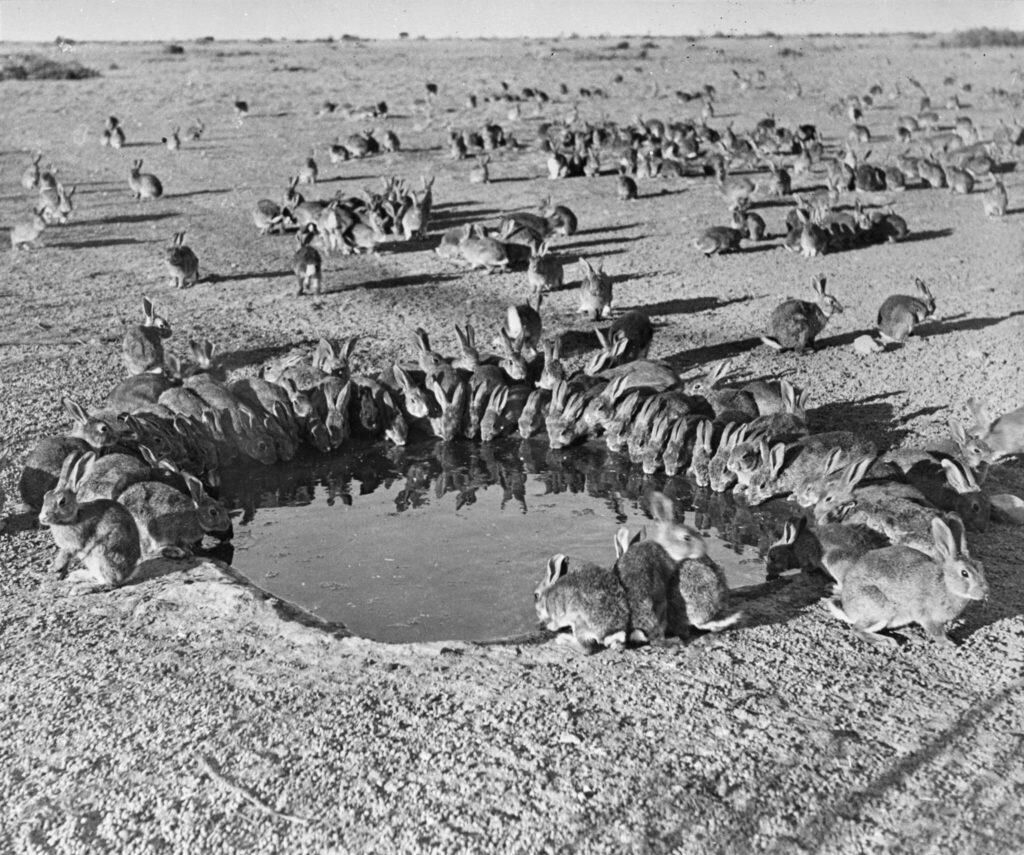
Rabbits around a waterhole at the myxomatosis trial enclosure on Wardang Island in 1938.
Credit: National Archives of Australia (public domain)
Then came rabbit calicivirus disease (RCD), which, again, dramatically reduced numbers overall, though now there are suggestions that RCD, too, is losing its ability to hold rabbit populations at low levels. Horace was right!
In fact, all of this is only to be expected, given what we know of the relationship between a host and a disease organism. Clearly, if a disease organism kills its host too quickly, it will have little opportunity to spread to other hosts. Then, too, by the processes of natural selection, over time hosts will tend to acquire a natural immunity or resistance to the disease organism.
Many diseases are also density dependent; meaning that they will only spread when the density of the host population is sufficient to sustain that spread. When these two viruses were first introduced, scientists warned that they would not afford a total cure, and they have been proved right.
Cost-Effective Control?
So, naturally enough, people ask, “What can we do about the situation?” To answer that question properly, we need to look both forwards and backwards, for though a large part of the present problem has to do with animal biology, an equally large part has to do with the way we as humans respond to the challenge. Moreover, we really need to view the rabbit problem in the arid zone in quite a different light from rabbit infestations in the higher-rainfall country. Let me explain.
In the arid pastoral zone, where stocking rates are low and holdings are of a huge size, most of the conventional means of rabbit control simply will not work. Poisoning, fencing, shooting, and so on are rarely effective because of the sheer scale of the problem.
Warren destruction is very effective but prohibitively costly on a large scale, particularly with diesel prices today. This is where some form of biological control is especially needed.
We must remember, too, that in the arid zone the ecological cost of rabbits is just as important as the economic cost. Early research by Dr Brian Cooke, one of the best-known names in rabbit control research, proved that just a couple of rabbits per hectare was often enough to completely prevent regeneration of mulga – an iconic outback shrub.
The situation in the higher-rainfall country is different because here, agricultural holdings are smaller and the land is more productive. This means that methods such as poisoning, warren fumigation, warren ripping, and so on all have a place in an integrated scheme of rabbit control.
Here too, the economic benefits of effective rabbit control are more obvious. It is said that seven to nine rabbits will consume as much feed as a sheep. Historically, though, the problem has been to convince farmers of the benefits of rabbit control.
In my view, one of the turning points was the introduction of the Landcare Movement late last century, combined with a system of effective government grants to local Landcare Groups for measures such as warren ripping. The great benefit of the Landcare scheme was in managing to get joint action so that district-scale measures could be carried out. If I may quote Horace again: “When your neighbour’s wall is on fire, it becomes your business.”
If you decide to spend money and eradicate your rabbits, it is of doubtful benefit unless all of your neighbours do the same (rabbit netting is now far too expensive to protect your asset on anything beyond a very small holding).
I can remember back to my early days in rabbit control, when I was urging local farmers to take some effective action. Time and again, I would be told: “Look, they are not really my rabbits. They travelled in from the north. A few weeks back, I had scarcely a rabbit!”
I once wrote a poem about “travelling rabbits” and my fruitless search to find the “northern source” (see box below). When I got far enough north, all the cockies said they were coming from the south!
But, again in my view, a lot of the early enthusiasm engendered by the Landcare Movement has now waned and, after years of low rabbit numbers, many landholders have become complacent and have neglected the all-important “maintenance control” to keep rabbits below that threshold from whence they can rapidly increase. This is why the alarm bells are now ringing.
It would be a great pity if governments and research organisations put all their eggs in the one basket, so to speak, to look for some pathogen as the silver bullet. And remember, too, that, in these days of scarce research funding, it is all too easy for the CSIRO and the universities (most funding now is for large, integrated research projects involving many teams) to “talk up” novel approaches in biological control without emphasising the need for maintenance “back-up” control in higher rainfall country.
Over much of this country, we already have the means to achieve cost-effective control of rabbits. It is more a question of having the will to put our hands to the plough – or the poison cart! Getting the last rabbit is a pipe dream, but achieving cost-effective control is not. That has been proven time and again outside the arid zone.
TRAVELLING RABBITS
There’s a little place called Warren Ridge not far from Burrowane.
It’s blessed with pastures green and lush, and ample sun and rain.
The cockies here grow fine wool sheep, and farming’s mostly good,
But as the locals tell you, they’ve more rabbits than they should.
We were gathered round a poison pit at Brady’s near the creek
Waiting for the poison bait – it was rabbit poisoning week.
McPherson pushed his hat back and gestured vaguely north.
“You could flog a flea for miles up there and that’s the flamin’ source.
It’s the same each year – they travel down an’ cross at the back o’ Fords.
I got the beggars swarming now like the Assyrian bloody hordes.”
“I think you’re right,” old Reidy said, as he squatted on the ground,
“They’re travellin’ from the north – I’m sure – they don’t know their
way around.
They run along the fences and miss the holes and logs.
They have no local knowledge and are easy caught by dogs.”
To this local observation, each man grunted his assent.
They all knew how the rabbits came, but no one where they went.
So, there beside the poison pit I decided that, henceforth,
I’d abandon local matters to find this northern source.
I got as far as Horsham, where I thought I had the source,
Til I met a trapper on the track – he was heading further north.
“There’s rabbits here, no doubt,” he said, “but not the local breed.
They’re comin’ down from Sea Lake in search of greener feed.”
But they’d travelled down to Sea Lake from the Sunset and from Hattah
And they’d swum the swollen Murray just to get a little fatter.
A drover on the northern bank had seen a mob go past;
They were mean and lean and hungry, and travelling awful fast.
So I pushed on up the Darling to find this rabbit source,
Til I met a bloke at Tilpa – he was camped there with his horse.
“These rabbits that you see here now – there wasn’t one last year,
They’ve got that northern, travellin’ look, by hell they have, no fear.”
A bloke at Bourke had seen ‘em worse when he was just a lad,
But they didn’t travel much back then and their “burrers” weren’t as bad.
“It’s the changin’ weather pattern – El Ninos, what I says.
The Ozone hole has made ‘em shift to dodge the UV rays.”
I traced them up through the Back-o-Bourke to the Cuttaburra Creek,
But they were thick around the border where there wasn’t one last week.
They must have breached the Dingo Fence and travelled with their lunch
For there’s nothing left in Queensland on which rabbits like to munch.
I pushed on past the Bulloo ‘til I reached a welcome spot,
Old Carbarita Station, where for rabbits it’s too hot.
They don’t go further north than this, so I had the problem beat,
But as the locals saw it, I was affected by the heat.
“There’s rabbits here orright,” they said, “but they never stay or breed.
They come from further south, you know, in search of better feed.”
I threw my swag up on the truck and slowly drove away
And the source of local rabbits stays a mystery to this day.
___
Republished with thanks to News Weekly. Image courtesy of Adobe.
3 Comments
Leave A Comment
Recent Articles:

13 October 2026
1.8 MINS
Australia faces mounting geopolitical, economic and defence threats, but its political leaders lack the statesmanship, bold vision and decisive communication needed to prepare the nation.

13 October 2026
2.8 MINS
The church in Ephesus had so much going for it. Yet despite their hard work, perseverance, endurance, and discernment, there was something deeply wrong: they had left their first love.

12 October 2026
4.6 MINS
Learn how journalists use loaded language, selective quotes and misleading headlines to shape public opinion, using a controversial report about James and Joanna Howe as a case study.

12 October 2026
3.1 MINS
The proposed livestream of Nidal Hasan’s execution has reignited debate over justice, deterrence and public accountability, with critics comparing American justice to ISIS propaganda.

12 October 2026
3.3 MINS
In the week leading up to Christ’s crucifixion, Jesus' soul was troubled. He responded with a bold prayer, and his example challenges us to that same boldness.

11 October 2026
2.6 MINS
Jesus offers us intimate friendship, which produces great joy as we walk closely with him.

10 October 2026
4.1 MINS
When Jesus rebuked the Laodicean church, this was not a sign of his lack of love, but proof of it and how greatly he longs to reward and bless us. He is knocking — will we answer?



Feral pigs could be substituted for rabbits in this article and still ring true.
….and deer…. But I fear the govt don’t care….
If only we could genetically engineer cane toads to eat rabbits. And vice versa.