


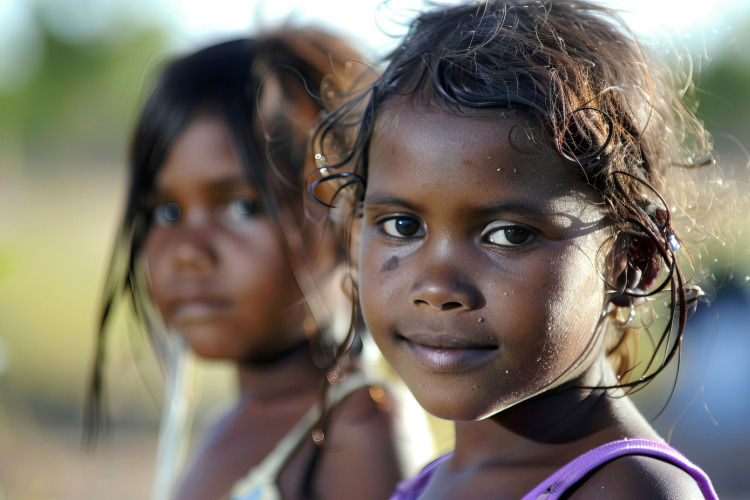
Aboriginal Elders Are Begging for Intervention to Save Their Kids
by Warwick da Silva
Recently, an article was published in The Australian – as part of a series on Indigenous affairs in remote communities — that raised the controversial topic of another “Stolen Generation”. The article followed an Aboriginal elder in Western Australia who was calling for abused children to be taken away from “bad parents”.
The point that the Elder wanted to emphasise was that what she proposed was not a matter of a new Stolen Generation.
The “bad parents” she was talking about are parents who should be charged with neglect or abuse, just as would occur, naturally, if the children of such parents were suffering from these abuses in metro regions. Then the Department of Child protection (DCP) or a relevant law enforcement agency would step in to protect these children. Why then, in some remote and regional communities, is nothing done?
Nyamal-Pitjikarli Elder Doris Eaton spoke up in particular with reference to abandoned young children living alone at a derelict property in Frisby Court in South Hedland. And unfortunately, this is not the only case.
“If parents aren’t parenting, if parents are neglecting and abandoning and being violent in front of their kids and drinking and abusing drugs and being bad parents, then they should have their kids removed, and the Government needs to think up another name for what they’re going to call this,” the 76-year-old said.
“This is not another Stolen Generation — that was kids being taken away from good parents. This is different. We need to take neglected and abused kids away from bad parents. Come up with a new name for that because there are no parents parenting properly in Frisby Court. There are just kids defending themselves from gnarbi (meth) and gunga (marijuana) and violence and dangerous men who want to take advantage of them.”
Indigenous Policy
Is intervention too political? Earlier this month, a few top advisers to Prime Minister Anthony Albanese on the Voice highlighted voids in Indigenous policy and that politicians were “too timid” to act on widespread problems.
The Western Australian Government has been under pressure, especially from State Liberal Opposition Leader Basil Zempilas, who has called the situation in South Hedland a national disgrace. “Ultimately, this comes down to the safety of children, and those children need to be provided for,” he said.
He said of Child Protection Minister Jessica Stojkovski’s recent visit to Port Hedland: “To be clear, she only went out after sustained reporting in The Australian newspaper,” Mr Zempilas said. “She didn’t go up before that and only went up when it was clear that something needed to be done.”
This case of the abandoned children at Port Hedland comes on the heels of the case of the murdered Hawke children in 2022 and the killing of five-year-old girl Kamanjayi Little Baby in Alice Springs last April.
Leaked DCP reports showed that the Hawke children were at extreme risk of harm from an unhinged meth-addicted mother, herself the victim of brutal domestic violence at the hands of a series of savage male partners.
Ms Eaton said,
“I cried for the Hawke children. We all went to the funeral. We came together as one big family. But the government wasn’t there to support Dorothy Papertalk at that funeral — they just wiped their hands of her. DCP behaved appallingly to Dorothy, and they were negligent towards her ‘grandies’.
“Their policies are racist. They just ignore Indigenous children. They pretend they don’t exist. They pretend our children don’t need help. I cry for my country at the moment. Our country has been taken away and destroyed by mining, and now the DCP is destroying our next generation of children.”
We hear too often about abuses and deaths of Aboriginal children in the regions. The killing of Kamanjayi Little Baby in Alice Springs on 25 April shocked the country.
Kamanjayi Little Baby was the niece of Senator Jacinta Nampijinpa Price, who, after the announcement, broke down in tears in Parliament, calling on the Government to respond to the challenges facing vulnerable Indigenous children.
She said the death of her five-year-old niece tragically shook her family, but the circumstances of the death were all too familiar to the people of central Australia.
Senator Price told Parliament that governments and institutions avoid difficult conversations about violence, neglect and alcohol abuse in town camps and remote communities.
“For too long in this country, there has been silence around what is happening in too many town camps and remote communities — a silence driven by fear, a fear of causing offence, a fear of being labelled racist,” she said.
“Vulnerable children are growing up in that silence, and it is killing our babies.”
“Hands-Off Culture”
Senator Price said that a “hands-off culture” exists in parts of the child-protection system, in which ideologies and political sensitivities have been prioritised ahead of child welfare.
“My niece was a little Australian girl, yet there is an ideology in this country that has deliberately encouraged people to treat children like her differently because of her racial heritage,” she said.
“It’s that same ideology that has created a hands-off culture within parts of a child protection system.”
In the wake of the death of Kamanjayi Little Baby, Northern Territory Child Protection Minister Robyn Cahill said a review would be conducted of the system, “from top to bottom”, including legislation, staffing, resources and workplace culture. “Every Territory child deserves to be safe, that is not negotiable,” Cahill said.
The same should be applied in Western Australia. Every West Australian child should be safe.
So, what is the solution?
Children need care and nurturing, proper nutrition, healthcare and education. Most importantly, they need to be in a safe environment where they can thrive and grow up to be responsible adults who can contribute to their communities.
If these children received the proper wrap-around services, and if needed, were placed in temporary foster homes, including with other Aboriginal families who are willing to help and have the means to do so, they would be in a much safer social setting where they can grow up securely. On a deeper level, they would have the opportunity to experience love and care rather than hurt and abandonment.
Greater emphasis should also be placed on Aboriginal Kinship Care, which allows Aboriginal children who cannot safely remain with their parents to be cared for by relatives or close family friends. This helps maintain important connections to culture, community and identity while ensuring children are protected from harm.
There also needs to be a greater on-the-ground presence from child protection agencies. More child-protection workers should be permanently based in remote communities, rather than relying heavily on fly-in fly-out arrangements. Building relationships with families and communities over time is critical to identifying vulnerable children early and responding effectively when intervention is needed.
There needs to be a thorough examination of the operations of intervention services like the DCP in the regions and assurance that adequate services exist to assist children in these communities. High-risk cases should be subject to regular review, and agencies must be held accountable when repeated warnings about endangered children are ignored.
Not Another Statistic
There is no place for taboo, or a “hands-off culture”, as Senator Price described, when children’s lives are at stake. The reason Kumanjayi Little Baby’s name was changed was to ensure that she is remembered and does not become just another statistic.
To the Cook Labor Government, let us not allow these children in our state to become statistics either. Change needs to happen at a systemic level.
In August 2024, Nyunggai Warren Mundine wrote a paper entitled “Where To Now? The Road Ahead for Indigenous Policy”, published by the Centre for Independent Studies. This paper was at least in part to emphasise that the failure of the referendum on the Voice to Parliament had to do with the ideology that lay behind it, not any ill will among the general Australian populace towards the Indigenous peoples.
Mundine said: “Australians do not want divisive and ideology-driven solutions or race-based policies. Australians want real improvements in Indigenous lives and policies directed towards need that deliver outcomes.”
Intervention is necessary when it can make for real improvements in Indigenous lives — not least if those who know best are calling for it.
___
Warwick da Silva is a Thomas More Centre/National Civic Council organiser in Perth and a commentator on economic and social, rural and regional issues in Western Australia.
Republished with thanks to News Weekly.
3 Comments
Leave A Comment
Recent Articles:

20 November 2026
4 MINS
Israelis are calling for a boycott of Australian products following Labor’s latest sanctions against Israeli settlers, while reports suggest Israel may consider counter-sanctions.
20 November 2026
7.7 MINS
A revised edition of "Unhumans" examines the history, tactics and ideological foundations of communist revolutions, warning of socialism’s growing influence and its hostility to Christianity.

20 November 2026
2.1 MINS
A satirical legal battle exposes the absurdity of separating Hamas’s political and social activities from its military wing, using Hitler’s imagined defence to make the point.
20 November 2026
3 MINS
The Snowy Hydro scheme has ballooned from a $2 billion nation-building promise to a potential $42 billion financial disaster, exposing serious failures in planning, governance and accountability.

20 November 2026
4.5 MINS
Christ’s authority extends over every sphere of society. The church must reclaim its prophetic voice and challenge ungodly civil governance.
19 November 2026
2.7 MINS
International Men’s Day 2026 celebrates the contribution of men and boys, launches a landmark global report and calls for greater recognition, inclusion and equality.

19 November 2026
4.5 MINS
Amanda Flavell is campaigning for Swiss-style direct democracy in Australia, giving citizens greater power to challenge legislation and influence decisions on climate policy, censorship and women’s rights.




This Tragedy needs urgent attention , but, governments , whose first duty is to protect Australians,are failing these poor young lives. As Christians it is our Duty to demand change–NOW ! Where is the $400 million annually spent on Aborigines going ? Kinship is probably the best solution. In my culture, when an aunt with young children was widowed and had no money to raise them , with her consent , the children were informally “adopted ” by one or more relatives. 4 of our cousins went from dreadful orphanages –one to remain with the mother,another 2 with married aunts, and another with an aunty and uncle in Florence which was far away. They were constantly in touch . As adults they all went to live within walking distance of each other , see each other daily and , remain to this day, very close and loving.
Here Here ..let real change to help children be safe etc happen asap
Thanks Warwick Da Silva. This is a desperate issue that needs urgent attention.. Sadly I and my family have been watching the tragedy unfold for the last 36 years.