


Polling vs Headlines: Why Australians Are More Aligned with One Nation on Abortion than Media Suggests
Nation First explores why One Nation’s pro-life policies may be closer to mainstream Australian opinion than many media reports suggest.
For years, abortion has largely been treated as a settled issue in Australian politics.
Most major political parties preferred not to talk about it. Most journalists assumed the debate was over. Most Australians probably assumed that whatever abortion laws existed in their state were broadly similar to those elsewhere in the country.
Then Pauline Hanson’s One Nation walked straight back into the argument.
Article Quick-Read
- The media has launched a coordinated attack on One Nation’s pro-life policies while often failing to explain what those policies actually are.
- One Nation is not proposing a blanket abortion ban but is focusing on issues such as late-term abortion, sex-selective abortion and protections for babies born alive.
- Polling suggests many Australians oppose late-term abortion and support safeguards that receive little attention in mainstream coverage.
- Broad polling questions about abortion access can conceal significant public concern about the outer limits of abortion laws.
- Australians deserve an honest debate about abortion laws rather than being told the issue is already settled.
Media’s Pro-Life Attack
In recent weeks, the party has come under fierce attack for its pro-life policies. Journalists, commentators and political opponents have accused One Nation of trying to roll back abortion rights and import American-style politics into Australia.
The backlash has been intense.
But amid all the outrage, something important has been missing from the discussion.
What exactly is One Nation proposing?
And do Australians really disagree with it as strongly as the media claims?
Those questions matter because much of the current debate has been built around a simple assumption: that Australians overwhelmingly support abortion and that any attempt to revisit abortion laws is automatically outside the mainstream.
Yet when you look beyond the headlines, the picture becomes far more complicated.
One Nation’s Position
In fact, on some of the issues now being used to attack One Nation, there is evidence that many Australians may be closer to One Nation’s position than they realise.
One Nation’s policy is not a blanket ban on abortion.
The party acknowledges that human life begins in the womb and seeks to roll back what it describes as Australia’s most extreme abortion laws. Among other things, it wants to reduce gestational limits, ban sex-selective abortion, provide counselling and support for women considering abortion, protect babies born alive during abortion procedures, restore doctors’ conscience rights, ban the use of organs from aborted babies and improve abortion data reporting.
Whether you agree with those proposals or not, they are very different from the caricature often presented in media coverage.
The current controversy began because abortion laws in some Australian states allow abortions far later in pregnancy than many people realise.
Critics of One Nation argue these laws are necessary and should remain unchanged.
One Nation argues they have gone too far.
That disagreement is legitimate. It is precisely the kind of issue that should be debated openly in a democracy.
Instead, much of the public discussion has focused on portraying One Nation itself as beyond the pale.
The assumption underpinning that approach is that Australians overwhelmingly support the existing framework and would reject any attempt to introduce additional safeguards.
The polling suggests otherwise.
Polling Suggests Australians Are Against the Most Extreme Abortion Laws
One of the most significant surveys conducted on these issues was carried out by YouGov Galaxy among Queensland voters.
The results paint a very different picture from the one usually presented in newspaper headlines.
Seventy-six per cent opposed abortion after 23 weeks of pregnancy.
Eighty-three per cent opposed sex-selective abortion.
Seventy per cent believed babies born alive following a late-term abortion should receive the same medical care as any other premature baby.
Eighty-eight per cent supported independent counselling for women considering abortion.
Seventy-four per cent supported conscience protections allowing doctors and nurses to refuse participation in abortion procedures.
Those are not fringe positions.
Nor are they confined to Queensland.
A Victorian poll conducted in 2023 found almost 70 per cent of respondents supported babies born alive after a late-term abortion being given medical care, rising to 87 per cent among those expressing a view.
The same poll found 74 per cent opposed abortion beyond 23 weeks of pregnancy.
These findings do not prove Australians are pro-life.
They do suggest, however, that many Australians are uncomfortable with some of the most extreme aspects of modern abortion law.
That distinction matters.
Dishonest Debate
A common trick in this debate is to ask broad questions such as whether abortion should be legal or whether women should have access to abortion services.
Most Australians answer yes.
The media then often treats that answer as if it settles every other question.
Support for abortion in some circumstances becomes support for abortion in almost all circumstances.
Support for legal abortion becomes support for abortion right up to birth.
Support for healthcare becomes support for denying conscience rights to medical professionals.
The nuance disappears.
The difficult questions are avoided.
And anyone who raises them is labelled an extremist.
That may be politically convenient, but it is not intellectually honest.
The reality is that abortion is not one question.
It is a collection of questions.
Should abortions occur late in pregnancy?
Should an unborn child be aborted because it is the “wrong” sex?
Should a baby born alive after an abortion attempt receive medical care?
Should doctors be forced to participate in procedures they believe are morally wrong?
These are not crazy questions.
They are serious ethical questions.
They deserve serious answers.
Most importantly, they deserve public debate.
Silencing Speech
One Nation’s critics are free to disagree with its proposals.
That is how democracy works.
But pretending that nobody shares those concerns, or that the debate itself is somehow illegitimate, is something else entirely.
Australians are capable of discussing difficult moral questions.
They are capable of weighing competing arguments.
They are capable of deciding for themselves where the line should be drawn.
The real extremism may not be found in those who want to debate abortion laws.
It may be found in the growing insistence that those laws should never be questioned at all.
Because if the polling tells us anything, it is that many Australians remain deeply uncomfortable with late-term abortion, sex-selective abortion, babies born alive being denied medical care and the erosion of conscience rights.
The media may not want that conversation.
But Australians deserve to have it.
___
This article first appeared at ConfidentialDaily.com. Republished with thanks to Nation First. Originally titled, “The Abortion Debate Isn’t Over“.
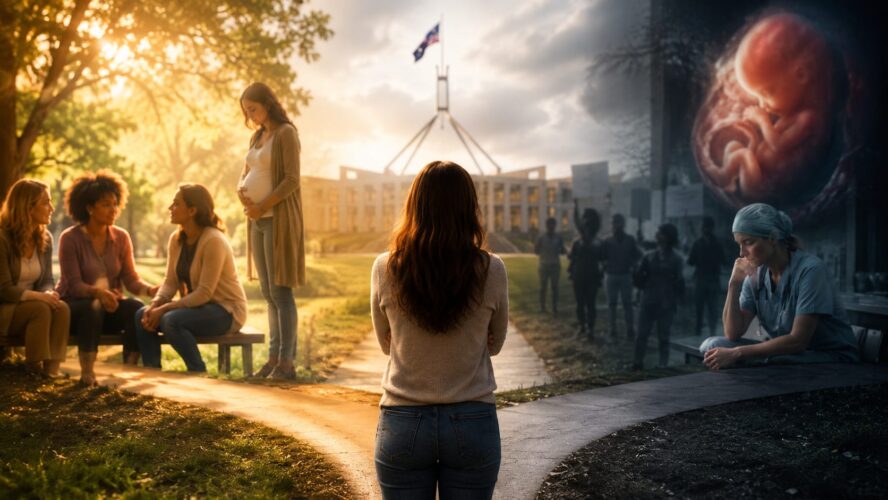
Image by Nation First.
5 Comments
Leave A Comment
Recent Articles:

10 October 2026
4.1 MINS
When Jesus rebuked the Laodicean church, this was not a sign of his lack of love, but proof of it and how greatly he longs to reward and bless us. He is knocking — will we answer?
9 October 2026
5 MINS
During a recent dialogue between high profile legal experts, a top Australian constitutional law expert was asked if Australia should have a Bill of Rights. His answer may surprise you.
9 October 2026
1.3 MINS
Season 6 of The Chosen is releasing next month, and until 15 November, your church has the opportunity to host a free pre-release screening of Episode 1. Here's how.

9 October 2026
1.8 MINS
Pen Power Australia has been busy confronting antisemitism and double standards, lodging letters, pursuing accountability and celebrating several important wins along the way.

9 October 2026
3.3 MINS
New South Wales healthcare workers who object to abortion and voluntary assisted dying face growing pressure, raising serious questions about conscience rights, employment and moral injury.

9 October 2026
2.9 MINS
God is intensely relational, and he puts us into a community of believers so we can use our gifts in service of Christ's body.
8 October 2026
3.6 MINS
John Anderson warns that Australia’s decline is rooted in spiritual and cultural disintegration, calling for a recovery of Christian foundations, social cohesion and national purpose.



The issue is black and white……abortion is wrong .
Thanks George.
I believe most Australians are pretty ignorant of abortion statistics.
The more One Nation presents the truth, the more support they will get.
Very well put George and the media’s slant clearly presented. Yes Australian’s aren’t stupid and we deserve to have a fair discussion on this whole sorry issue.
Murdering unborn children is an absolute affrontery to Almighty God, the creator of all things.
“Thou shalt not murder”.
At the moment of conception in the mother’s womb, God places a spirit into that conception to give that conception life. Precisely why with the living, when the spirit is removed by God, the body of flesh blood and bone, is dead. The spirit returns to God the rightful owner of your soul.
Almighty God has “Being”, therefore we are human beings, in the image and likeness of God – we have His character.
There is no such thing as an animal being; dog being, horse being, bird being etc.
Deliberately killing an unborn child is utterly demonic, highly Satanical.
More can be read concerning abortion from a book recently published through, Amazon.com.au …. titled “Christians, be alert”.
Excellent article. Pauline may not hold a full Christian view of abortion but it is light years ahead of most other politicians and if those policies could be put in place that would be a tremendous step forward. I know that there are people out there that say that the only acceptable policy is a complete ban on abortion but this is naïve as it will never get passed (for now). It is like saying to three drowning children “I can not save you all so I wont save any of you.”
We achieved our current abortion laws incrementally, the leftist-marxists types understand how to move a society subtly along the path to their preferred outcome. People on the right in general and Christians in particular really do not understand the mechanics of these processes which is why we continue to end up with bad laws and are unable to push back effectively. At the very least what Pauline, Barnaby and ON are doing is starting the process to win back the ground we have lost and in doing so hopefully the broader public will start to engage in some serious discussion about abortion and I think most people are horrified by what the can understand as they start to look at this issue seriously.