
Redeeming 31 October: Reformation, Reclamation, Re-establishment
Three pivotal events on 31 October shaped Christian faith, Australian military history and Israel’s future. Their enduring legacy deserves to be remembered and reclaimed.
31 October is a momentous day in history, and we need to see it reclaimed from the hands of the enemy. Several important events happened on this day.
The Protestant Reformation
On this day, 509 years ago, Martin Luther hammered his 95 theses onto the door of the church at Wittenberg, challenging some of the unbiblical teachings and practices of the then Roman Catholic Church to which he belonged. One of those practices was the sale of indulgences to forgive sin, from which the church profited.
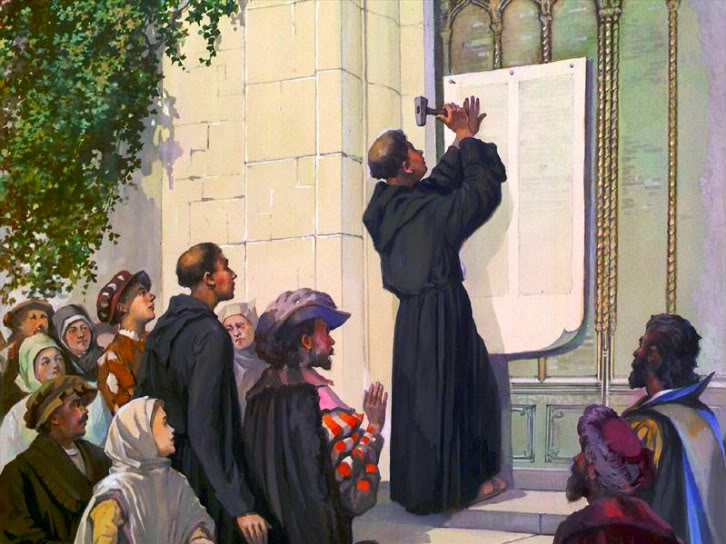
His defiance eventually led to him being excommunicated, but the movement spread and became the Protestant Reformation. He translated the Bible into the vernacular language of German, making it accessible to every person, and its fundamental truth radically transformed society as it rolled out across Europe and the Western world.
Luther rediscovered from the Bible that a person could only be saved from their sin by putting their trust in the person of Jesus and what He did on the cross, not by their own works or through a church or institution.
The Light Horse Charge at Beersheba
The 109th anniversary of the Battle of Beersheba is on the same day. This World War 1 battle changed the course of the Palestinian campaign.
The Turks were holding a line from Gaza on the Mediterranean coast to Beersheba, 45 km inland. The British and their Allies had failed twice to take Gaza, and General Allenby decided that they would have to storm Beersheba, which involved trekking the troops for three nights through the desert, where there was little water.
The battle raged all day, with the British and the New Zealanders taking much of the lead. However, by mid-afternoon, they had still not secured the city with its vital wells, famous since the time of Abraham. Dying of thirst in the desert was a looming possibility for the troops and their horses.
Decisive action was needed, and General Harry Chauvel called on two regiments of Australian Light Horsemen (about 800 men) to spearhead a surprise mounted charge an hour before sunset. Light Horsemen normally rode to the battle site, then dismounted and fought on foot. On this occasion, they would not stop.
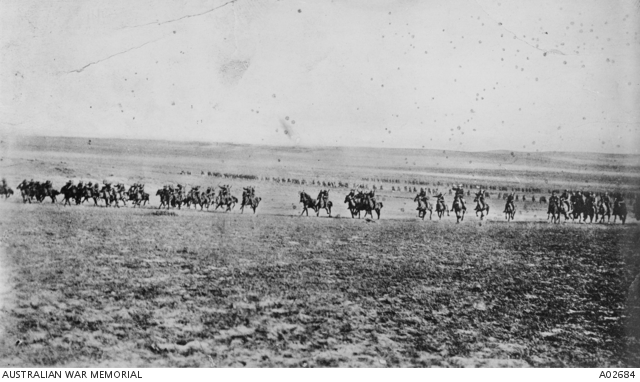
Disputed picture of the charge at Beersheba (or re-enactment) – Australian War Memorial. It was probably taken when two regiments of the 4th Brigade, Australian Light Horse, re-enacted the charge for the official photographer Frank Hurley, at Belah on 7 February 1918.
800 Light Horsemen lined up to face 4,000 entrenched Turkish troops with artillery, machine guns and German bomber aircraft. Their speed and audacity won the day as the Turkish shrapnel burst behind them. They jumped the trenches and galloped into town, capturing most of the precious wells intact.
31 Australians died, 36 were injured, and 70 horses were killed, but the toll was expected to be much higher. Their success is known in military circles as ‘the last great cavalry charge in history’. Their courage not only broke the military cordon but also the spirit of the Turks, who from then on feared the ‘madmen’ in the slouch hats with emu feathers.
The Balfour Declaration
The same day, almost at the same hour as the physical battle was raging on the ground, the British War Cabinet was meeting in London to formalise how the captured lands would be administered once the war ended. On 2 November, Lord Balfour wrote a letter to Lord Rothschild stating their decision:
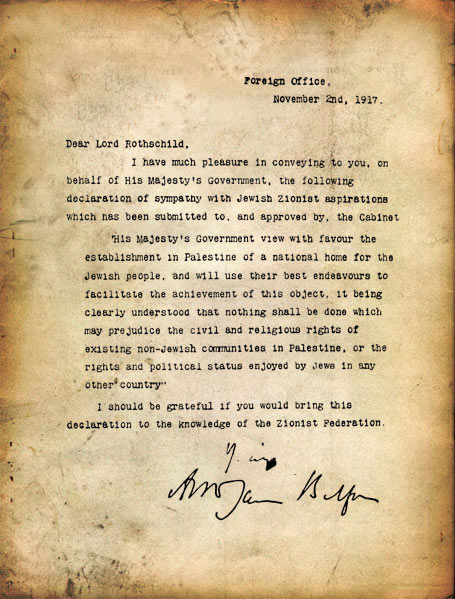
‘His Majesty’s Government views with favour the establishment in Palestine of a National Home for the Jewish people, and will use their best endeavours to facilitate the achievement of that object, it being clearly understood that nothing shall be done, which may prejudice the civil and religious rights of the existing non-Jewish Communities in Palestine, or the rights and political status enjoyed by Jews in any other country.’
(Kelvin Crombie, Anzacs, Empires and Israel’s Restoration, Vocational Educational and Training Pub, 2000, 181.)
The essence of this letter became the backbone of the Balfour Declaration, which was the foundation of the San Remo Agreement, ratified in 1922 by the League of Nations, and never rescinded. This meeting allocated mandated areas to the British and French to administer until the newly formed countries could govern independently.
Thus, Lebanon, Syria, Jordan and Israel were birthed, with Palestine being divided to give a homeland for the Arabs, which became Jordan, and the Jews, which became Israel. This day changed history and is truly worthy of remembrance. For more information, go to Beersheba100.org.
___
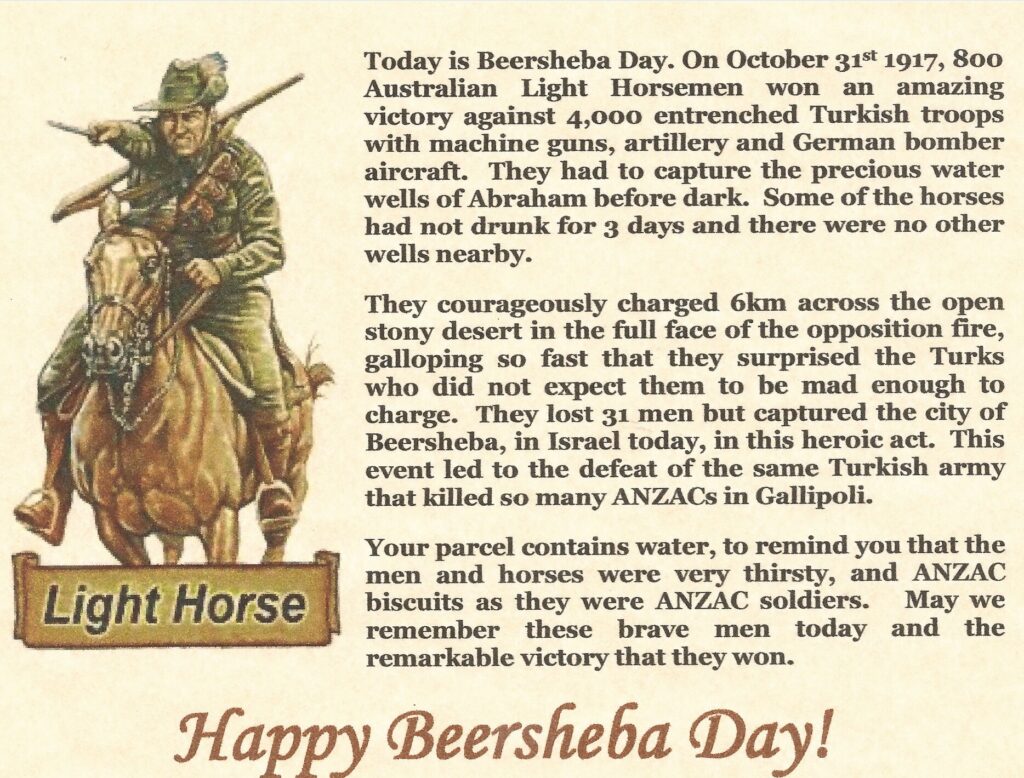
You may like to print the picture and story below and give it to the children with an Anzac biscuit and a bottle of water, and tell them about the battle of Beersheba:
___
Featured image courtesy of Adobe.
Recent Articles:

28 October 2026
4 MINS
The assault on Helen Haines highlights Australia’s growing political hostility. Recovering civility requires personal accountability, respectful debate and a renewed commitment to Christian moral foundations.
28 October 2026
1.8 MINS
A candlelit performance of Mozart’s Requiem at Sydney Town Hall will honour 21 Australian Army nurses murdered in the Bangka Island massacre, along with generations of military nurses.
23 October 2026
3.1 MINS
As Western societies grow more hostile, could abandoning Christianity’s moral foundations be contributing to the rise of ideological extremism, political intolerance and violence?
21 October 2026
7.9 MINS
A collection of sobering reflections on Western civilisation’s decline, the loss of Christian foundations and the dangers of cultural complacency, ending with a message of enduring Christian hope.
20 October 2026
4.9 MINS
James McAuley’s legacy reaches far beyond Australia’s Catholic hymnals. Poet, convert and cultural warrior, he defended beauty, truth and faith in an age of changing values.
15 October 2026
6.1 MINS
Historian Frank Furedi warns that the West is waging a war against its own past, censoring books, rewriting history and severing future generations from their heritage.

14 October 2026
5.3 MINS
Marco Rubio’s Athens speech celebrates the Greek, Roman and Christian foundations of Western civilisation, warning that cultural self-loathing and radical ideologies threaten its future.